Groupoid sheaves as quantale sheaves
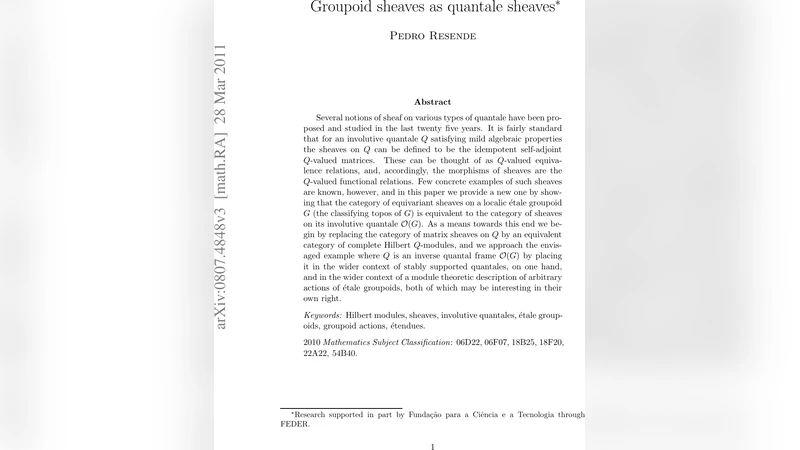
Several notions of sheaf on various types of quantale have been proposed and studied in the last twenty five years. It is fairly standard that for an involutive quantale Q satisfying mild algebraic properties the sheaves on Q can be defined to be the idempotent self-adjoint Q-valued matrices. These can be thought of as Q-valued equivalence relations, and, accordingly, the morphisms of sheaves are the Q-valued functional relations. Few concrete examples of such sheaves are known, however, and in this paper we provide a new one by showing that the category of equivariant sheaves on a localic etale groupoid G (the classifying topos of G) is equivalent to the category of sheaves on its involutive quantale O(G). As a means towards this end we begin by replacing the category of matrix sheaves on Q by an equivalent category of complete Hilbert Q-modules, and we approach the envisaged example where Q is an inverse quantal frame O(G) by placing it in the wider context of stably supported quantales, on one hand, and in the wider context of a module theoretic description of arbitrary actions of 'etale groupoids, both of which may be interesting in their own right.
💡 Research Summary
The paper addresses a long‑standing gap in the theory of quantale‑valued sheaves: while the abstract definition of a sheaf on an involutive quantale Q—typically given as an idempotent self‑adjoint Q‑valued matrix (interpreted as a Q‑valued equivalence relation) with morphisms given by Q‑valued functional relations—is well‑established, concrete examples beyond the trivial ones have been scarce. The authors fill this gap by exhibiting a rich, geometrically motivated example: the category of equivariant sheaves on a localic étale groupoid G (which is precisely the classifying topos of G) is shown to be equivalent to the category of sheaves on the involutive quantale O(G) associated with G.
The work proceeds in several stages. First, the authors revisit the matrix‑sheaf approach and replace it with an equivalent categorical framework based on complete Hilbert Q‑modules. A Hilbert Q‑module is a Q‑module equipped with an inner product ⟨·,·⟩: M × M → Q that is self‑adjoint, Q‑linear in each argument, and such that the module is complete with respect to the induced Cauchy structure. They prove that the category of idempotent self‑adjoint Q‑valued matrices is canonically equivalent to the category of such Hilbert modules, thereby providing a more analytic and module‑theoretic perspective on quantale sheaves.
Next, the paper situates O(G) within the broader class of stably supported quantales. A stably supported quantale is an involutive quantale equipped with a support map σ: Q → Q satisfying σ(q·r)=σ(q)·σ(r) and other natural axioms that make σ compatible with the involution and the multiplication. This structure captures the idea that each element of the quantale carries a “support” that behaves well under multiplication, mirroring the way open subsets of a groupoid’s space of arrows support each other. Inverse quantal frames—quantales of the form O(G) for an étale groupoid G—are shown to be special cases of stably supported quantales.
The core of the paper then develops a module‑theoretic description of actions of étale groupoids. An equivariant sheaf on G can be viewed as a G‑set (or more precisely a G‑space) whose underlying locale is equipped with a compatible action of the open sets of G. By translating this action into the language of O(G)‑modules, the authors construct a functor from the category of G‑equivariant sheaves to the category of complete Hilbert O(G)‑modules. Conversely, given a Hilbert O(G)‑module, one can recover a G‑action by interpreting the inner product values as open subsets of the groupoid and using the support map to define the action on objects and arrows. The two constructions are shown to be inverse up to natural isomorphism, establishing a categorical equivalence.
The main theorem can be stated succinctly:
The category of equivariant sheaves on a localic étale groupoid G is equivalent to the category of sheaves on its involutive quantale O(G).
This equivalence has several immediate consequences. It provides a concrete, non‑trivial example of quantale‑valued sheaves, thereby validating the abstract matrix‑sheaf definition in a geometric setting. It also bridges topos theory and non‑commutative geometry: the classifying topos of G, traditionally studied via sheaves on its space of objects, can now be approached through the algebraic structure of O(G). Moreover, the Hilbert‑module viewpoint suggests new tools for analyzing morphisms, limits, and colimits in the quantale‑sheaf category, as these constructions translate into familiar operations on Hilbert modules (e.g., direct sums, tensor products).
The paper concludes with a discussion of future directions. While the result is proved for localic étale groupoids, extending the framework to non‑étale or non‑localic groupoids, or to more general quantales lacking a stable support, remains open. The authors also hint at potential applications in the semantics of non‑classical logics, where quantales model resource‑sensitive conjunctions, and in the study of non‑commutative locales, where the interplay between topology and algebra is mediated by quantale structures.
In summary, the authors succeed in unifying two previously disparate strands—groupoid sheaf theory and quantale sheaf theory—by showing that the natural quantale O(G) attached to an étale groupoid captures exactly the same sheaf‑theoretic information as the groupoid’s classifying topos. This result not only enriches the catalogue of examples for quantale sheaves but also opens a pathway for cross‑fertilization between topos theory, non‑commutative geometry, and the algebraic theory of quantales.