Modeling the topology of protein interaction networks
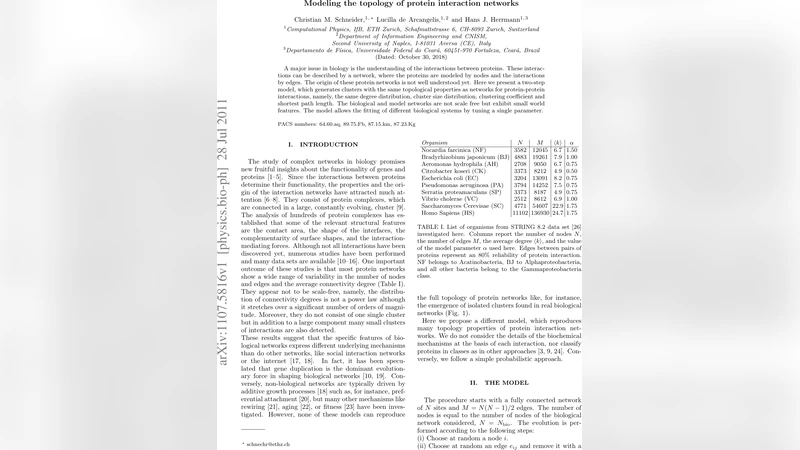
A major issue in biology is the understanding of the interactions between proteins. These interactions can be described by a network, where the proteins are modeled by nodes and the interactions by edges. The origin of these protein networks is not well understood yet. Here we present a two-step model, which generates clusters with the same topological properties as networks for protein-protein interactions, namely, the same degree distribution, cluster size distribution, clustering coefficient and shortest path length. The biological and model networks are not scale free but exhibit small world features. The model allows the fitting of different biological systems by tuning a single parameter.
💡 Research Summary
The paper addresses the challenge of reproducing the topological features of protein‑protein interaction (PPI) networks, which differ markedly from classic scale‑free graphs and instead display a mixture of large connected components, many small clusters, high clustering, and short average path lengths—hallmarks of small‑world networks. To capture these characteristics, the authors propose a two‑step stochastic model that operates on an initially fully connected graph with the same number of nodes (N) as a given biological network.
Step 1 – Preferential Depletion:
A node i is chosen at random, then one of its incident edges e_{ij} is selected for removal. The removal probability depends on the degree k_j of the neighboring node j:
p_{i,j}=p_j/N_i, p_j = (k_j – α)/k_j (if k_j>1, otherwise 0)
where N_i normalizes the probabilities over all neighbors of i, and α>0 is the sole tunable parameter. When α=0 the process reduces to random edge deletion; larger α values protect high‑degree nodes, causing low‑degree nodes to lose edges first (“the poor get poorer”). This step is repeated until the total number of edges equals N, i.e., the graph becomes sparse enough to contain many isolated nodes and small clusters.
Step 2 – Similarity‑Based Re‑wiring:
Two nodes i and j are selected at random, and an edge between them is added with probability
p_{i,j}=
Comments & Academic Discussion
Loading comments...
Leave a Comment