The Continuum Limit of Toda Lattices for Random Matrices with Odd Weights
This paper is concerned with the asymptotic behavior of the free energy for a class of Hermitean random matrix models, with odd degree polynomial potential, in the large N limit. It continues an investigation initiated and developed in a sequence of …
Authors: Nicholas M. Ercolani, Virgil U. Pierce
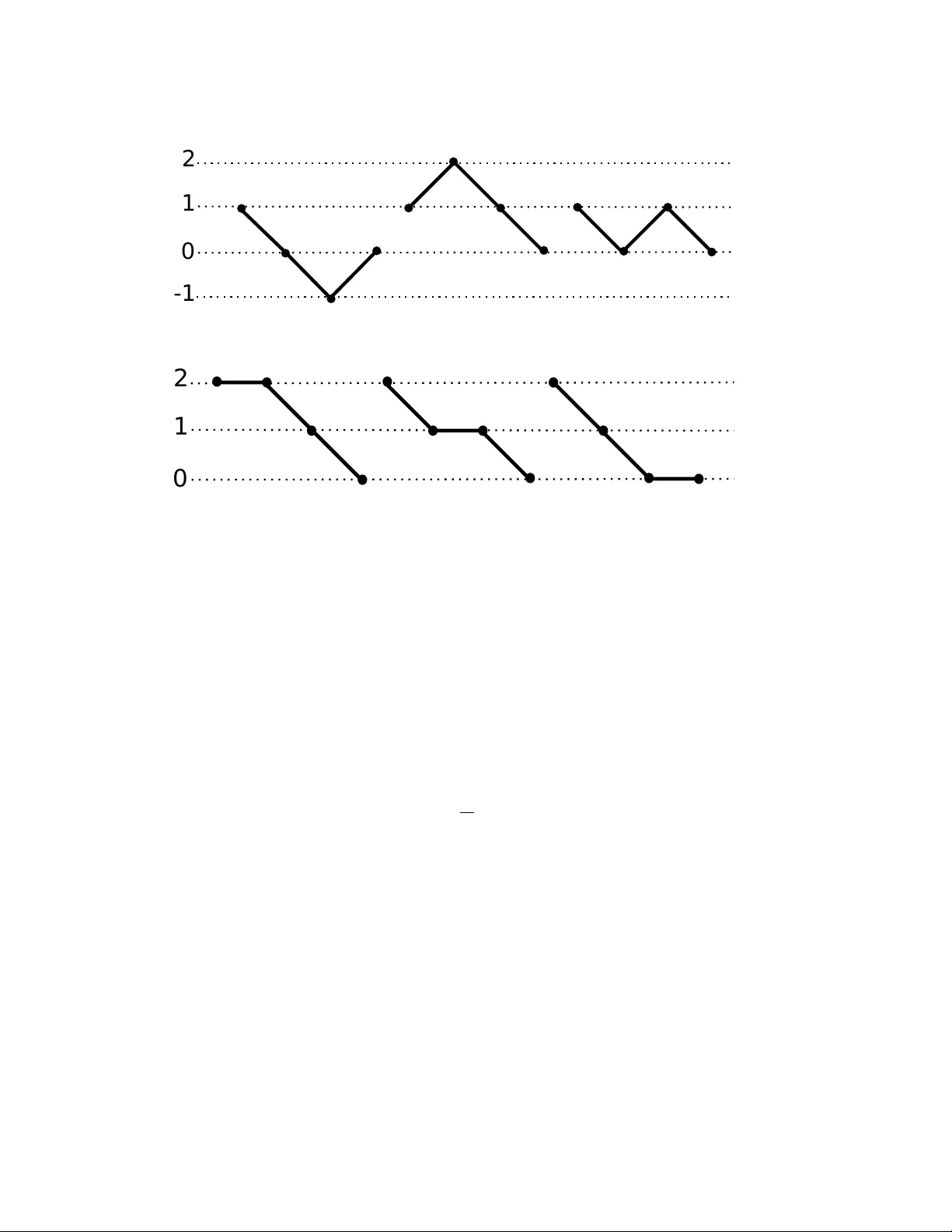
THE CONTINUUM LIMIT OF TOD A LA TTICES F OR RANDOM MA TRICES WITH ODD WEIGHTS NICHOLAS M. ERCOLANI ∗ AND VIRGIL U. PIERCE † Abstract. This paper is concerned with the asymptotic b ehavior of the free energy for a class of Hermitean random matrix models, with o dd degree p olynomial potential, in the large N limit. It contin ues an in v estigation initiated and developed in a sequence of prior works whose ultimate aim is to rev eal and understand, in a rigorous w ay , the deep connections b et ween correlation functions for eigenv alues of these random matrix ensembles on the one hand and the enumerativ e interpretations of their matrix momen ts in terms of map combinatorics (a branch of graph theory) on the other. In doing this we make essential use of the link b et w een the asymptotics of the random matrix partition function and orthogonal p olynomials with exp onen tial weigh t equal to the random matrix potential. Along the wa y we develop and analyze the con tinuum limits of b oth the T o da lattice equations and the difference string equations associated to these orthogonal p olynomials. The former are found to hav e the structure of a hierarch y of near-conserv ation laws univ ersal in the p oten tial; the latter are a nov el semi-classical extension of the traditional string equations. Our methods apply to regular maps of b oth even and o dd v alence, how ever we fo cus on the latter since that is the relev an t case for this paper. These metho ds enable us to rigorously determine closed form expressions for the generating functions that enumerate triv alen t maps, in general implicitly , but also explictly in a n um b er of cases. Key w ords. random matrices, T o da lattice, Motzkin paths, string equations, conserv ation law hierarchies, map enumeration sub ject classifications. 05C30, 34M55, 60B20 1. In tro duction The general class of matrix ensembles we wan t to analyze has probabilit y measures of the form dµ t j = 1 Z ( n ) N ( t j ) exp {− N T r[ V j ( M , t j )] } dM , where (1.1) V j ( λ ; t j ) = 1 2 λ 2 + t j λ j (1.2) defined on the space H n of n × n Hermitean matrices, M , and with N a positive parameter. The normalization factor Z ( n ) N ( t j ), whic h serves to mak e µ t a probabilit y measure, is called the p artition function of this unitary ensem ble. Previous w orks, [9, 10, 12, 7], hav e fo cussed on the case of even j for which the measure (1.1) is indeed normalizable for t j > 0. The case of o dd j is more complicated; it is not clear prima facie ho w to initiate a rigorous analysis in this setting. V ery recen tly , ho wev er, a generalization of the e quilibrium me asur e (which go v erns the leading order b eha vior of the free energy asso ciated to (1.1)) w as dev elop ed and applied to this problem, [3]. It is based on a complex con tour deformation of the v ariational problem for the leading order of the free energy that w as motiv ated by new ideas in approximation theory related to complex Gaussian quadrature of integrals with high order stationary points [4]. This analysis sho ws that an equilibrium measure asso ciated to the w eight exp − N 1 2 λ 2 + t 2 ν +1 λ 2 ν +1 , with dominant exp onen t o dd, will exist. It is con- structed explicitly for the case of a cubic w eigh t, ν = 1, in [3]. A detailed study of the explicit construction for general o dd-dominan t w eigh ts, as opp osed to just the ∗ Department of Mathematics, The University of Arizona, T ucson, AZ 85721–0089, ( ercolani@math.arizona.edu ). Supported by NSF grant DMS-0808059. † Department of Mathematics, The Universit y of T exas – P an American, Edinburg, TX 78539, ( piercevu@utpa.edu ). Supported by NSF grant DMS-0806219. 1 2 CONT. LIMIT OF TOD A LA TTICES F OR RANDOM MA TRICES existence argumen t which may b e deduced from [4], will be tak en up elsewhere. The b oundaries of the supp ort of this equilibrium measure are determined b y the sim ul- taneous solutions of the t wo equations: Z B A V 0 ( λ ) p ( λ − A )( λ − B ) dλ = 0 (1.3) Z B A λV 0 ( λ ) p ( λ − A )( λ − B ) dλ = 2 π i. (1.4) One can compute these in tegrals whic h, in the cubic case, V ( λ ) = 1 2 λ 2 + t 3 λ 3 , leads to a pair of equiv alent algebraic equations determining A and B . 1 2 ( A + B ) + 3 t 3 ( 3 8 A 2 + 1 4 AB + 3 8 B 2 ) = 0 (1.5) ( 3 8 A 2 + 1 4 AB + 3 8 B 2 ) + 3 t 3 5 16 A 3 + 3 16 A 2 B + 3 16 AB 2 + 5 16 B 3 = 2 . (1.6) It is natural to make the following change of v ariables: z 0 = 1 16 ( B − A ) 2 and u 0 = 1 2 ( A + B ). The corresp onding algebraic equations for z 0 , u 0 are u 0 + 3 t 3 ( u 2 0 + 2 z 0 ) = 0 (1.7) u 2 0 + 2 z 0 + 3 t 3 ( u 3 0 + 6 u 0 z 0 ) = 2 . (1.8) With the ab o ve notations, the interv al of supp ort of the equilibrium measure in the cubic case may b e written as [ A, B ] = [ u 0 − 2 √ z 0 , u 0 + 2 √ z 0 ] . The equilibrium measure has a v ariational characterization [4] and from the v ariational equations the measure can b e explicitly determined to b e 1 2 π i (1 + 3 t 3 ( λ + u 0 )) χ [ A,B ] ( λ ) p ( λ − A )( λ − B ) . (1.9) A minimal basis for the ideal of relations given by (1.7) and (1.8) is 3 t 3 u 2 0 + u 0 + 6 t 3 z 0 = 0 (1.10) − 6 t 3 z 0 u 0 + (1 − z 0 ) = 0 . (1.11) It is straightforw ard to use (1.10) to eliminate z 0 in (1.11) and get 18 t 2 3 u 3 0 + 9 t 3 u 2 0 + u 0 + 6 t 3 = 0 . (1.12) The resultant of (1.7) and (1.8) eliminating u 0 is given by R ( z 0 ) = 3 t 3 1 6 t 3 z 0 − 6 t 3 z 0 1 − z 0 0 0 − 6 t 3 z 0 1 − z 0 (1.13) = 3 t 3 72 t 2 3 z 3 0 − z 2 0 + 1 = 0 . (1.14) W e note that (1.14) has a form that is reminiscent of the implicit equation for z 0 that one has in the case of even weigh ts [10, 7]. N. M. ERCOLANI AND V. U. PIER CE 3 F or general p olynomial p oten tials V with even dominant p o wer, it is p ossible to establish the follo wing fundamental asymptotic expansion [9], [10] of the free energy asso ciated to the partition function. More precisely , those pap ers consider p oten tials of the form V ( λ ) = 1 2 λ 2 + J X j =1 t j λ j , (1.15) with J = 2 ν . In tro ducing a renormalized partition function, which w e refer to as a tau function , τ 2 n,N ( ~ t ) = Z ( n ) N ( ~ t ) Z ( n ) N (0) , (1.16) where ~ t = ( t 1 , . . . t J ) ∈ R J , this expansion has the form log τ 2 n,N ( ~ t ) = n 2 e 0 ( x, ~ t ) + e 1 ( x, ~ t ) + 1 n 2 e 2 ( x, ~ t ) + · · · + 1 n 2 g − 2 e g ( x, ~ t ) + . . . (1.17) as n, N → ∞ with x = n N held fixed. Moreo ver, for T = (1 − , 1 + ) × {| ~ t | < δ } ∩ { t J > 0 } for some > 0 , δ > 0, (i) the expansion is uniformly v alid on a compact subsets of T ; (ii) e g ( x, ~ t ) extends to b e complex analytic in T C = ( x, ~ t ) ∈ C J +1 | x − 1 | < , | ~ t | < δ ; (iii) the expansion may b e differentiated term b y term in ( x, ~ t ) with uniform error estimates as in (i) The meaning of (i) is that for each g there is a constant, K g , dep ending only on T and g suc h that log τ 2 n,N ~ t − n 2 e 0 ( x, ~ t ) − · · · − 1 n 2 g − 2 e g ( x, ~ t ) ≤ K g n 2 g for ( x, ~ t ) in a compact subset of T . The estimates referred to in (iii) hav e a similar form with τ 2 n,N and e j ( x, ~ t ) replaced by their mixed deriv ativ es (the same deriv atives in each term) and with a p ossibly different constant. This result is based on the analysis of a Riemann-Hilb ert problem (RHP) for orthogonal p olynomials on R whose exp onential weigh t is asso ciated to the weigh t of the random matrix measure. This RHP was first in tro duced in [11] for studying the asymptotic b eha vior of random matrix partition functions. The relev an t analysis of this RHP for the ab o ve result w as carried out in [9] by the metho d of nonline ar ste ep est desc ent [5]. In particular, in [9] it is sho wn that the constants K g are explicitly determinable in terms of Airy asymptotics stemming from the Airy parametrix that is used in the vicinity of the endp oin ts of the supp ort of the equilibrium measure to explicitly solve the RHP . This result extends directly to the case of V with o dd dominan t p o wer (i.e. with J = 2 ν + 1) once one has the existence of the equilibrium measure (which is explicitly giv en by (1.9) in the cubic case). This inv olv es studying the asymptotic b eha vior of the appropriate non-Hermitean orthogonal p olynomials for the given o dd weigh t (see section 2). More precisely , the Riemann-Hilb ert analysis of [9] carries ov er mutatits m utandis to a Riemann-Hilb ert problem for the non-Hermitean orthogonal p olynomi- als with the principal difference being that the con tour along whic h the jump matrices are originally defined is no longer the real axis but rather a deformed con tour [4, 3]. 4 CONT. LIMIT OF TOD A LA TTICES F OR RANDOM MA TRICES Our principal in terest in this paper is to b etter understand the analytical structure of the co efficien ts e g for p oten tials of the form (1.15) when J there is o dd. F or J even these co efficien ts pro vide a wealth of information ab out problems in combinatorial en umeration as well as ab out eigenv alue correlations for random matrices [7]. One exp ects to see similar connections in the case of odd J but this is m uc h less dev elop ed. Despite the fact that we are focussed on p oten tials of the form (1.2) that only dep end on a single t j , we will need to appeal to properties (i - iii) for other parameters as w ell, sp ecifically t 1 and x . That is b ecause in characterizing the e g w e will w an t to mak e use of differential relations in t 1 and t j b et ween these co efficien ts as w ell as certain rescalings of these v ariables in terms of x : s 1 = x − 1 2 t 1 (1.18) s j = x j 2 − 1 t j . (1.19) W e will also b e studying the tau-functions (1.16) as functions of lattice v ariables on the non-negative in tegers, indexed b y n , which depend analytically on ( x, ~ t ) as parameters. Certain logarithmic deriv atives of the tau functions with resp ect to these parameters satisfy difference equations which, in this con text, w e refer to as differ- enc e string e quations . F urthermore they satisfy differential (in t j ) - difference (in n ) equations classically known as the T o da lattic e e quations . Of particular relev ance for describing and analyzing the e g will b e the contin uum limits of the difference parts of all these equations. These in volv e, as independent v ariables, s j and s 1 as well as a con- tin uous ”spatial” v ariable w in terms of which the differencing in our string and T oda equations may b e regarded as a discretization. At the final stage, after one has recur- siv ely solved the contin uum limit hierarchies for e g (and v arious of their deriv ativ es) as functions of ( x, s 1 , s j , w ), the auxiliary v ariables are set to ( x, s 1 , w ) = (1 , 0 , 1) to arrive at the desired closed formulae for e g ( s j ) = e g ( t j ). (Note that when x = 1 , s j = t j .) The contin uum limit of the difference string equations is a hierarch y of nonlinear o des in w while that of the T o da equations is a hierarch y of quasi-linear p des in s j and w where in both cases g indexes the resp ectiv e hierarc h y . One will hav e these hierarc hies for each v alue of j . W e take a momen t here to briefly explain the connection of the expansion (1.17) to combinatorial enumeration that was alluded to earlier. The e g ( t j ) = e g x = 1 , ~ t = (0 , . . . , 0 , t j ) (w e hav e set J = j here) are generating functions for the en umeration of j -r e gular maps . A map is an embedding of a lab elled graph into a compact, orien ted and connected surface X with the requiremen t that the comple- men t of the graph in X should b e a disjoint union of simply connected op en sets. More sp ecifically the asymptotic expansion co efficien t e g is a generating function for en umerating (top ological) equiv alence classes of maps on a Riemann surface of genus g ( g -maps) whose embedded graphs are j -regular: e g ( t j ) = X m ≥ 1 1 m ! ( − t j ) m κ ( j ) g ( m ) (1.20) in which eac h of the T aylor expansion coefficients κ ( j ) g ( m ) is the n um b er of g -maps with m j -v alent vertices. Consequently the T aylor co efficien ts of e g ( t j ) , κ ( j ) g ( m ), are non-negativ e integers. The notion of g -maps was introduced by T utte and his collaborators in the ’60s [15] as a means to study the four color conjecture. Ho wev er, this sub ject so on to ok N. M. ERCOLANI AND V. U. PIER CE 5 on a life of its o wn as a sub-topic of com binatorial graph theory . In the early ’80s a group of ph ysicists [2] disco v ered a profound connection b et ween the enumerativ e problem for lab elled g -maps and diagrammatic expansions of random matrix theory . That seminal work was the basis for bringing asymptotic analytical metho ds into the study of maps and other related combinatorial problems. The trivalent case of map enumeration (whic h corresp onds to the random ma- trix ensem ble with cubic weigh t) is of particular relev ance for problems in discrete geometry since the corresp onding maps are dual to triangulations which are stable discretizations of the asso ciated Riemann surfaces. In particular, in Section 4, in or- der to explicitly solve the con tinuum difference string equations we will use the fact that the co efficien t z 0 app earing in the equilibrium measure is the generating func- tion for en umerating labelled triv alent maps on a sphere connected to t wo marked univ alent vertices. This is dual to the generating function that enumerates ordered triangulations of the sphere with tw o marked lo ops. One also expects z 0 to hav e a com binatorial interpretation analogous to the one it has in the cases of even v alence whic h is as a generating function for the Catalan num b ers (in the case of v alence 4) and generalized Catalan num b ers in the cases of higher even v alence [10, 7]. That in teresting topic will b e taken up elsewhere. Recen tly , in [7], closed form expressions for all of the e g ( t j ) were derived for the cases of even j . This was based on the con tin uum limit of T o da lattice equations, dev elop ed in [10], that are closely related to the random matrix ensembles (1.1). In this pap er we will deriv e the analogous contin uum j -T o da equations for o dd j as well as the related hierarc h y of contin uum difference string equations. F rom these we will deriv e explicit closed form expressions for the e g ( t 3 ) for some low v alues of the genus g . F or example we will find that e 0 ( t 3 ) = 1 2 log( z 0 ) + 1 12 ( z 0 − 1)( z 2 0 − 6 z 0 − 3) ( z 0 + 1) , e 1 ( t 3 ) = − 1 24 log 3 2 − z 2 0 2 , (1.21) e 2 ( t 3 ) = 1 960 ( z 2 0 − 1) 3 (4 z 4 0 − 93 z 2 0 − 261) ( z 2 0 − 3) 5 , where z 0 is given by the b oundary of the equilibrium measure discussed ab o ve and is implicitly related to t 3 b y the p olynomial equation (1.14) 1 = z 2 0 − 72 t 2 3 z 3 0 . W e exp ect that our metho ds will ultimately enable one to derive closed form expres- sions for the e g ( t j ) for all o dd j and all genus g . In [3] the T a ylor co efficien ts of e 0 and e 1 are calculated for the cubic case ( j = 3). These deriv ations w ere based on a differen t approach using the classical string equations. The outline of this pap er is as follo ws. In section 2 we summarize the necessary bac kground on non-Hermitean orthogonal p olynomials that is the basis for the v alidity of the asymptotic expansions that we study as well as their contin uum limits. This section also presents a p ath formulation for b oth the T o da lattice equations and the difference string equations asso ciated to these orthogonal p olynomials. The latter in particular represent a nov el metho d for the study of random matrix con tinuum limits. The contin uum limits themselves are deriv ed in Section 3, for general o dd 6 CONT. LIMIT OF TOD A LA TTICES F OR RANDOM MA TRICES v alence, at least for the leading order and higher order homogeneous terms. T o help mak e this pap er more self-contained, a preliminary subsection of Section 3 is included that summarizes prior results on whic h the work in this pap er is based. This part also con tains a new result: a description of the asymptotic structure of the diagonal recursion co efficien ts for the orthogonal p olynomials. This result was not needed previously because these diagonal co efficien ts v anish in the case of even p oten tials. Although this result has a similar c haracter to what had previously b een found for the off-diagonal recursion co efficien ts, the deriv ation is technically more complicated due to the fact that the Hirota expression (3.12) for the diagonal co efficien ts is given in terms of a leading order differen tial-difference operator rather than the pure second deriv ative (3.13) for the off-diagonal co efficien ts. In Section 4 we specialize to the triv alent case and derive the full T o da and difference string equations up to order g = 1. Moreov er, we illustrate the use of these metho ds by explicitly solving the g = 1 difference string equations. Finally in Section 5 we derive a recursive metho d for expressing each generating function e g ( t 3 ) in terms of z 0 and use this to establish the explicit formulae (1.21). 2. The Role of Orthogonal P olynomials and their Asymptotics Let us recall the classical relation b et ween orthogonal polynomials and the space of square-in tegrable functions on the real line, R , with resp ect to exp onen tially weigh ted measures. In particular, we w an t to fo cus atten tion on weigh ts that corresp ond to the random matrix p oten tials, V ( λ ), (1.2), that interest us here. T o that end we consider the Hilb ert space H = L 2 R , e − N V ( λ ) of weigh ted square integrable functions. This space has a natural p olynomial basis, { π n ( λ ) } , determined by the conditions that π n ( λ ) = λ n + lo wer order terms Z π n ( λ ) π m ( λ ) e − N V ( λ ) dλ = 0 for n 6 = m. F or the construction of this basis and related details we refer the reader to [5]. With resp ect to this basis, the op erator of multiplication by λ is representable as a semi-infinite tri-diagonal matrix, L = a 0 1 b 2 1 a 1 1 b 2 2 a 2 . . . . . . . . . . (2.1) L is commonly referred as the r e cursion op er ator for the orthogonal p olynomi- als and its entries as r e cursion c o efficients . W e remark that often a basis of or- thonormal, rather than monic orthogonal, p olynomials is used to mak e this repre- sen tation. In that case the analogue of (2.1) is a symmetric tri-diagonal matrix. As long as the co efficien ts { b n } do not v anish, these t w o matrix representations can b e related through conjugation by a semi-infinite diagonal matrix of the form diag (1 , b − 1 1 , ( b 1 b 2 ) − 1 , ( b 1 b 2 b 3 ) − 1 , . . . ). Similarly , the op erator of differentiation with resp ect to λ , whic h is densely defined on H , has a semi-infinite matrix represen tation, D , whic h w e no w determine. Observ e N. M. ERCOLANI AND V. U. PIER CE 7 that Z π 0 n ( λ ) π m ( λ ) e − N V ( λ ) dλ = 0 for n ≤ m ; Z π 0 n ( λ ) π m ( λ ) e − N V ( λ ) dλ = N Z π n ( λ ) V 0 ( λ ) π m ( λ ) e − N V ( λ ) dλ for n > m = N Z π n ( λ ) λ + j tλ j − 1 π m ( λ ) e − N V ( λ ) dλ ; (2.2) hence, D = N L + j t L j − 1 − (2.3) where the ”minus” subscript denotes pro jection onto the strictly lo w er part of the matrix. F rom the canonical (Heisenberg) relation on H , one sees that [ ∂ λ , λ ] = 1 , where here λ in the brack et and 1 on the righ t hand side are regarded as multiplication op erators. Using this and orthogonality one has Z { [ ∂ λ , λ ] π n ( λ ) } π m ( λ ) e − N V ( λ ) dλ = κ n δ nm , with κ n > 0; = Z π n ( λ ) n [ λ, − ∂ λ ] π m ( λ ) e − N V ( λ ) o dλ, where we note that under this tr ansp osition of the brac ket within the inner pro duct the order of comp osition of the op erators has interc hanged and the minus sign on the deriv ative comes from integrating by parts; = Z π n ( λ ) X ` [ L , D ] `,m π ` ( λ ) e − N V ( λ ) dλ, b y (2.2) and (2.3); = κ n [ L , D ] n,m . It follows that [ L , D ] = I . F rom this observ ation one deduces a fundamental r elation among the recurrence co efficien ts, h L , L + j t L j − 1 − i = 1 N I . (2.4) The relations implicit in (2.4) hav e b een referred to as string e quations in the physics literature, but their origins go further bac k to the classical literature in appro ximation theory [13]. In fact the relations that one has, row by row, in (2.4) are actually 8 CONT. LIMIT OF TOD A LA TTICES F OR RANDOM MA TRICES successiv e differences of consecutive string equations in the usual sense. How ev er, by con tinuing bac k to the first row one may recursiv ely de-couple these differences to get the usual equations. T o make this distinction clear we will refer to the ro w b y ro w equations that one has directly from (2.4) as differ enc e string e quations . L depends smo othly on the coupling parameter t j in the p otential V ( λ ) (see 1.2). The explicit dependence can b e determined from the fact that multiplication b y λ comm utes with differen tiation b y t j and the follo wing consequence of the orthogonality relations: Z ∂ ∂ t j ( π n ( λ )) π m ( λ ) e − N V ( λ ) dλ = N Z λ j π n ( λ ) π m ( λ ) e − N V ( λ ) dλ , for n > m. This yields our se c ond fundamental r elation on the recurrence co efficien ts, 1 N ( L ) t j = h L j − , L i , (2.5) whic h is equiv alen t to the j th equation of the semi-infinite T o da Lattice hierarch y . 2.0.1. Odd W eights and Non-Hermitean Orthogonal P olynomials When j is odd, H as defined ab o ve ceases to b e a finite measure space; how ever, b y deforming the real axis to an appropriate complex contour Γ one can define a non-Hermitean analogue of orthogonal p olynomials with resp ect to this contour and w eight, [3, 4]. These polynomials ma y not b e defined for all v alues of n but asymptoti- cally they exist (i.e., for n ≥ n 0 − 1 for some sufficiently large in teger n 0 ) [4]. Thus one can w ork on the space H = L 2 Γ , e − N V ( λ ) of w eigh ted square in tegrable functions on the deformed con tour Γ. Of course in doing this deformation one can no longer relate the construction of the orthogonal p olynomials to an inner product on H as w as done before (hence the nomenclature non-Hermite an ). Instead one works with the non-degenerate complex-v alued bilinear form that integration naturally gives us. One can then, as we will shortly see, define a basis of p olynomials whose pairwise pro duct in tegrates to zero if they are of different degree. One can still use this basis to represen t the recurrence op erators and related op erators through the bilinear form. T o that end let H = span of 1 , λ, . . . λ n 0 − 1 , π n 0 ( λ ) , π n 0 +1 ( λ ) , . . . where π n ( λ ) is a monic p olynomial of degree n such that 0 = Z Γ π n ( λ ) λ k e − N V ( λ ) dλ for k = 0 , . . . , n − 1 . With resp ect to this basis, multiplication by λ is represented as L = ? 0 α 0 α 1 . . . α n 0 − 1 0 a n 0 1 b 2 n 0 +1 a n 0 +1 1 b 2 n 0 +2 a n 0 +2 . . . . . . . . . , (2.6) where b 2 n 0 π n 0 − 1 ( λ ) = α n 0 − 1 λ n 0 − 1 + · · · + α 1 λ + α 0 . N. M. ERCOLANI AND V. U. PIER CE 9 One may apply standard methods of orthogonal p olynomial theory [14] to the lo wer right semi-infinite blo c k of this matrix ˆ L = a n 0 1 b 2 n 0 +1 a n 0 +1 1 b 2 n 0 +2 a n 0 +2 . . . . . . . . . . (2.7) In particular there is a unique semi-infinite low er unip otent matrix A suc h that ˆ L = A − 1 A where = 0 1 0 0 1 0 0 . . . . . . . . . . (F or a description of the construction of such a unip oten t matrix we refer the reader to Prop osition 1 of [8].) This is related to the Hankel matrix H = c 0 c 1 c 2 . . . c 1 c 2 c 3 . . . c 2 c 3 c 4 . . . . . . . . . . . . . . . , where c k = Z Γ λ k e − N V ( λ ) dλ is the k th momen t of the measure, by AD A † = c n 0 +1 c n 0 +2 c n 0 +3 . . . c n 0 +2 c n 0 +3 c n 0 +4 . . . c n 0 +3 c n 0 +4 c n 0 +5 . . . . . . . . . . . . . . . , D = diag { d n 0 +1 , d n 0 +2 . . . } with d n = det H n det H n − 1 where H n denotes the n × n principal sub-matrix of H whose determinan t may be expressed as (see Szeg¨ o’s classical text [14]), det H n = n ! ˆ Z ( n ) N ( t 1 , t 2 ν +1 ) ˆ Z ( n ) N ( t 2 ν +1 ) = Z Γ · · · Z Γ exp ( − N 2 " 1 N n X m =1 V ( λ m ; t 1 , t 2 ν +1 ) − 1 N 2 X m 6 = ` log | λ m − λ ` | d n λ, (2.8) 10 CONT. LIMIT OF TODA LA TTICES FOR RANDOM MA TRICES where V ( λ ; t 1 , t 2 ν +1 ) = 1 2 λ 2 + t 1 λ + t 2 ν +1 λ 2 ν +1 . Remark 2.1. As mentione d in the intr o duction, we wil l sometimes ne e d to extend the domain of the tau functions to include other p ar ameters, such as t 1 , as we have done her e. Doing this pr esents no difficulties in the prior c onstructions. The diagonal elements may in fact b e expressed as d n = τ 2 n,N τ 2 n − 1 ,N d n (0) where τ 2 n,N = ˆ Z ( n ) N ( t 1 , t 2 ν +1 ) ˆ Z ( n ) N (0 , 0) (2.9) = Z ( n ) N ( t 1 , t 2 ν +1 ) Z ( n ) N (0 , 0) (2.10) whic h agrees with the definition of the tau function giv en in (1.16). The second equalit y follo ws b y reducing the unitarily inv arian t matrix in tegrals in (2.10) to their diagonalizations whic h yields (2.9) [9]. This also provides the connection to eigen v alue correlations alluded to in the introduction. T racing through these connections, from ˆ L to D , one may deriv e the basic identit y relating the random matrix partition function to the recurrence co efficients, b 2 n,N = τ 2 n +1 ,N τ 2 n − 1 ,N τ 4 n,N b 2 n,N (0) (2.11) whic h is the basis for our analysis of contin uum limits in the next section. With this, the fundamental relations (2.4) and (2.5) contin ue to hold in the non-Hermite an case for n sufficiently large. Remark 2.2. It ne e ds to b e note d that the biline ar form use d to define ortho gonal p olynomials and r e curr enc e c o efficients in this se ction dep ends on the choic e of the c ontour Γ and ther efor e so do these p olynomials and c o efficients. However, it do es not affe ct the asymptotics of these obje cts. This is a c onse quenc e of the fact that outside the lo cus of supp ort of the e quilibrium me asur e, one has exp onential de c ay of the asymptotics. The deformation of Γ away fr om R is taken in these exp onential ly de c aying r e gimes. We r efer the r e ader to [11, 6, 7] wher e similar issues c onc erning non-Hermite an ortho gonal p olynomials and their asymptotics ar e discusse d but for a differ ent pr oblem. Remark 2.3. The fact that the lower de gr e e r e curr enc e c o efficients may not exist in the non-Hermite an c ase cr e ates te chnic al difficulties in deriving the usual string e quations sinc e, as was p ointe d out e arlier, this derivation r e quir es that one b e able to r e cursively r elate higher de gr e e r e curr enc e c o efficients al l the way b ack to de gr e e 0. However, this issue p oses no pr oblems for the asymptotic differ enc e string e quations nor for the asymptotic T o da e quations which ar e what wil l b e use d in this p ap er. N. M. ERCOLANI AND V. U. PIER CE 11 2.0.2. P ath W eigh ts and Recurrence Coefficients In order to effectively utilize the relations (2.4, 2.5) it will b e essential to keep track of how the matrix en tries of p o w ers of the recurrence op erator, L j , dep end on the original recurrence co efficien ts. That is b est done via the combinatorics of weigh ted w alks on the index lattice of the orthogonal p olynomials. The relev an t walks here are Motzkin p aths whic h are w alks, P , on Z which, at each step, can increase by 1, decrease by 1 or stay the same. Set P j ( m 1 , m 2 ) = the set of all Motzkin paths of length j from m 1 to m 2 . (2.12) Then step weigh ts, path weigh ts and the ( m 1 , m 2 )-en try of L j are, resp ectiv ely , giv en b y ω ( p ) = 1 if the p th step mov es from n to n + 1 on the lattice a n if the p th step stays at n b 2 n if the p th step mov es from n to n − 1 ω ( P ) = Y steps p ∈ P ω ( p ) L j m 1 ,m 2 = X P ∈P j ( m 1 ,m 2 ) ω ( P ) . (2.13) 2.1. Motzkin Represen tation of the Difference String equations The differ enc e string e quations are given (for the j -v alen t case) by (2.4): h L , L + j t L j − 1 − i = 1 N I . (2.14) This leads to a pair of equations: • the ( n + 1 , n ) entry gives 0 = ( a n +1 − a n ) L + j t L j − 1 n +1 ,n + L + j t L j − 1 n +2 ,n − L + j t L j − 1 n +1 ,n − 1 , (2.15) • and the ( n, n ) entry gives 1 N = L + j t L j − 1 n +1 ,n − L + j t L j − 1 n,n − 1 . (2.16) Let us work this out in terms of Motzkin paths for the particular case of j = 3. The equations for the diagonal and sub diagonal equations reduce resp ectiv ely to x n = ( L n +1 ,n − L n,n − 1 ) + 3 t L 2 n +1 ,n − L 2 n,n − 1 0 = ( a n +1 − a n ) L n +1 ,n + 3 t L 2 n +1 ,n + ( L n +2 ,n − L n +1 ,n − 1 ) + 3 t L 2 n +2 ,n − L 2 n +1 ,n − 1 where we hav e used the relation x = n N . Referring to (2.12), we see that the relev ant path classes here are P 1 ( n + 1 , n ) = a descent by one step P 1 ( n + 2 , n ) = the empty set P 2 ( n + 1 , n ) = a horizontal step follow ed by a single descent or a single descent follow ed by a horizontal step P 2 ( n + 2 , n ) = t wo successive descent steps . 12 CONT. LIMIT OF TODA LA TTICES FOR RANDOM MA TRICES Note that the structure of the path classes do es not actually dep end up on n . This is a reflection of the underlying spatial homogeneity of these equations. Th us, for the purp ose of describing the path classes, one can translate n to 0. No w applying (2.13) the difference string equations b ecome 1 n = b 2 n +1 − b 2 n + 3 t a n +1 b 2 n +1 + a n b 2 n +1 − a n b 2 n − a n − 1 b 2 n 0 = ( a n +1 − a n ) b 2 n +1 + 3 t ( a n +1 + a n ) b 2 n +1 + 3 t b 2 n +2 b 2 n +1 − b 2 n +1 b 2 n where, for this example, w e hav e set the parameter x equal to 1. The co efficien t b 2 n +1 is non-v anishing by (2.11) and the fact that the partition functions are non-v anishing for n sufficiently large. Hence w e may divide it out of the second equation to arrive at the slightly simpler system 1 n = b 2 n +1 − b 2 n + 3 t b 2 n +1 ( a n +1 + a n ) − b 2 n ( a n + a n − 1 ) 0 = ( a n +1 − a n ) (1 + 3 t ( a n +1 + a n )) + 3 t b 2 n +2 − b 2 n . 2.2. Motzkin Represen tation of the T o da equations W e now pass to a more explicit form of of the T o da e quations (2.5) in the case j = 2 ν + 1: − 1 N da n dt 2 ν +1 = L 2 ν +1 n +1 ,n − L 2 ν +1 n,n − 1 (2.17) − 1 N db 2 n dt 2 ν +1 = ( a n − a n − 1 ) L 2 ν +1 n,n − 1 + L 2 ν +1 n +1 ,n − 1 − L 2 ν +1 n,n − 2 . (2.18) T o describ e this in more detail we will once again sp ecialize to the triv alent case ( ν = 1). There are tw o relev ant path classes here: P 3 ( n + 1 , n )describ ed in Figures 2.1 and 2.2 for the case n = 0 P 3 ( n + 2 , n )describ ed in Figure 2.3 for the case n = 0 . The latter case corresponds to what w as used in [10] but for Dyck paths (Motzkin paths without any horizontal steps) of length 2 ν . 1 0 Fig. 2.1 . Elements of P 3 (1 , 0) with two horizontal steps Applying (2.13), the triv alen t T o da equations b ecome − 1 n da n dt = a 2 n +1 b 2 n +1 − a 2 n b 2 n + a n +1 a n b 2 n +1 − a n a n − 1 b 2 n + a 2 n b 2 n +1 − a 2 n − 1 b 2 n + b 2 n +1 b 2 n − b 2 n b 2 n − 1 + b 2 n +2 b 2 n +1 − b 2 n +1 b 2 n + b 2 n +1 b 2 n +1 − b 2 n b 2 n − 1 n db 2 n dt = ( a n − a n − 1 ) a 2 n b 2 n + a n a n − 1 b 2 n + a 2 n − 1 b 2 n + b 2 n b 2 n − 1 + b 2 n +1 b 2 n + b 2 n b 2 n + a n +1 b 2 n +1 b 2 n − a n b 2 n b 2 n − 1 + a n b 2 n +1 b 2 n − a n − 1 b 2 n b 2 n − 1 + a n − 1 b 2 n +1 b 2 n − a n − 2 b 2 n b 2 n − 1 where we hav e again used the relation x = n N and then set the parameter x = 1. N. M. ERCOLANI AND V. U. PIER CE 13 2 1 0 -1 Fig. 2.2 . Elements of P 3 (1 , 0) with no horizontal steps (Dyck p aths) 2 1 0 Fig. 2.3 . Elements of P 3 (2 , 0) 3. Con tin uum Limits A num b er of discrete v ariables will app ear in the fol- lo wing discussion as we prepare to mak e the transition to the contin uum limit. Not all of these discrete v ariables will b e directly in volv ed in the description of that limit. Ho wev er, in order to av oid confusion, it is p erhaps b est that w e start by briefly de- scribing all of these v ariables and their in terrelations as w ell as their relations with other v ariables and parameters. As indicated at the outset, the p ositiv e parameter N sets the scale for the p otential in the random matrix partition function and, through- out this paper, it is taken to b e large. The discrete v ariable n lab els the lattice p osition on Z ≥ 0 that marks, for instance, the n th orthogonal p olynomial and recurrence co ef- ficien ts, diagonal or sub-diagonal. W e also alwa ys take n to b e large and in fact to b e of the same order as N . As stated in the Introduction, it is to b e understo od that as n and N tend to ∞ , they do so in such a w ay that their ratio x . = n N (3.1) remains fixed at a v alue close to 1. In fact within all subsequen t proofs and deriv ations x itself will b e held fixed. In addition to the glob al or absolute lattice v ariable n , w e also introduce a lo c al or r elative lattice v ariable which we will denote by k . It v aries ov er in tegers but will alwa ys b e taken to b e small in comparison to n and indep enden t of n . W e will frequen tly study expressions inv olving n + k which we will think of as small discrete v ariations around a large v alue of n . W e hav e already encoun tered this in the form of the difference string or T o da equations. The spatial homogeneit y of those equations manifests itself in their all ha ving the same form, independent of what n is, while k in those equations v aries ov er {− ν − 1 , . . . , − 1 , 0 , 1 , . . . , ν + 1 } , as explicitly display ed for the triv alen t case ( ν = 1) in subsections 2.1 and 2.2. Indeed in what follows it will suffice to take ν + 1 << n in order to insure the necessary separation of scales b etw een k and n . 14 CONT. LIMIT OF TODA LA TTICES FOR RANDOM MA TRICES W e introduce a num b er of other scalings of v ariables that we will b e using. s 1 . = x − 1 2 t 1 (3.2) or more generally for ν ∈ Z + , s 2 ν +1 . = x ν − 1 2 t 2 ν +1 (3.3) ˜ w . = 1 + k n . (3.4) The v ariable ˜ w is introduced for tw o reasons. First, to help make some of the subse- quen t expressions less cum b ersome. Which v alue of k is intended will b e clear from the context or it will b e made explicit. The second reason for introducing this v ari- able is that it pro vides the transition to the contin uum equations. As we shall see, at a certain p oin t in the subsequent arguments ˜ w will app ear within the argumen ts of coefficient functions of the large n asymptotic expansions. Since these co efficien t functions are in fact analytic in their argumen ts, we will take adv antage of this fact to regard these functions as analytic functions of ˜ w regarded as a contin uous v ariable. In Theorem 3.3 we will present a more precise statemen t and extension of prior results on the free energy expansion (1.17) as they will relate to what we do in the re- mainder of this paper. How ever, b efore gettin g to that w e need to recall a preliminary prior result: Proposition 3.1. [10] τ 2 n + k,N ( t 1 , t 2 ν +1 ) = τ 2 n + k,n + k n + k N − 1 / 2 t 1 , n + k N ν − 1 / 2 t 2 ν +1 ! = τ 2 n + k,n + k 1 + k n − 1 / 2 s 1 , 1 + k n ν − 1 / 2 s 2 ν +1 ! = τ 2 n + k,n + k ˜ w − 1 / 2 s 1 , ˜ w ν − 1 / 2 s 2 ν +1 . Pr o of . The first equality follows from an appropriate change of v ariables in the Szeg¨ o representation (2.8, 2.9), the second just applies the definitions (3.2) and (3.3) and the third applies (3.4). The change of v ariables in the Szeg¨ o representation amoun ts to introducing the re-scaling λ j = √ x ˆ λ j , from which we then hav e ˆ Z ( n ) N ( t 1 , t 2 ν +1 ) = x n 2 / 2 Z · · · Z exp − n n X j =1 1 2 ˆ λ 2 j + t 2 ν +1 x ν − 1 / 2 ˆ λ 2 ν +1 j + t 1 √ x ˆ λ j V ( ˆ λ ) d n ˆ λ = x n 2 / 2 ˆ Z ( n ) n ( s 1 , s 2 ν +1 ) , (3.5) where V ( λ ) = Q j <` | λ j − λ ` | 2 . Shifting from n to n + k this b ecomes ˆ Z ( n + k ) N ( t 1 , t 2 ν +1 ) = x ( n + k ) 2 / 2 ˆ Z ( n + k ) n + k 1 + k n − 1 / 2 s 1 , 1 + k n ν − 1 / 2 s 2 ν +1 ! The prop osition follows immediately from this. N. M. ERCOLANI AND V. U. PIER CE 15 Remark 3.2. Starting in subse ction 3.1 we wil l in gener al b e setting x = 1 . That is b e c ause the main fo cus in this p ap er is on the structur e of the p artition function c o ef- ficients as gener ating functions for map enumer ation. However, for (p ossible, futur e) applic ations to the statistics of r andom matrix eigenvalues, the ability to asymptot- ic al ly “detune” the matrix size away fr om the sc ale of the p otential is imp ortant. Ther efor e, we have chosen to ke ep this p ar ameter fr e e up thr ough this pr eliminary subse ction. W e introduce one more notational definition: ∆ k log τ 2 n,n ( s 1 , s 2 ν +1 ) . = log τ 2 n + k,n + k ( ˜ w − 1 / 2 s 1 , ˜ w ν − 1 / 2 s 2 ν +1 ) − log τ 2 n,n ( s 1 , s 2 ν +1 ) . (3.6) Theorem 3.3. [9, 10, 3] log τ 2 n + k,n + k ( s 1 , s 2 ν +1 ) = n 2 ˜ w 2 e 0 ( ˜ w − 1 / 2 s 1 , ˜ w ν − 1 / 2 s 2 ν +1 )+ + e 1 ( ˜ w − 1 / 2 s 1 , ˜ w ν − 1 / 2 s 2 ν +1 ) + . . . + 1 n 2 g − 2 ˜ w 2 − 2 g e g ( ˜ w − 1 / 2 s 1 , ˜ w ν − 1 / 2 s 2 ν +1 ) + . . . (3.7) is an asymptotic exp ansion in n − 2 , uniformly valid for ( s 1 , s 2 ν +1 ) ∈ K = any c omp act subset of ( − δ, δ ) × [0 , s ( ν,g ) c ) and | k | ≤ ν + 1 with ν +1 n < for and δ sufficiently smal l. (Her e s ( ν,g ) c is a fixe d p ositive c onstant dep ending only on ν and g .) Explicitly, this me ans that for e ach g ther e is a c onstant, C g , dep ending only on ν and K such that log τ 2 n + k,n + k ( s 1 , s 2 ν +1 ) − n 2 ˜ w 2 e 0 ( ˜ w − 1 / 2 s 1 , ˜ w ν − 1 / 2 s 2 ν +1 ) − . . . − 1 n 2 g − 2 ˜ w 2 − 2 g e g ( ˜ w − 1 / 2 s 1 , ˜ w ν − 1 / 2 s 2 ν +1 ) ≤ C g n 2 g for al l ( s 1 , s 2 ν +1 ) ∈ K and | k | ≤ ν + 1 . a) This exp ansion may b e differ entiate d term by term in s 1 , s 2 ν +1 with the same typ e of uniformity exc ept that the c onstant C g wil l now also de- p end on the multi-index of the derivatives. Mor e over, the c o efficient e g ( w − 1 / 2 s 1 , w ν − 1 / 2 s 2 ν +1 ) and its mixe d derivatives in ( w , s 1 , s 2 ν +1 ) , after b e- ing evaluate d at ( w , s 1 ) = (1 , 0) , ar e al l c omplex analytic in a disc of r adius s ( ν,g ) c c enter e d at 0 in the c omplex s 2 ν +1 plane. (Her e we intr o duc e w as a c ontinuous c omplex variable r eplacing ˜ w ; henc e, one may differ entiate e g with r esp e ct to it.) One exp e cts this r adius of c onver genc e to b e indep endent of g as is known to b e true in the c ase of even weights [7]. b) One also has an asymptotic exp ansion for differ enc es ∆ k log τ 2 n,n : ∆ k log τ 2 n,n ( s 1 , s 2 ν +1 ) = ∞ X g =0 1 n 2 g − 2 (3.8) ∞ X j =1 1 j ! ∂ j ∂ w j w 2 − 2 g e g ( w − 1 / 2 s 1 , w ν − 1 / 2 s 2 ν +1 ) | w =1 k n j wher e we r e gar d w as a c ontinuous c omplex variable. Onc e again this exp an- sion is uniformly valid for ( s 1 , s 2 ν +1 ) ∈ K and | k | ≤ ν + 1 , by which we me an 16 CONT. LIMIT OF TODA LA TTICES FOR RANDOM MA TRICES that for e ach g ther e is a c onstant, D g , dep ending only on ν and K such that ∆ k log τ 2 n,n ( s 1 , s 2 ν +1 ) − g X m =0 1 n 2 m − 2 (3.9) 2( g − m )+1 X j =1 1 j ! ∂ j ∂ w j w 2 − 2 m e m w − 1 / 2 s 1 , w ν − 1 / 2 s 2 ν +1 | w =1 k n j ≤ D g n 2 g . This exp ansion may b e differ entiate d term by term in s 1 , s 2 ν +1 pr eserving uniformity. Pr o of . The basic result is that of [9] extended, in [3], to the case of weigh ts with o dd dominant p o w er (see (1.17) i - iii). F rom this it follows that one has constants ˆ C g dep ending only on ν, K such that log τ 2 n + k,n + k ( s 1 , s 2 ν +1 ) − ( n + k ) 2 e 0 ( ˜ w − 1 / 2 s 1 , ˜ w ν − 1 / 2 s 2 ν +1 ) − . . . · · · − 1 ( n + k ) 2 g − 2 e g ( ˜ w − 1 / 2 s 1 , ˜ w ν − 1 / 2 s 2 ν +1 ) ≤ ˆ C g ( n + k ) 2 g W e then rewrite the ab o ve equation using n + k = n ˜ w , log τ 2 n + k,n + k ( s 1 , s 2 ν +1 ) − n 2 ˜ w 2 e 0 ( ˜ w − 1 / 2 s 1 , ˜ w ν − 1 / 2 s 2 ν +1 ) − . . . · · · − 1 n 2 g − 2 ˜ w 2 − 2 g e g ( ˜ w − 1 / 2 s 1 , ˜ w ν − 1 / 2 s 2 ν +1 ) ≤ ˆ C g n 2 g ˜ w 2 g . The desired estimate is realized by taking C g = ˆ C g (1 − ) 2 g ≥ ˆ C g ˜ w 2 g . The ensuing statemen ts of the theorem, in (a), also follow directly from these prior results. In particular, the analyticity of e g in its arguments follo ws from (1.17) ii; mixed deriv ativ es then yield linear combinations of deriv atives of e g with resp ect to its argumen ts whose co efficien ts are p olynomials in s 1 , s 2 ν +1 and fractional p o wers of w (whic h is b ounded a wa y from zero). Ev aluating at ( w , s 1 ) = (1 , 0) then yields a linear combination of deriv atives of e g with co efficien ts that are p olynomial is s 2 ν +1 . By (ii) this linear combination is analytic in a disc as stated in the theorem. F or (b) observ e that a straightforw ard estimate of the difference of the asymptotic expansions for log τ 2 n + k,n + k and log τ 2 n,n yields log τ 2 n + k,n + k ( s 1 , s 2 ν +1 ) − log τ 2 n,n ( s 1 , s 2 ν +1 ) − n 2 w 2 e 0 ( w − 1 / 2 s 1 , w ν − 1 / 2 s 2 ν +1 ) + e 0 ( s 1 , s 2 ν +1 ) − . . . − 1 n 2 g − 2 w 2 − 2 g e g ( w − 1 / 2 s 1 , w ν − 1 / 2 s 2 ν +1 ) + e g ( s 1 , s 2 ν +1 ) w =1+ k n ≤ 2 C g n 2 g . W e rewrite this as ∆ k log τ 2 n,n ( s 1 , s 2 ν +1 ) − g X m =0 1 n 2 m − 2 w 2 − 2 m e m ( w − 1 / 2 s 1 , w ν − 1 / 2 s 2 ν +1 ) − e g ( s 1 , s 2 ν +1 ) w =1+ k n ≤ 2 C g n 2 g , N. M. ERCOLANI AND V. U. PIER CE 17 whic h is ∆ k log τ 2 n,n ( s 1 , s 2 ν +1 ) − g X m =0 1 n 2 m − 2 (1 + k n ) 2 − 2 m e m ((1 + k n ) − 1 / 2 s 1 , (1 + k n ) ν − 1 / 2 s 2 ν +1 ) − e g ( s 1 , s 2 ν +1 ) ≤ 2 C g n 2 g . One no w T aylor expands the e m terms cen tered at w = 1 and ev aluated at 1 + k n . F or notational conv enience set F m ( w , s 1 , s 2 ν +1 ) = w 2 − 2 m e m ( w − 1 / 2 s 1 , w ν − 1 / 2 s 2 ν +1 ) . Then this expansion has the form ∆ k log τ 2 n,n ( s 1 , s 2 ν +1 ) − g X m =0 1 n 2 m − 2 2( g − m )+1 X j =1 1 j ! ∂ j ∂ w j F m ( w , s 1 , s 2 ν +1 ) | w =1 k n j + R ( m ) ( w , s 1 , s 2 ν +1 ) k n 2( g − m +1) ≤ 2 C g n 2 g where R ( m ) ( w , s 1 , s 2 ν +1 ) denotes the remainder term, of order 2( g − m + 1) in w , for F m . By elemen tary inequalities one then has ∆ k log τ 2 n,n ( s 1 , s 2 ν +1 ) − g X m =0 1 n 2 m − 2 2( g − m )+1 X j =1 1 j ! ∂ j ∂ w j w 2 − 2 m e m w − 1 / 2 s 1 , w ν − 1 / 2 s 2 ν +1 | w =1 k n j ≤ 2 C g n 2 g + 1 n 2 g g X m =0 R ( m ) ( w , s 1 , s 2 ν +1 ) | k | 2( g − m +1) . By Cauch y’s remainder theorem for analytic functions one has R ( m ) ( w , s 1 , s 2 ν +1 ) ≤ 2 2( g − m +1) d m d m = max ( s 1 ,s 2 ν +1 ) ∈K max | w − 1 | =1 / 2 F m ( w , s 1 , s 2 ν +1 ) . (W e assume here, as we may , that < 1 / 2.) Thus statemen t (b) is established by taking D g = 2 C g + g X m =0 d m | 2 ν + 2 | 2( g − m +1) . Remark 3.4. We mention her e that the variables s j as define d ab ove differ slightly fr om their usage in r elate d works [10, 7] wher e s j = − c j t j for appr opriate c onstants c j > 0 . Also for c omp arison with [3], s 3 = − u wher e u is the weight p ar ameter in 18 CONT. LIMIT OF TODA LA TTICES FOR RANDOM MA TRICES that work. We further observe that b e c ause of the c ombinatorial interpr etation of these gener ating functions, one c an show that e g ( s 2 ν +1 ) is even in s 2 ν +1 . Thus o dd derivatives of e g ar e o dd functions and even derivatives ar e even. Remark 3.5. By c ol le cting terms in (3.9) of the same or der in n − 1 one se es that the asymptotic series r epr esente d by (3.8) do es inde e d have a uniformly valid, wel l or der e d exp ansion in inverse p owers of n . The pr e cise form of the c o efficients in this r e-summe d exp ansion is not prima facie obvious; however, the r esults in the r emainder of this p ap er wil l show pr e cisely how these c o efficients and those of other similarly derive d asymptotic series c an in fact b e determine d. A key p oint for this pr o c ess may alr e ady b e observe d in (3.9); namely, al l terms in the r e-summation wil l b e in the form of differ ential expr essions in the c ontinuous variable w which ar e then uniformly evaluate d at w = 1 . In the r elevant settings, the c o efficients of the inverse p owers of n may b e r e gar de d as hier ar chies of differ ential e quations in w which ar e to b e solve d and whose solutions ar e then evaluate d at w = 1 in or der to yield explicit expr essions for gener ating functions (in s 2 ν +1 ) and similar functions of c ombinatorial or statistic al inter est. In the r emainder of this se ction we build up on these ide as to derive the gener al form of the various hier ar chies of differ ential e quations. In se ctions 4 and 5 we c arry out this pr o c ess in c omplete detail for the trivalent c ase ( ν = 1 ). T o get an ide a of how the whole str ate gy c omes to gether the r e ader might find it useful to br owse these last two se ctions b efor e pr o c e e ding systematic al ly thr ough the gener al derivations which b e gin in subse ction 3.1. W e will make essential use of the Hirota formulas for the T oda v ariables in their original scaling. Lemma 3.6. (Hir ota) a n,N = − 1 N ∂ ∂ t 1 log " τ 2 n +1 ,N τ 2 n,N # = − 1 N ∂ ∂ t 1 log " Z ( n +1) N ( t 1 , t 2 ν +1 ) Z ( n ) N ( t 1 , t 2 ν +1 ) # (3.10) b 2 n,N = 1 N 2 ∂ 2 ∂ t 2 1 log τ 2 n,N = 1 N 2 ∂ 2 ∂ t 2 1 log 1 N 2 Z ( n ) N ( t 1 , t 2 ν +1 ) , (3.11) wher e the factors of 1 / N ar e c onsistent with the ener gy sc aling chosen in the definition of µ (1.1). Pr o of . F rom (2.17) and (2.18) one deduces that the T oda equations for ν = 0 are − 1 N da n,N dt 1 = b 2 n +1 ,N − b 2 n,N − 1 N db 2 n,N dt 1 = b 2 n,N ( a n,N − a n − 1 ,N ) . Substituting the fundamental identit y (2.11) into the second of these equations one has a n,N − a n − 1 ,N = − 1 N d dt 1 log τ 2 n +1 ,N − 2 log τ 2 n,N − log τ 2 n − 1 ,N . F rom the Szeg¨ o represen tation one has that the τ 2 n,N are sim ultaneously analytic in ( t 1 , t 2 ν +1 ). By contin uation of ( t 1 , t 2 ν +1 ) bac k to (0 , 0), the recurrence co efficien ts b ecome those of the Hermite p olynomials. F rom these initial v alues and the previous line one may deduce that, in fact, a n,N = − 1 N d dt 1 log τ 2 n +1 ,N τ 2 n,N N. M. ERCOLANI AND V. U. PIER CE 19 whic h is the first Hirota relation. Substituting this into the first T o da equation ab o ve one may similarly derive the second Hirota relation. The expression in terms of the partition function in each case follows directly from (1.16). Corollar y 3.7. a n + k,N ( t 1 , t 2 ν +1 ) = − 1 N ∂ ∂ t 1 log τ 2 n + k +1 ,N ( t 1 , t 2 ν +1 ) − log τ 2 n + k,N ( t 1 , t 2 ν +1 ) = − x 1 / 2 n ∂ ∂ s 1 ∆ 1 log τ 2 n + k,n + k ( s 1 , s 2 ν +1 ) (3.12) b 2 n + k,N ( t 1 , t 2 ν +1 ) = 1 N 2 ∂ 2 ∂ t 2 1 log τ 2 n + k,N = x n 2 ∂ 2 ∂ s 2 1 log τ 2 n,n ( s 1 , s 2 ν +1 ) + ∆ k log τ 2 n,n ( s 1 , s 2 ν +1 ) . (3.13) Pr o of . These representations follow directly from the Hirota relations (3.10), (3.11), along with (3.2), (3.3) and the definition (3.6) of ∆ k . W e hav e the following asymptotic expansions for a n + k,N , b n + k,N . Moreov er, expanding the ∂ /∂ w and ∂ /∂ s 1 deriv atives within the co efficien ts in these asymptotic expansions one can see that these co efficients acquire a self-similar scaling. Theorem 3.8. The fol lowing ar e asymptotic series in 1 /n : (3.14) a n + k,N = h ( s 1 , s 2 ν +1 , ˜ w ) = x 1 / 2 X g ≥ 0 h g ( s 1 , s 2 ν +1 , ˜ w ) n − g h g ( s 1 , s 2 ν +1 , ˜ w ) = − ˜ w 1 − g × X 2 g 1 + j = g + 1 g 1 ≥ 0 , j > 0 1 j ! ∂ j +1 ∂ s 1 ∂ w j h w 2 − 2 g 1 e g 1 ( w ˜ w ) − 1 / 2 s 1 , ( w ˜ w ) ν − 1 / 2 s 2 ν +1 i w =1 (3.15) b 2 n + k,N = f ( s 1 , s 2 ν +1 , ˜ w ) = x X g ≥ 0 f g ( s 1 , s 2 ν +1 , ˜ w ) n − 2 g f g ( s 1 , s 2 ν +1 , ˜ w ) = ˜ w 2 − 2 g ∂ 2 ∂ s 2 1 e g ( ˜ w − 1 / 2 s 1 , ˜ w ν − 1 / 2 s 2 ν +1 ) . Mor e over h g ( s 1 , s 2 ν +1 , w ) = w 1 2 − g u g ( s 1 w − 1 / 2 , s 2 ν +1 w ν − 1 2 ) (3.16) f g ( s 1 , s 2 ν +1 , w ) = w 1 − 2 g z g ( s 1 w − 1 / 2 , s 2 ν +1 w ν − 1 2 ) (3.17) wher e u g and z g ar e analytic functions of their ar guments in a neighb orho o d of (0 , 0) and w is a c ontinuous variable in terms of which the gener al form of these c o efficient functions is describ e d.. Pr o of . W e first consider (3.15). By (3.13), (3.7) and the fact that these asymptotic 20 CONT. LIMIT OF TODA LA TTICES FOR RANDOM MA TRICES series may b e differentiated term by term, one has b 2 n + k,N = f ( s 1 , s 2 ν +1 , ˜ w ) = x ∞ X g =0 1 n 2 g ˜ w 2 − 2 g ∂ 2 ∂ s 2 1 e g ( ˜ w − 1 / 2 s 1 , ˜ w ν − 1 / 2 s 2 ν +1 ) = x ∞ X g =0 1 n 2 g ˜ w 1 − 2 g ∂ 2 ∂ q 2 e g ( q , ˜ w ν − 1 / 2 s 2 ν +1 ) | q = ˜ w − 1 / 2 s 1 . (3.18) Th us we define z g ( s 1 w − 1 / 2 , s 2 ν +1 w ν − 1 2 ) . = ∂ 2 ∂ q 2 e g ( q , w ν − 1 / 2 s 2 ν +1 ) | q = w − 1 / 2 s 1 whic h, in light of Theorem 3.3, establishes all claims concerning f and f g . The case for h and h g pro ceeds in essentially the same manner but is a bit more complicated. By (3.12) and (3.7) one has a n + k,N = − x 1 / 2 n ∂ ∂ s 1 X g ≥ 0 h ( n + k + 1) 2 − 2 g e g ( ˜ w + 1 /n ) − 1 / 2 s 1 , ( ˜ w + 1 /n ) ν − 1 / 2 s 2 ν +1 − ( n + k ) 2 − 2 g e g ˜ w − 1 / 2 s 1 , ˜ w ν − 1 / 2 s 2 ν +1 i . Setting ˆ w = 1 + 1 n + k this may b e rewritten as h ( s 1 , s 2 ν +1 , ˜ w ) = − x 1 / 2 n ∂ ∂ s 1 X g ≥ 0 ( n + k ) 2 − 2 g h ˆ w 2 − 2 g e g ( ˆ w ˜ w ) − 1 / 2 s 1 , ( ˆ w ˜ w ) ν − 1 / 2 s 2 ν +1 − e g ˜ w − 1 / 2 s 1 , ˜ w ν − 1 / 2 s 2 ν +1 i . W e next expand the summands in terms of T a ylor series in the contin uous v ariable w cen tered at w = 1 and ev aluated at w = 1 + 1 n + k : h ( s 1 , s 2 ν +1 , ˜ w ) = − x 1 / 2 n ∂ ∂ s 1 X g ≥ 0 ( n + k ) 2 − 2 g × X j ≥ 1 1 j ! ∂ j ∂ w j h w 2 − 2 g e g ( w ˜ w ) − 1 / 2 s 1 , ( w ˜ w ) ν − 1 / 2 s 2 ν +1 i w =1 1 ( n + k ) j = − x 1 / 2 n ∂ ∂ s 1 X g ≥ 0 ( n + k ) 1 − g × X 2 g 1 + j = g + 1 g 1 ≥ 0 , j > 0 1 j ! ∂ j ∂ w j h w 2 − 2 g 1 e g 1 ( w ˜ w ) − 1 / 2 s 1 , ( w ˜ w ) ν − 1 / 2 s 2 ν +1 i w =1 = x 1 / 2 X g ≥ 0 n − g ˜ w 1 − g X 2 g 1 + j = g + 1 g 1 ≥ 0 , j > 0 − 1 j ! ∂ j +1 ∂ s 1 ∂ w j w 2 − 2 g 1 e g 1 ( w ˜ w ) − 1 / 2 s 1 , ( w ˜ w ) ν − 1 / 2 s 2 ν +1 w =1 . N. M. ERCOLANI AND V. U. PIER CE 21 In the second equality ab o ve, we hav e collected the co efficien ts of ( n + k ) 1 − g ; and in the last equality , w e make use of the relation n + k = n ˜ w . T o see the self-similar structure of the internal sum in this last line, observe that ∂ ∂ w w m E ( w ˜ w ) − 1 / 2 s 1 , ( w ˜ w ) ν − 1 / 2 s 2 ν +1 = mw m − 1 E ( w ˜ w ) − 1 / 2 s 1 , ( w ˜ w ) ν − 1 / 2 s 2 ν +1 + ( ν − 1 2 ) w m − 1 ( w ˜ w ) ν − 1 / 2 s 2 ν +1 ∂ ∂ q 2 E ( w ˜ w ) − 1 / 2 s 1 , q 2 ) q 2 =( w ˜ w ) ν − 1 / 2 s 2 ν +1 − 1 2 w m − 1 ( w ˜ w ) − 1 / 2 s 1 ∂ ∂ q 1 E ( q 1 , ( w ˜ w ) ν − 1 / 2 s 2 ν +1 ) q 1 =( w ˜ w ) − 1 / 2 s 1 , where E ( q 1 , q 2 ) is an arbitrary analytic function of ( q 1 , q 2 ). W e see from this equation that a w deriv ativ e of a p ow er of w times a function of the self-similar v ariables q 1 = ( w ˜ w ) − 1 / 2 s 1 , q 2 = ( w ˜ w ) ν − 1 / 2 s 2 ν +1 has the same form, with the p o w er of the pre-factor reduced b y 1. Th us, by induction, the summands of the expression for h g ( s 1 , s 2 ν +1 , ˜ w ) are of the form ˜ w 1 − g ∂ j +1 ∂ s 1 ∂ w j h w 2 − 2 g 1 e g 1 ( w ˜ w ) − 1 / 2 s 1 , ( w ˜ w ) ν − 1 / 2 s 2 ν +1 i w =1 = ˜ w 1 / 2 − g ∂ j ∂ w j w 3 / 2 − 2 g 1 ∂ ∂ q 1 e g 1 ( q 1 , ( w ˜ w ) ν − 1 / 2 s 2 ν +1 q 1 =( w ˜ w ) − 1 / 2 s 1 w =1 = ˜ w 1 / 2 − g E j ( ˜ w − 1 / 2 s 1 , ˜ w ν − 1 / 2 s 2 ν +1 ) , for a function E j of the self-similar v ariables w − 1 / 2 s 1 and w ν − 1 / 2 s 2 ν +1 . The claims concerning h and h g no w follow from these observ ations. Example. The terms of order less than 1 /n 2 in these series hav e the co efficien ts h 0 ( s 1 , s 2 ν +1 , ˜ w ) = − ˜ w ∂ 2 ∂ s 1 ∂ w w 2 e 0 (( w ˜ w ) − 1 / 2 s 1 , ( w ˜ w ) ν − 1 / 2 s 2 ν +1 ) w =1 = − ∂ 2 ∂ s 1 ∂ ( w ˜ w ) ( w ˜ w ) 2 e 0 (( w ˜ w ) − 1 / 2 s 1 , ( w ˜ w ) ν − 1 / 2 s 2 ν +1 ) w ˜ w = ˜ w = − ∂ 2 ∂ s 1 ∂ w w 2 e 0 ( w − 1 / 2 s 1 , w ν − 1 / 2 s 2 ν +1 ) w = ˜ w , (3.19) at order 1 in h , where in the second line w e ha ve made a change of v ariables while in the third line we hav e relab eled w ˜ w as w ; and, f 0 ( s 1 , s 2 ν +1 , ˜ w ) = ˜ w 2 ∂ 2 ∂ s 2 1 e 0 ( ˜ w − 1 / 2 s 1 , ˜ w ν − 1 / 2 s 2 ν +1 ) h 1 ( s 1 , s 2 ν +1 , ˜ w ) = − 1 2 ∂ 3 ∂ s 1 ∂ w 2 w 2 e 0 (( w ˜ w ) − 1 / 2 s 1 , ( w ˜ w ) ν − 1 / 2 ) w =1 = − 1 2 ∂ 3 ∂ s 1 ∂ ( w ˜ w ) 2 ( w ˜ w ) 2 e 0 (( w ˜ w ) − 1 / 2 s 1 , ( w ˜ w ) ν − 1 / 2 ) w ˜ w = ˜ w = − 1 2 ∂ 3 ∂ s 1 ∂ w 2 w 2 e 0 ( w − 1 / 2 s 1 , w ν − 1 / 2 ) w = ˜ w , (3.20) at order 1 in f and order 1 /n in h resp ectiv ely . 22 CONT. LIMIT OF TODA LA TTICES FOR RANDOM MA TRICES In particular, the terms up through order 1 /n of a n,N and b n,N are, resp ectiv ely , x 1 / 2 h 0 ( s 1 , s 2 ν +1 , 1) = x 1 / 2 u 0 ( s 1 , s 2 ν +1 ) = − x 1 / 2 ∂ 2 ∂ s 1 ∂ w w 2 e 0 ( w − 1 / 2 s 1 , w ν − 1 / 2 s 2 ν +1 ) | w =1 (3.21) x 1 / 2 h 1 ( s 1 , s 2 ν +1 , 1) = x 1 / 2 u 1 ( s 1 , s 2 ν +1 ) = − 1 2 x 1 / 2 ∂ 3 ∂ s 1 ∂ w 2 w 2 e 0 ( w − 1 / 2 s 1 , w ν − 1 / 2 s 2 ν +1 ) | w =1 (3.22) xf 0 ( s 1 , s 2 ν +1 , 1) = xz 0 ( s 1 , s 2 ν +1 ) = x ∂ 2 ∂ s 2 1 e 0 ( s 1 , s 2 ν +1 ) . (3.23) In Subsection 4.1.1 w e will show that the coefficients u 0 and z 0 defined here are indeed the same as the functions in tro duced in Section 1 to describe ho w the endp oints of the supp ort of the equilibrium measure dep end on the parameters in the exp onen tial w eight. W e also introduce a shorth and notation to denote the expansion of the coefficients of h ( s 1 , s 2 ν +1 , ˜ w ) and f ( s 1 , s 2 ν +1 , ˜ w ) around w = 1. This is analogous to what was done in interpreting (3.8) via (3.9), the main difference b eing that the order of summation is interc hanged. This is again justified by the asymptotic in terpretation (3.9) where b oth summations are finite. Definition 3.9. F or ˜ w = 1 + k /n with | k | ≤ 2 ν and 2 ν n < , h ( s 1 , s 2 ν +1 , ˜ w ) = ∞ X m =0 h w ( m ) | w =1 m ! k n m (3.24) f ( s 1 , s 2 ν +1 , ˜ w ) = ∞ X m =0 f w ( m ) | w =1 m ! k n m (3.25) wher e the subscript w ( m ) denotes the formal op er ation of taking the m th derivative with r esp e ct to w of e ach c o efficient of h (r esp e ctively f ): h w ( m ) = X g ≥ 0 ∂ m ∂ w m h g ( s 1 , s 2 ν +1 , w ) 1 n g f w ( m ) = X g ≥ 0 ∂ m ∂ w m f g ( s 1 , s 2 ν +1 , w ) 1 n 2 g As valid asymptotic exp ansions these r epr esentations denote the asymptotic series whose suc c essive terms ar e gotten by c ol le cting al l terms with a c ommon p ower of 1 /n in (3.24) (r esp e ctively (3.25)). In what follo ws, in the rest of section 3 and in section 4, we will frequently abuse notation and drop the ev aluation at w = 1. In particular, with x = 1, we will write a n + k,N = ∞ X m =0 h w ( m ) m ! k n m = ∞ X m =0 1 m ! X g ≥ 0 ∂ m ∂ w m h g ( s 1 , s 2 ν +1 , w ) 1 n g k n m (3.26) b 2 n + k,N = ∞ X m =0 f w ( m ) m ! k n m = ∞ X m =0 1 m ! X g ≥ 0 ∂ m ∂ w m f g ( s 1 , s 2 ν +1 , w ) 1 n 2 g k n m (3.27) N. M. ERCOLANI AND V. U. PIER CE 23 In doing this these series must now b e regarded as formal but whose orders are still defined by collecting all terms with a common p o w er of 1 /n . They will b e substituted in to the difference string and the T o da equations to derive the resp ectiv e contin uum equations. At any p oin t in this pro cess, if one ev aluates these expressions at w = 1 one may recov er v alid asymptotic expansions in which the a n + k,N and b 2 n + k,N ha ve their original significance as v alid asymptotic expansions of the recursion co efficien ts. In particular, in Section 5, the results of the formal deriv ations will b e ev aluated at w = 1 and we will recov er explicit expressions for the e g app earing in the asymptotic expansion of the partition function. 3.1. Con tin uum Limits of t he Difference String Equations W e are no w in a p osition to substitute our asymptotic expansions for a n + k,N and b n + k,N in to the difference string equations, (2.15) and (2.16). Collecting terms in these equations order by order in p o wers of 1 /n w e will ha v e a hierarc hy of equations that, in principle, allo ws one to recursively determine the co efficients of (3.14) and (3.15). W e will refer to this hierarch y as the Continuum Differ enc e String Equations . (Note that one has suc h a hierarch y for each v alue of ν .) Of course this is a standard pro cedure in p erturbation theory . The equations w e will deriv e are o des in which w , now regarded as a contin uous v ariable, is the indep enden t v ariable. The v ariables s 1 and s 2 ν +1 here are parameters on which the ode dep ends analytically . One m ust still determine, at eac h lev el of the hierarc hy , whic h solution of the ode is the one that corresponds to the expressions given for h g and f g in Theorem 3.8. This amounts to a kind of solv ability condition which will b e imp osed through a small num b er of initial T aylor co efficien ts of e g to insure that the solution coincides with its en umerative in terpretation in terms of coun ting maps. This solv ability analysis will be illustrated in detail in Section 4. In this subsection the main emphasis will b e to derive the form of the contin uum string difference equations and their general solutions. F rom this p oin t on in this section (and in fact for the remainder of the pap er) w e will set x = 1; i.e., n = N . This has the effect of cen tering the matrix size n at the same scale as that of the p oten tial, N . W e will also set s 1 = 0 from now on since its role in determining the structure of the asymptotic expansions of a n + k and b n + k is no w completed. When x = 1, s 2 ν +1 = t 2 ν +1 ; how ever, w e will con tin ue to presen t statements in terms of the s -v ariables. If one wan ts to subsequently “detune” to a v alue x . 1 one can do this by replacing s 2 ν +1 with its expressions in (3.3) and comparing to (3.14) and (3.15). Finally , when the context is clear, we will for simplicit y just use s to denote s 2 ν +1 . W e b egin by substituting the expansions (3.26) and (3.27) into the difference equations, (2.15) and (2.16), satisfied b y these co efficien ts (as represented through L ). W e arrive at the following formal asymptotic equations. F or equation (2.15) one 24 CONT. LIMIT OF TODA LA TTICES FOR RANDOM MA TRICES has: 0 = " ∞ X m =1 h w ( m ) m ! 1 n m # (" ∞ X m =0 f w ( m ) m ! 1 n m # + (2 ν + 1) s 2 ν +1 X P ∈P 2 ν (1 , 0) (3.28) 2 µ ( P )+1 Y p a =1 ∞ X m =0 h w ( m ) m ! ` p a n m ν − µ ( P ) Y p b =1 ∞ X m =0 f w ( m ) m ! ` p b n m + (2 ν + 1) s 2 ν +1 X P ∈P 2 ν (2 , 0) 2 µ ( P ) Y p a =1 ∞ X m =0 h w ( m ) m ! ` p a n m ν − µ ( P )+1 Y p b =1 ∞ X m =0 f w ( m ) m ! ` p b n m − 2 µ ( P ) Y p a =1 ∞ X m =0 h w ( m ) m ! ` p a − 1 n m ν − µ ( P )+1 Y p b =1 ∞ X m =0 f w ( m ) m ! ` p b − 1 n m (3.29) where µ ( P ) = b σ / 2 c for σ equal to the total n um b er of horizon tal steps in a giv en path P and ` p a (resp ectiv ely ` p b ) denotes the lattice lo cation of the path at the p th a horizon tal step (resp ectiv ely before the p th b do wnstep). Note also that w e hav e tak en adv antage of the discr ete sp ac e homo geneity of these w alks in order to shift the initial/final points of these paths to (1 , 0) , (2 , 0) and (2 , 1) in the resp ectiv e cases. Note further that each term of (3.28) is divisible by b 2 n +1 = ∞ X m =0 f w ( m ) m ! 1 n m . Lik ewise for (2.16) w e find 1 n = " ∞ X m =1 f w ( m ) m ! 1 n m # + (2 ν + 1) s 2 ν +1 X P ∈P 2 ν (1 , 0) 2 µ ( P )+1 Y p a =1 ∞ X m =0 h w ( m ) m ! ` p a n m ν − µ ( P ) Y p b =1 ∞ X m =0 f w ( m ) m ! ` p b n m − 2 µ ( P )+1 Y p a =1 ∞ X m =0 h w ( m ) m ! ` p a − 1 n m ν − µ ( P ) Y p b =1 ∞ X m =0 f w ( m ) m ! ` p b − 1 n m . (3.30) N. M. ERCOLANI AND V. U. PIER CE 25 T o b egin with, the equations at leading order are 0 = ∂ w h 0 1 + (2 ν + 1) s 2 ν +1 ν − 1 X µ =0 2 ν 2 µ + 1 , ν − µ − 1 , ν − µ h 2 µ +1 0 f ν − µ − 1 0 ! + (2 ν + 1) s 2 ν +1 ν − 1 X µ =0 2 ν 2 µ, ν − µ − 1 , ν − µ + 1 ∂ w h 2 µ 0 f ν − µ +1 0 /f 0 , 1 = ∂ w f 0 + (2 ν + 1) s 2 ν +1 ν − 1 X µ =0 2 ν 2 µ + 1 , ν − µ − 1 , ν − µ ∂ w h 2 µ +1 0 f ν − µ 0 . This may b e written in a vector form as Proposition 3.10. A h 0 ,w f 0 ,w = 0 1 (3.31) wher e A 11 = 1 + (2 ν + 1) s 2 ν +1 ν − 1 X µ =0 2 ν 2 µ + 1 , ν − µ − 1 , ν − µ h 2 µ +1 0 f ν − µ − 1 0 (3.32) + (2 ν + 1) s 2 ν +1 ν − 1 X µ =0 2 ν 2 µ, ν − µ − 1 , ν − µ + 1 (2 µ ) h 2 µ − 1 0 f ν − µ 0 , A 12 = (2 ν + 1) s 2 ν +1 ν − 1 X µ =0 2 ν 2 µ, ν − µ − 1 , ν − µ + 1 ( ν − µ + 1) h 2 µ 0 f ν − µ − 1 0 , (3.33) A 21 = f 0 A 12 , (3.34) A 22 = 1 + (2 ν + 1) s 2 ν +1 ν − 1 X µ =0 2 ν 2 µ + 1 , ν − µ − 1 , ν − µ ( ν − µ ) h 2 µ +1 0 f ν − µ − 1 0 = A 11 , (3.35) in terms of tri-nomial c o efficients. W e will see that the coefficient matrix of the n − 2 g − 1 terms is of the same form as the matrix in equation (3.31). Thus the following lemma will b e useful: Lemma 3.11. F or the matrix A given in (3.31) A − 1 = f 0 ,w h 0 ,w h 0 ,w f 0 f 0 ,w . Pr o of . The second column of the inv erse follows directly from (3.31). T o find the first column one notes that A − 1 = A 11 A 12 A 12 f 0 A 11 − 1 = 1 A 2 11 − A 2 12 f 0 A 11 − A 12 − A 12 f 0 A 11 . Th us w e hav e that A 11 / det( A ) = f 0 ,w and − A 12 / det( A ) = h 0 ,w , and the result follo ws. 26 CONT. LIMIT OF TODA LA TTICES FOR RANDOM MA TRICES W e will also need the followin g lemma: Lemma 3.12. F or the matrix A given in (3.31) δ h 0 A 12 − δ f 0 A 11 = 0 δ h 0 A 22 − δ f 0 A 21 = 0 , wher e δ h 0 (r esp. δ f 0 ) denotes the functional derrivative with r esp e ct to h 0 (r esp. f 0 ). Pr o of . The left-hand side of the first equation, written out, is (2 ν + 1) s 2 ν +1 " ν − 1 X µ =1 2 ν 2 µ, ν − µ − 1 , ν − µ + 1 ( ν − µ + 1)(2 µ ) h 2 µ − 1 0 f ν − µ − 1 0 − ν − 1 X µ =0 2 ν 2 µ + 1 , ν − µ − 1 , ν − µ ( ν − µ − 1) h 2 µ +1 0 f ν − µ − 2 0 (3.36) − ν − 1 X µ =1 2 ν 2 µ, ν − µ − 1 , ν − µ + 1 (2 µ )( ν − µ ) h 2 µ − 1 0 f ν − µ − 1 0 # . Shifting the index of the middle sum by µ 7→ µ − 1 one sees that the co efficient of each monomial in h 0 , f 0 cancels and the result follows. T o pro v e the second formula one first applies the identit y (3.34) to find δ h 0 A 22 − δ f 0 A 21 = δ h 0 A 22 − f 0 δ f 0 A 12 − A 12 . (3.37) W ritten out, the right-hand side of (3.37) is (2 ν + 1) s 2 ν +1 ν − 1 X µ =1 2 ν 2 µ + 1 , ν − µ − 1 , ν − µ ( ν − µ )(2 µ + 1) − 2 ν 2 µ, ν − µ − 1 , ν − µ + 1 ( ν − µ + 1)( ν − µ − 1) − 2 ν 2 µ, ν − µ − 1 , ν − µ + 1 ( ν − µ + 1) h 2 µ 0 f ν − µ − 1 0 , whose co efficien ts manifestly v anish. The homogenous terms of the equations at level n − 2 g − 1 can be computed directly . They are linear in h 2 g and f g with co efficien ts dep ending only on h 0 , f 0 and their w deriv atives. The inhomogeneous (forcing) terms dep end on h j for j < 2 g , and f j for j < g . As usual in p erturbation theory , the homogeneous part of the equation can b e deriv ed by replacing ( h 0 , f 0 ) in the leading order equations with ( h 0 + h 2 g , f 0 + f g ) , (3.38) and retaining just the first order in terms. W e find that the homogeneous terms are A h 2 g ,w f g ,w + h 2 g δ h 0 A h 0 ,w f 0 ,w + f g δ f 0 A h 0 ,w f 0 ,w . (3.39) N. M. ERCOLANI AND V. U. PIER CE 27 W e also hav e the iden tity ∂ w A h 2 g f g = A h 2 g ,w f g ,w + δ h 0 A h 0 ,w h 2 g h 0 ,w f g + δ f 0 A f 0 ,w h 2 g f 0 ,w f g . (3.40) Lemma 3.12 implies that (3.39) is in fact equal to the righ t-hand side of (3.40). Thus the equation at order n − 2 g − 1 has the form ∂ w A h 2 g f g = F (1) 2 g F (2) 2 g ! , (3.41) where F (1) 2 g and F (2) 2 g are expressions inv ovling the low er order terms in the expansions of (3.28) and (3.30). W e also find, at order n − 2 g , that ∂ w { A 11 h 2 g − 1 } = F (1) 2 g − 1 . (3.42) In fact there is a second equation inv olving h 2 g − 1 ; ho wev er, it must b e equiv alen t to the first and so we do not record it. Equations (3.41) and (3.42), together with Lemma 3.11 yield the following Proposition 3.13. The functions h 2 g , h 2 g − 1 , f g may b e r e cursively found by the formulas h 2 g f g = f 0 ,w h 0 ,w h 0 ,w f 0 f 0 ,w Z F (1) 2 g F (2) 2 g ! dw , (3.43) h 2 g − 1 = 1 A 11 Z F (1) 2 g − 1 dw . (3.44) 3.2. The Contin uum Limit of the T o da equations Analogous to what w as done in the previous subsection for the difference string equations, one can study the system (2.17) and (2.18) expanded on the formal asymptotic series (3.26) and (3.27): − 1 n d ds h ( s, w ) = X P ∈{P 2 ν +1 (1 , 0) } 2 µ ( P ) Y p a =1 ∞ X m =0 h w ( m ) m ! ` p a n m ν − µ ( P )+1 Y p b =1 ∞ X m =0 f w ( m ) m ! ` p b n m − 2 µ ( P ) Y p a =1 ∞ X m =0 h w ( m ) m ! ` p a − 1 n m ν − µ ( P )+1 Y p b =1 ∞ X m =0 f w ( m ) m ! ` p b − 1 n m (3.45) 28 CONT. LIMIT OF TODA LA TTICES FOR RANDOM MA TRICES − 1 n d ds f ( s, w ) = X P ∈{P 2 ν +1 (2 , 0) } 2 µ ( P )+1 Y p a =1 ∞ X m =0 h w ( m ) m ! ` p a − 1 n m ν − µ ( P )+1 Y p b =1 ∞ X m =0 f w ( m ) m ! ` p b − 1 n m − 2 µ ( P )+1 Y p a =1 ∞ X m =0 h w ( m ) m ! ` p a − 2 n m ν − µ ( P )+1 Y p b =1 ∞ X m =0 f w ( m ) m ! ` p b − 2 n m (3.46) − ∞ X m =1 h w ( m ) m ! − 1 n m ! X P ∈{P 2 ν +1 (1 , 0) } 2 µ ( P ) Y p a =1 ∞ X m =0 h w ( m ) m ! ` p a − 1 n m × ν − µ ( P )+1 Y p b =1 ∞ X m =0 f w ( m ) m ! ` p b − 1 n m where, again, µ ( P ) = b σ / 2 c for σ equal to the total num b er of horizontal steps in a giv en path P and ` p a (resp ectiv ely ` p b ) denotes the lattice lo cation of the path at the p th a horizon tal step (resp ectively b efore the p th b do wnstep). As b efore, the expansion order by order produces a hierarc hy of equations that we will call the Continuum T o da e quations . At leading order in the hierarch y one has, for general ν , − d ds h 0 ( s, w ) = ∂ w ν X µ =0 2 ν + 1 2 µ, ν − µ, ν − µ + 1 h 2 µ 0 f ν − µ +1 0 (3.47) − d ds f 0 ( s, w ) = ∂ w ν − 1 X µ =0 2 ν + 1 2 µ + 1 , ν − µ − 1 , ν − µ + 1 h 2 µ +1 0 f ν − µ +1 0 + (3.48) + ∂ w h 0 ν X µ =0 2 ν + 1 2 µ, ν − µ, ν − µ + 1 h 2 µ 0 f ν − µ +1 0 . A t orders n − 2 g the equations are equiv alent to a hierarc hy of 2 × 2 quasi-linear systems of PDE: Proposition 3.14. − d ds h 2 g f g = ∂ w B h 2 g f g + 0 − r 1 f 0 ,w h 2 g + r 2 h 0 ,w f g + F or cing (1) g F or cing (2) g ! , (3.49) wher e B 11 = B 22 = ν X µ =1 2 ν + 1 2 µ, ν − µ, ν − µ + 1 2 µh 2 µ − 1 0 f ν − µ +1 0 , (3.50) B 12 = ν X µ =0 2 ν + 1 2 µ, ν − µ, ν − µ + 1 ( ν − µ + 1) h 2 µ 0 f ν − µ 0 , (3.51) N. M. ERCOLANI AND V. U. PIER CE 29 B 21 = f 0 B 12 , (3.52) r 1 = (2 ν + 1) h 2 ν 0 + ν − 1 X µ =0 2 ν + 1 2 µ + 1 , ν − µ − 1 , ν − µ + 1 (2 µ + 1)( ν − µ + 1) h 2 µ 0 f ν − µ 0 , (3.53) r 2 = ν X µ =0 2 ν + 1 2 µ, ν − µ, ν − µ + 1 ( ν − µ + 1) h 2 µ 0 f ν − µ 0 . (3.54) Pr o of . The prop osition follows from the same approach and metho ds used to establish Prop osition 3.13. The v arious relationships b et w een the entries of B are consequences of simple trinomial identities as w as the case for the relations betw een en tries of A . Remark 3.15. We observe that the homo gene ous terms in (3.49) ar e almost in pur e c onservation law form, with the first terms on the right b eing in the form of a sp atial derivative of a flux p air asso ciate d to the density p air ( h 2 g , f g ) . The form of the non- c onservative homo gene ous terms (the se c ond gr oup of terms) suggests that one might b e able to use the differ enc e string e quations to r ewrite these in terms of lower genus expr essions and ther eby p ass them into the for cing so that the e quations would then have the structur e of a hier ar chy of for c e d c onservation laws. Inde e d, in Se ction 4 we show that this is what happ ens for the genus 1 e quations. We also note that the numeric al c o efficients app e aring in the homo gene ous terms of (3.49) dep end only on the total numb er of Motzkin p aths of e ach class P j ( m 1 , m 2 ) that app e ar in the T o da e quations. On the other hand the sp e cific terms in the for cing expr essions dep end on mor e detaile d c ombinatorial char acteristics of these Motzkin p aths. Se e [10, 7] for details ab out how the for cing terms c an b e determine d explicitly fr om the structur e of the lattic e p aths in the c ase of even valenc e. 4. Sp ecialization to the T riv alent Case W e no w illustrate the results of section 3, in the triv alent case (when ν = 1) to demonstrate their form and utility . W e will then pic k up from lemma 3.13 in this case and find explicit expressions for h 1 , h 2 and f 1 in terms of f 0 , h 0 and their w - deriv atives. As men tioned at the start of subsection 3.1, this will require comparison with the enumerativ e significance of the coefficients in the asymptotic expansions in order to determine a unique solution. Note in particular that we will need to go b ey ond the results of section 3 in order to explicitly determine the forcing terms F (1) 1 , F (1) 2 and F (2) 2 . In this section we will use s to denote s 3 . 4.1. String difference Equations for j = 3 In the trivalent c ase one has 0 = b 2 n +1 ( a n +1 − a n )(1 + 3 s ( a n + a n +1 )) + 3 s ( b 2 n +2 − b 2 n ) , (4.1) 1 n = ( b 2 n +1 + 3 sb 2 n +1 ( a n + a n +1 )) − ( b 2 n + 3 sb 2 n ( a n + a n − 1 )) (4.2) = ( b 2 n +1 − b 2 n ) + 3 sb 2 n +1 ( a n + a n +1 ) − 3 sb 2 n ( a n + a n − 1 ) . (4.3) Using (3.10) and (3.11), and T aylor expansions around w = 1 of the contin uum limits we hav e: 30 CONT. LIMIT OF TODA LA TTICES FOR RANDOM MA TRICES • Dividing (4.1) by b 2 n +1 : 0 = ( h ( s, 1 + 1 n ) − h ( s, 1))(1 + 3 s ( h ( s, 1) + h ( s, 1 + 1 n )) + 3 s ( f ( s, 1 + 2 n ) − f ( s, 1)) = ∞ X m =1 h w ( m ) m ! 1 n m ! " 1 + 3 s 2 h + ∞ X m =1 h w ( m ) m ! 1 n m !# + 3 s ∞ X m =1 f w ( m ) m ! 2 m n m ! , (4.4) where the second line is ev aluated at w = 1. • The equation (4.2) b ecomes: 1 n = ( f ( s, 1 + 1 n ) − f ( s, 1)) + 3 sf ( s, 1 + 1 n )( h ( s, 1) + h ( s, 1 + 1 n )) − 3 sf ( s, 1)( h ( s, 1) + h ( s, 1 − 1 n )) = ∞ X m =1 f w ( m ) m ! 1 n m ! + 3 s f + ∞ X m =1 f w ( m ) m ! 1 n m ! 2 h + ∞ X m =1 h w ( m ) m ! 1 n m ! − 3 sf 2 h + ∞ X m =1 h w ( m ) m ! ( − 1) m m ! ! , (4.5) where the second line is ev aluated at w = 1. 4.1.1. Leading Order The leading order ( O ( n − 1 )) of the system (4.4-4.5) is as given in (3.31) with ν = 1: 0 1 = 1 + 6 sh 0 6 s 6 sf 0 1 + 6 sh 0 h 0 ,w f 0 ,w . (4.6) Expanding we hav e 0 = (1 + 6 sh 0 ) h 0 ,w + 6 sf 0 ,w 1 = 6 sf 0 h 0 ,w + (1 + 6 sh 0 ) f 0 ,w . These can b e anti-differen tiated with resp ect to w : C 1 ( s ) = h 0 + 3 sh 2 0 + 6 sf 0 w + C 2 ( s ) = 6 sf 0 h 0 + f 0 . The C 1 ( s ) and C 2 ( s ) are constants of in tegration whic h must b e determined by the com binatorial in terpretation or some other constraints. F or example conv erting to the self-similar v ariables, ˜ s = w 1 / 2 s , dividing the first equation by w 1 / 2 and the second by w , we find w − 1 / 2 C 1 ( s ) = u 0 ( ˜ s ) + 3 ˜ su 0 ( ˜ s ) 2 + 6 ˜ sz 0 ( ˜ s ) 1 + w − 1 C 2 ( s ) = 6 ˜ sz 0 ( ˜ s ) u 0 ( ˜ s ) + z 0 ( ˜ s ) . In order for the left hand side of these equations to give functions of the self-similar v ariable ˜ s w e must ha v e that C 1 ( s ) = c 1 s − 1 and C 2 ( s ) = c 2 s − 2 . How ever the functions on the right hand side are analytic in a neighborho od of s = s 3 = 0 and s o w e conclude that c 1 = c 2 = 0. Comparing these with (1.10) and (1.11), we ha v e shown here that the leading order functions of the asymptotic expansion of a n,N and b n,N agree with the functions u 0 and z 0 describing the equilibrium measure. N. M. ERCOLANI AND V. U. PIER CE 31 4.1.2. n − 2 g terms The odd terms of the expansion for h ( s, w ) are gov erned b y either of the n − 2 g terms of equations (4.4-4.5); i.e., by either of the equations 0 = h 2 g − 1 ,w [1 + 6 sh 0 ] + h 0 ,w [6 sh 2 g − 1 ] − F (1) 2 g − 1 0 = 6 sf 0 h 2 g − 1 ,w + 6 sf 0 ,w h 2 g − 1 − F (2) 2 g − 1 , where the F ( j ) 2 g − 1 are the forcing terms coming from the n − 2 g terms of (4.4-4.5) which do not contain an h 2 g − 1 or its derriv atives. The first equation is equiv alent to the sp ecialization of (3.42) to the triv alent case: ∂ w { [1 + 6 sh 0 ] h 2 g − 1 } = F (1) 2 g − 1 . 4.1.3. n − 2 g − 1 terms The ev en terms of the expansion for h ( s, w ) and the terms of the expansion for f ( s, w ) are gov erned by the n − 2 g − 1 terms of equations (4.4-4.5). W e find the system (giv en by taking ν = 1 in (3.41)) ∂ w 1 + 6 sh 0 6 s 6 sf 0 1 + 6 sh 0 h 2 g f g = F (1) 2 g F (2) 2 g ! (4.7) where F ( j ) 2 g are the forcing terms coming from the n − 2 g − 1 terms of (4.4-4.5) which do not contain an h 2 g or f g or their derriv atives. Applying Lemma 3.11 and Prop osition 3.13 we hav e h 2 g f g = f 0 ,w h 0 ,w h 0 ,w f 0 f 0 ,w Z F (1) 2 g F (2) 2 g ! dw . (4.8) h 2 g − 1 = 1 1 + 6 sh 0 Z F (1) 2 g − 1 dw . (4.9) Lemma 4.1. h 1 ( s, w ) = 1 2 h 0 ,w ( s, w ) Pr o of . F rom (3.44) and the n − 2 co efficien ts in the first difference string equation (4.4) one has [1 + 6 sh 0 ] h 1 = − Z 3 sh 2 0 ,w + 1 2 (1 + 6 sh 0 ) h 0 ,ww + 6 sf 0 ,ww dw = − 1 2 (1 + 6 sh 0 ) h 0 ,w + 6 sf 0 ,w + C ( s ) = 1 2 ((1 + 6 sh 0 ) h 0 ,w ) + C ( s ) by (4.6) h 1 = 1 2 h 0 ,w + C ( s ) 1 + 6 sh 0 . W e see that this agrees with the first tw o terms of the asymptotic expansion of a n + k,N , giv en in (3.19) and (3.20), h 0 ( s, w ) = − ∂ 2 ∂ s 1 ∂ w w 2 e 0 w − 1 / 2 s 1 , w 1 / 2 s 3 s 1 =0 (4.10) h 1 ( s, w ) = − 1 2 ∂ 3 ∂ s 1 ∂ w 2 w 2 e 0 w − 1 / 2 s 1 , w 1 / 2 s 3 s 1 =0 , (4.11) 32 CONT. LIMIT OF TODA LA TTICES FOR RANDOM MA TRICES from which we can also conclude that C ( s ) ≡ 0. Proposition 4.2. h 2 f 1 = − f 0 ,w h 0 ,w h 0 ,w f 0 f 0 ,w 13 4 s ( h 0 ,w ) 2 + 5 2 sh 0 h 0 ,ww + 4 sf 0 ,ww + 5 12 h 0 ,ww 0 Pro of. F rom (3.43) and the n − 3 co efficien ts in the differenced string equations (4.4-4.5) one has h 2 f 1 = − f 0 ,w h 0 ,w h 0 ,w f 0 f 0 ,w × Z 6 s ( h 1 + h 0 ,w ) h 1 ,w + 1 2 h 0 ,ww + (1 + 6 sh 0 ) 1 2 h 1 ,ww + 1 6 h 0 ,ww w + 1 6 (1 + 6 sh 0 ) f 0 ,ww w + 3 2 sf 0 ,w (2 h 1 ,w + h 0 ,ww ) + 3 2 sf 0 ,ww (2 h 1 + h 0 ,w )+ +4 sf 0 ,ww w + sf 0 h 0 ,ww w dw . Substituting for the h 1 on the righ t-hand side, from the previous lemma, one finds that the integrand is an exact deriv ativ e so that the right-hand side b ecomes: − f 0 ,w h 0 ,w h 0 ,w f 0 f 0 ,w 13 4 s ( h 0 ,w ) 2 + 5 2 sh 0 h 0 ,ww + 4 sf 0 ,ww + 5 12 h 0 ,ww + C 1 ( s ) 2 sh 0 ,w f 0 ,w + s ( h 0 f 0 ,ww + h 0 ,ww f 0 ) + 1 6 f 0 ,ww + C 2 ( s ) . (4.12) One finds further, using the leading order equations (4.6), that the second entry of the righ t v ector in (4.12) is iden tically zero, except possibly for the constan t of in tegration C 2 ( s ). Con verting to equations in the self-similar v ariable ˜ s = w 1 / 2 s , and fo cusing on the terms inv olving C 1 and C 2 in the expression for f 1 (the second comp onen t in (4.12)), w e hav e f 1 ( ˜ s ) = w − 1 z 1 ( ˜ s ) = [terms not inv olving C 1 , C 2 ] − { ( f 0 h 0 ,w ) C 1 ( s ) + ( f 0 ,w ) C 2 ( s ) } z 1 ( ˜ s ) = [terms not inv olving C 1 , C 2 ] − 1 2 z 0 ( ˜ s )( u 0 ( ˜ s ) + ˜ su 0 0 ( ˜ s )) w 3 / 2 C 1 ( s ) − ( z 0 ( ˜ s ) + 1 2 ˜ sz 0 0 ( ˜ s )) w C 2 ( s ) . F or this to give an equation for z 1 as a function of the self-similar v ariable ˜ s w e must ha ve that C 1 ( s ) = c 3 s 3 and C 2 ( s ) = c 2 s 2 . T o pin down c 1 and c 2 w e expand the first 3 terms of the T aylor series for z 1 , as given just ab o ve, and find that: z 1 ( s ) = − c 2 s 2 + ( − 72 c 2 + 6 c 3 + 810) s 4 + . . . . (4.13) On the other hand from the asymptotic expansion (3.18) we hav e z 1 ( s ) = f 1 ( s, 1) = ∂ 2 ∂ s 2 1 e 1 ( s 1 , s ) s 1 =0 , (4.14) and thus the combinatorial meaning of the j th co efficient in the T a ylor expansion of z 1 is the num b er of genus 1 maps, with 2 vertices of v alence 1, and j v ertices of v alence 3. The set of maps with a fixed v alence structure on their v ertices is bijectiv ely equiv alent to the set of pairs of p erm utations ( ω , σ ), where σ is a fixed p erm utation N. M. ERCOLANI AND V. U. PIER CE 33 whose cycle structure matches the v alence structure of the vertices and ω is a fixed p oin t free pro duct of disjoint transp ositions, satisfying a further condition equiv alent to connectedness of the corresponding maps. It is straightforw ard to partition these pairs by the gen us. More details on this equiv alence can b e found in [1] and [16]. This allows one to efficiently count the num b er of maps corresp onding to the first few T aylor co efficien ts of z 1 . The n um b ers of genus 1 triv alent maps for j = 2 and 4 are found to b e 0 and 810 · 4! = 19440 resp ectiv ely . Therefore we conclude that c 2 = c 3 = 0. 2 4.2. T o da Equations for j = 3 In the triv alent case we find that the leading order equations b ecome − d ds h 0 ( s, w ) = 3 ∂ w f 2 0 + h 2 0 f 0 (4.15) − d ds f 0 ( s, w ) = 3 ∂ w ( h 0 f 2 0 ) + 3 ( ∂ w h 0 ) f 2 0 + h 2 0 f 0 (4.16) One could integrate these equations and, after determining the constants of in tegra- tion, sho w that they are equiv alen t when w = 1 to (1.10) and (1.11). As this has already b een done for the leading order of the contin uum difference string equations in section 4.1.1 we omit the analogous computation here. The higher order equations (for g > 0) are − d ds 3 h 2 g f g = 3 ∂ w 2 h 0 f 0 (2 f 0 + h 2 0 ) f 0 (2 f 0 + h 2 0 ) 2 h 0 f 0 h 2 g f g + +3(2 f 0 + h 2 0 ) 0 h 0 w f g − f 0 w h 2 g + F orcing (1) g F orcing (2) g ! . Remark 4.3. We now observe that, for the c ase of g = 1 , by using Pr op osition 4.2 to r e-expr ess the terms in the se c ond summand ab ove in terms of h 0 , f 0 and their w -derivatives, these terms may b e absorb e d into the for cing and those homo gene ous terms that r emain ar e now in pur e c onservation law form as was asserte d in r emark 3.15. 4.2.1. Odd T erms The o dd terms of the expansion of h ( s, w ) also generate a hierarc h y of (scalar) quasi-linear pde, which are recurisevly decoupled from the even terms. The odd terms do app ear in the forcing terms for the non-homogeneous equations determining h 2 g and f g describ ed in the previous subsection. The n − 2 g +1 term of the expansion of (3.45) is − dh 2 g − 1 ds = 3 ∂ w (2 h 0 h 2 g − 1 f 0 ) + F orcing 2 g − 1 . (4.17) 5. Determining e g Recalling the basic identit y (2.11) b 2 n = τ 2 n +1 τ 2 n − 1 τ 4 n b 2 n (0) , (5.1) 34 CONT. LIMIT OF TODA LA TTICES FOR RANDOM MA TRICES w e hav e, b y taking logarithms, log τ 2 n +1 − 2 log τ 2 n + log τ 2 n − 1 = log( b 2 n ) − log( b 2 n )(0) , (5.2) where the initial v alue b 2 n (0) = n is given b y the recursion relations of the Hermite p olynomials. As in [10], we can use formula (5.2) to recursively determine e g in terms of solutions to the con tin uum equations. W e use the asymptotic expansion of b 2 n whic h has the form (3.15): 1 n b 2 n = ∞ X g =0 f g ( s, 1) n − 2 g = ∞ X g =0 z g ( s ) n − 2 g , (5.3) where we hav e used the self-similar scaling: f g ( s, w ) = w 1 − 2 g z g ( sw 1 / 2 ) , giving f g ( s, 1) = z g ( s ) . (5.4) In this section, unless otherwise stated we will use s to denote s 3 . It should also b e noted that the left hand side of equation (5.2) has the form of a cen tered second difference, ∆ 1 τ 2 n,n − ∆ − 1 τ 2 n.n . W e introduce here the classes of iter ate d inte gr als of r ational functions (or iir for short). These classes are defined inductively in terms of the v ariable z = z 0 regarded as an indep enden t v ariable. T o b egin with, the class con tains rational functions of z . One then adds integrals of these rational functions with resp ect to dz . Next one considers the v ector space of p olynomials in pro ducts of these in tegrals ov er the field of rational functions of z and augments the space by integrals, with resp ect to dz , of these functions. One contin ues this iterative pro cess up to any given finite stage. (In the classical literature these classes are sometim es referred to as ab elian functions .) It follows recursively from (3.43) and (3.44) that u 2 g , u 2 g − 1 and z g are p ossibly in a larger c lass of functions given by iter ate d inte gr als of r ational functions as wel l as squar e r o ots of r ational functions of z 0 . F or general g we ha ve the theorem: Theorem 5.1. The function e g ( s 3 ) satisfies e g ( s 3 ) = 4 γ 2 + 1 s − γ 1 − 1 3 Z s 3 0 s γ 1 H g ( s ) ds − s − γ 1 − γ 2 − 2 3 Z s 3 0 s γ 1 + γ 2 +1 H g ( s ) ds + (5.5) + C 1 s − γ 1 − 1 3 + C 2 s − γ 1 − γ 2 − 2 3 , wher e H g ( s ) is a c ol le ction of r e cursively define d drivers for e g involving terms de- p ending on z j for j ≤ g and e j for j < g , with ( γ 1 , γ 2 ) = (1 − 4 g , 1) or (3 − 4 g , − 3) , (5.6) and wher e C 1 and C 2 ar e c onstants of inte gr ation determine d either by the analyticity of e g ( s 3 ) or the initial T aylor c o efficients of e g ( s 3 ) determine d by some other metho d (for instanc e dir e ct c ounting of maps with few vertic es). Either choic e for the p air ( γ 1 , γ 2 ) in (5.6) pr o duc e the same expr ession. Mor e over, assuming that z j for j ≤ g ar e class iir, e g ( s 3 ) is also in the class of iter ate d inte gr als of r ational functions. Here s is a v ariable of integration, although it plays, in the integrand, the role of s 3 . N. M. ERCOLANI AND V. U. PIER CE 35 Pr o of . W e start from the expression (5.2) and inductively assume that all neces- sary z j ha ve b een determined (we will need them for j ≤ g , and will also need that, b y induction, e j has b een determined for j < g ). The left hand side of (5.2) is a sec- ond order cen tered difference and so has an expansion for large n inv olving only even deriv atives of the spatial v ariable w . W e hav e X g ≥ 0 1 n 2 g ∂ 2 ∂ w 2 w 2 − 2 g e g + 1 12 ∂ 4 ∂ w 4 w 4 − 2 g e g − 1 + · · · + 2 (2 g )! ∂ 2 g ∂ w 2 g w 2 e 0 w =1 = log( z 0 )+ + ∞ X j =1 1 n 2 j " z j z 0 − z j − 1 z 1 z 2 0 + · · · + ( − 1) j +1 j z j 1 z j 0 # (5.7) where on the left hand side e h = e h ( w 1 / 2 s 3 ). In the co efficien t of n − 2 g on the left hand side one expands the term containing e g as a second order linear differen tial operator applied to e g . The remaining con- tributions in the equation are terms that ha ve been recursively determined. More precisely , expanding the left hand side of ∂ 2 ∂ w 2 w 2 − 2 g e g ( w 1 / 2 s 3 ) w =1 = H g ( s 3 ) (5.8) w e find (2 − 2 g )(1 − 2 g ) e g + 1 4 (7 − 8 g ) s 3 e 0 g + 1 4 s 2 3 e 00 g = H g ( s 3 ) . (5.9) W e then mu ltiply by s γ 1 3 where γ 1 = 1 − 4 g , 3 − 4 g (5.10) and integrate once to find (2 − 2 g )(1 − 2 g ) γ 1 + 1 s γ 1 +2 3 e g + 1 4 s γ 1 +2 3 e 0 g = Z s 3 0 s γ 1 H g ( s ) ds + C 0 1 . (5.11) Next multiply b oth sides by s γ 2 3 with γ 2 = 1 , − 3 , (5.12) resp ectiv ely for each choice of γ 1 , and integrate once to find 1 4 s γ 1 + γ 2 +2 3 e g = Z s 3 0 s 0 γ 2 Z s 0 0 s γ 1 H g ( s ) dsds 0 + C 1 s γ 2 +1 3 + C 2 . (5.13) W e conclude by switc hing the order of integration in the double integral and comput- ing the integral with resp ect to s 0 . Finally we note that the H g ( s 3 ) are functions of z j for j ≤ g , and e j for j < g , and so provided that the z j are in the class of iir functions, we ha v e recursively that H g is an iir function. Therefore a consequence of formula (5.5) and this assumption is that e g will b e an iir function. Corollar y 5.2. If the driver terms have T aylor exp ansion H g ( s 3 ) = ∞ X k =1 η g (2 k ) s 2 k 3 (5.14) 36 CONT. LIMIT OF TODA LA TTICES FOR RANDOM MA TRICES then the T aylor c o efficients of the e g ( s 3 ) take the form κ (3) g (2 k ) = η g (2 k ) (2 k )! (1 − 2 g + k )(2 − 2 g + k ) (5.15) for k 6 = 2 g − 1 , 2 g − 2 . The pro of follows from integration using the p o wer rule. The exceptions, or p os- sible resonances, at k = 2 g − 1 and 2 g − 2 o ccur at precisely the p o wers of s asso ciated with the constants of integration C 1 and C 2 . T o demonstrate the usefulness of Theo- rem 5.1, we will now compute explicity expressions for e 0 and e 1 as functions of the fundamen tal auxiliary v ariable z 0 . These are analogous to the expressions determined for the e g in [10]. 5.1. Example: g = 0 In the case of g = 0, we hav e that H 0 ( s ) = log( z 0 ), and Theorem 5.1 gives e 0 ( s 3 ) = 2 s − 2 3 Z s 3 0 s log( z 0 ) ds − s − 4 3 Z s 3 0 s 3 log( z 0 ) ds + C 1 s − 2 3 + C 2 s − 4 3 . (5.16) W e see immediately that the constants must b e zero to preserv e analyticity near s 3 = 0. F ollowing [10] w e write b oth integrals in terms of z 0 , determined as a function of s by equation (1.14): 1 = z 2 0 − 72 s 2 z 3 0 . (5.17) One can then solve this equation for s as a function of z 0 : s = s z 2 0 − 1 72 z 3 0 , sds = − 1 144 ( z 2 0 − 3) z 4 0 dz 0 . (5.18) Th us we find: e 0 ( s 3 ) = − z 3 0 ( z 2 0 − 1) Z z 0 1 ( z 2 − 3) z 4 log( z ) dz + z 6 0 ( z 2 0 − 1) 2 Z z 0 1 ( z 2 − 1)( z 2 − 3) z 7 log( z ) dz = − z 3 0 ( z 2 0 − 1) − ( z 2 0 − 1) z 3 0 log( z 0 ) + 1 3 ( z 0 − 1) 2 (2 z 0 + 1) z 3 0 + + z 6 0 ( z 2 0 − 1) 2 − 1 2 ( z 2 0 − 1) 2 z 6 0 log( z 0 ) + 1 12 ( z 2 0 − 1) 3 z 6 0 = 1 2 log( z 0 ) + 1 12 ( z 0 − 1)( z 2 0 − 6 z 0 − 3) ( z 0 + 1) . (5.19) 5.2. Example: g = 1 In the case of g = 1, we hav e that H 1 ( s ) = z 1 z 0 − 1 12 ∂ 4 ∂ w 4 w 2 e 0 ( sw 1 / 2 ) w =1 , (5.20) where z 1 ( s ) is giv en by Prop osition 4.2 as follows: from that prop osition, after a bit of manipulation using the first comp onen t of equation (4.6), we hav e f 1 ( s, w ) = w − 1 z 1 ( sw 1 / 2 ) = − 3 2 sf 0 h 0 ,w f 0 ,ww − 3 4 sf 0 h 3 0 ,w , (5.21) N. M. ERCOLANI AND V. U. PIER CE 37 in to which we subsitute the self-similar scalings f 0 = w z 0 ( sw 1 / 2 ) and h 0 = w 1 / 2 u 0 ( sw 1 / 2 ) ( see Theorem 3.8 ), expand the w -deriv ativ es and then set w = 1 to find z 1 ( s ) = − 3 2 sz 0 1 2 u 0 + 1 2 su 0 0 3 4 sz 0 0 + 1 4 s 2 z 00 0 − 3 4 sz 0 1 2 u 0 + 1 2 su 0 0 3 ; (5.22) finally we use the algebraic relations (1.7) and (1.8), and the expression (5.18) to eliminate all but z 0 from the formula for z 1 , and we hav e z 1 ( s ) = 1 4 ( z 2 0 − 1) 2 ( z 2 0 + 9) z 0 ( z 2 0 − 3) 4 . (5.23) Theorem 5.1 gives e 1 ( s 3 ) = 2 s 2 3 Z s 3 0 s − 3 H 1 ( z 0 ) ds − Z s 3 0 s − 1 H 1 ( z 0 ) ds + C 1 s 2 3 + C 2 . (5.24) W e mak e the c hange of v ariables, as b efore, to integrals with respect to z 0 using (5.18). W e then ha ve: e 1 ( s 3 ) = − ( z 2 0 − 1) z 3 0 Z z 0 1 z 2 ( z 2 − 3) ( z 2 − 1) 2 H 1 ( z ) dz + Z z 0 1 ( z 2 − 3) z ( z 2 − 1) H 1 ( z ) dz + (5.25) + C 1 s 2 3 + C 2 . A direct calculation of H 1 ( z 0 ) using (5.17), (5.19) and (5.23) shows that the inte- grands of b oth integrals in (5.25) are regular at z 0 = 1 (which corresp onds to s 3 = 0). Hence, the v anishing of e 1 (0), whic h follo ws from (1.17), implies that C 2 = 0. T o de- termine C 1 w e will need to app eal to the T a ylor expansion of e 1 and its combinatorial in terpretation. Using the explicit form of H 1 as a function of z 0 ( s 3 ) one finds from (5.25) that e 1 ( s 3 ) = − 1 24 log 3 2 − z 2 0 2 + C 1 72 − 1 48 ( z 2 0 − 1) z 3 0 (5.26) = − 1 24 log 3 2 − z 2 0 2 + C 1 − 3 2 s 2 3 (5.27) = − 1 24 log 3 2 − z 2 0 2 , (5.28) where we hav e choosen C 1 = 3 / 2 so that the co efficien t of s 2 3 in e 1 ( s 3 ) will b e 3 / 2!, as can b e chec ked b y directly calculating the second deriv ative of (5.28) with resp ect to s 3 using the differen tial relation in (5.18) and then ev aluating at s 3 = 0 (equiv alently z 0 = 1). This v alue of the second order co efficien t is required b y the fact that there are three genus one maps with tw o vertices of v alence 3. The pro cedure can b e contin ued for as far as one wishes; the only real constraint is the abilit y to find explicit expressions for the z g needed. W e state without the computations the formula derived for e 2 ( s 3 ): e 2 ( s 3 ) = 1 960 ( z 2 0 − 1) 3 (4 z 4 0 − 93 z 2 0 − 261) ( z 2 0 − 3) 5 . (5.29) The form ulas w e ha ve derived for e 0 , e 1 , and e 2 as functions of z 0 ha ve muc h in common with those found in the case of even times in [10]. This suggests an extension of the 38 CONT. LIMIT OF TODA LA TTICES FOR RANDOM MA TRICES global result, prov en for the case of even times in [7]); namely , w e exp ect that for g > 1, e g ( s 3 ) is a rational function of z 2 0 with singularities o ccurring only at z 2 0 = 3, where z 0 is related to s 3 b y 1 = z 2 0 − 72 s 2 3 z 3 0 . 5.3. T a ylor Co efficien ts of e 0 ( s 3 ) and e 1 ( s 3 ) F rom form ulas for e g in terms of z 0 it is a straigh tforw ard pro cedure to derive expressions for the T a ylor co efficien ts using contour in tegrals. The trick as in [10] is to again change v ariables to integrals with resp ect to z 0 . One represents the T aylor co efficien ts of e 0 ( s 3 ) as contour integrals and substitutes the expression (5.19) in terms of z 0 . The 2 j th T a ylor co efficien t is given by: K (0) 2 j (2 j )! = 1 2 π i I s 3 ∼ 0 e 0 s 2 j +1 3 ds 3 (5.30) = 1 j 1 2 π i I z ∼ 1 de 0 dz s − 2 j 3 dz (5.31) = 1 j 1 2 π i I z ∼ 1 ( z 2 − 3)( z 2 − 2 z − 1) 6 z ( z + 1) 2 72 z 3 ( z 2 − 1) j dz (5.32) = 3 2 j − 1 2 3 j − 2 j 1 2 π i I z ∼ 1 z 3 j − 1 ( z − 1) 2 ( z 2 − 3)( z 2 − 2 z − 1) dz ( z 2 − 1) j +2 , (5.33) where we hav e used an integration by parts to find line (5.31), and the notation I z ∼ 1 indicates that the integral is o ver a small circle in the complex plane, oriented coun ter clo c kwise, and containing z = 1. W e then note that ( z − 1) 2 ( z 2 − 3)( z 2 − 2 z − 1) = z 6 − 4 z 5 + z 4 + 12 z 3 − 13 z + 3 . (5.34) W e insert this into the in tegral together with the change of v ariables ζ = z 2 : K (0) 2 j (2 j )! = 3 2 j − 1 2 3 j − 2 j 1 2 π i I ζ ∼ 1 ζ (3 j − 2) / 2 ζ 3 − 4 ζ 5 / 2 + ζ 2 + 12 ζ 3 / 2 − 13 ζ + 3 dζ ( ζ − 1) j +2 = 3 2 j − 1 2 3 j − 2 j 3 j 2 + 2 j + 1 − 4 3 j 2 + 3 2 j + 1 + 3 j 2 + 1 j + 1 + 12 3 j 2 + 1 2 j + 1 − 13 3 j 2 j + 1 + 3 3 j 2 − 1 j + 1 ! = 3 2 j 2 3 j j Γ 3 j 2 Γ j 2 Γ (3 + j ) . (5.35) Lik ewise we can express the T aylor co efficien ts of the genus one expansion as con tour integrals: K (1) 2 j (2 j )! = 3 2 j − 1 2 3 j − 2 j 2 π i I ζ ∼ 1 − ζ (3 j +1) / 2 ( ζ − 3) dζ ( ζ − 1) j . (5.36) Ac kno wledgemen t. W e thank the referees and the editor for their very careful reading of the manuscript. N. M. ERCOLANI AND V. U. PIER CE 39 REFERENCES [1] M. Bauer and C. Itzykson, T riangulations , Discrete Mathematics, 156 , 29–81, 1996. [2] D. Bessis, C. Itzykson, and J. B. Zub er, Quantum field theory te chniques in gr aphic al enumer- ation , Adv ances in Applied Mathematics, 1 109–157, 1980. [3] P . Bleher, and Dea˜ no, T opolo gic al Exp ansion in the Cubic R andom Matrix Mo del , arXiv:1011.6338v2, 2010. [4] A. Dea˜ no, D. Huybrech ts, and A. B. J. Kuijlaars. Asymptotic zer o distribution of c omplex or- tho gonal p olynomials asso ciated with Gaussian quadratur e , J. Approx. Theory . 162 , 2202– 2224, 2010. [5] P . Deift. Ortho gonal Polynomials and R andom Matric es: A Riemann-Hilb ert Appro ach . Courant Lecture Notes in Mathematics 3 NYU 1999. [6] M. Duits and A. B. J. Kuijlaars. Painlev´ e I asymptotics for ortho gonal polynomials with r esp e ct to a varying quartic weight , Nonlinearit y , 19 , 2211–2245, 2006. [7] N. M. Ercolani, Caustics, c ounting maps and semi-classic al asymptotics , Nonlinearity , 24 , 481–526, 2011. [8] N. M. Ercolani and K. D. T.-R. McLaughlin, Asymptotics and integr able structur es for biorthog- onal p olynomials asso ciated to a r andom two-matrix mo del , Ph ysica D. 152 - 153 , 232–268, 2001. [9] N. M. Ercolani and K. D. T.-R. McLaughlin, Asymptotics of the partition function for r andom matric es via Riemann Hilb ert te chniques, and applic ations to gr aphic al enumer ation , In t. Math. Res. Not. 14 , 755–820, 2003. [10] N. M. Ercolani, K. D. T.-R. McLaughlin, and V. U. Pierce, R andom matrices, gr aphical enu- mer ation and the c ontinuum limit of T o da lattic es , Commun. Math. Phys., 278 , 31–81, 2008. [11] A. S. F ok as, A. R. Its, and A.V. Kitaev, The isomono dr omy appr o ach to matrix mo dels in 2D quantum gr avity , Commun. Math. Phys. 147 , 395–430, 1992. [12] Y. Ko dama and V. U. Pierce, Combinatorics of dispersionelss inte grable systems and univer- sality in random matrix the ory , Commun. Math. Ph ys. 292 , 529–568, 2009. [13] A.P . Magn us, On F r eud’s equations for exponential weights , J. Approx. Theory . 46 65–99, 1986. [14] G. Szeg¨ o, Ortho gonal Polynomials , AMS Collo quium Publications, 23 , 1939. [15] W. T. T utte, On the enumer ation of planar maps , Bull. Amer. Math. So c. 74 , 64–74, 1968. [16] A. Zvonkin, How to dr aw a group? , Discrete Mathematics, 180 , 403–413, 1998.
Original Paper
Loading high-quality paper...
Comments & Academic Discussion
Loading comments...
Leave a Comment