Low Frequency Approximation for a class of Linear Quantum Systems using Cascade Cavity Realization
This paper presents a method for approximating a class of complex transfer function matrices corresponding to physically realizable complex linear quantum systems. The class of linear quantum systems under consideration includes interconnections of p…
Authors: Ian R. Petersen
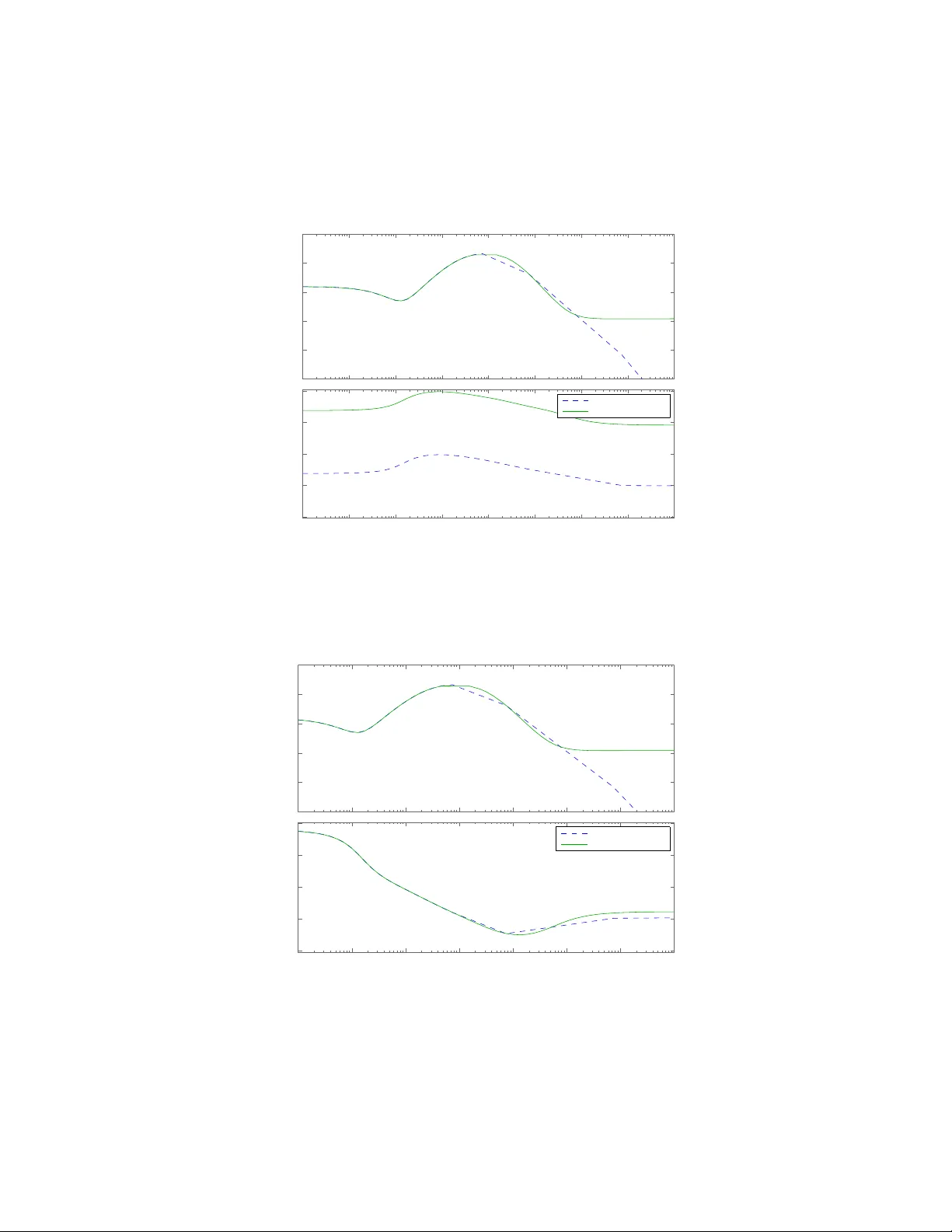
Lo w Frequency Approxim ation for a class of Linear Quantum Systems using Cascade Ca vity Realizat ion ✩ Ian R. Petersen School of Engineering and Informatio n T echnology , University of Ne w Sou th W ales at the Austr alian Defence F or ce Acad emy , Canberra AC T 26 00, A ustralia. Abstract This paper presents a method for approximating a class of complex transfer func- tion matrices corresponding to physically realizable complex linear quantum sys- tems. The class of linear quantum systems under consideration includes intercon- nections of passive optical components such as ca vities, beam-splitters, phase- shifters and interferometers. This approx imation m ethod builds on a previous result for cascade realization and giv es good approximations at lo w frequencies. K e ywor ds: Quantum Linear Systems, Model Reduction, Cascade Realization. 1. Intr oduction In recent years, there has been considerable interest in the modeling and fe ed- back control of linear quantum systems; e.g. , see [1–17]. Such linear qu antum systems comm only arise i n the are a of quantum optics; e.g., see [18, 19]. The feedback control of quantum optical systems has appli cations in areas su ch as quantum comm unications, qu antum t eleportation, and gravity wa ve detection. In particular , the papers [9, 15 – 17] have been concerned with a class of lin ear quan- tum systems in which the system can be defined in terms of a set of linear complex ✩ This work was sup ported by the Austra lian Research Coun cil and Air Force Office of Scie n- tific Research (AFOSR). Th is material is based o n research sponso red by the Air Force Researc h Laborato ry , under a greement numb er F A2386-09-1 -4089. The U .S. Government is authorized to reprod uce and distrib ute rep rints for Governmental purposes notwithstanding any copyright nota- tion there on. The views and co nclusions containe d herein are tho se of the auth ors and sho uld not be interpreted as necessarily representing the of ficial policies or endorsemen ts, either e xpre ssed or implied, of the Air Force Res earch La borator y or the U.S. Government. Email address : i.r .petersen@gm ail.com ( Ian R. Petersen) Pr eprint submitted to Systems & Contr ol Letters November 22, 2017 quantum stochastic differential e quatio ns (QSDEs) defined purely in terms of an- nihilation operators. Such linear comp lex quantum systems correspond to optical systems made up of passive optical components such as opt ical ca viti es, b eam- splitters, and ph ase sh ifters. This p aper is concerned wi th the approximati on of systems in t his class of linear com plex qu antum systems. T he method p roposed in this paper b uilds on the result of [9, 17] which giv es a method for physically re al- izing a giv en complex transfer function matrix corresponding to a linear quantum system in the class considered in [15, 16]. In the approximation of linear quantum systems, it i s important that the ap- proximate s ystem which i s obtained is physically realizable. The i ssue of physi- cal realizability for linear quantum systems was considered in th e papers [4, 5, 10, 15, 16]. Thi s notion relates to whether a give n QSDE model represents a physical quantum system which obeys the laws of quantum mechanics. In applying apply- ing approximation methods to obtain approximate m odels of quantum systems, it is important that th e approximate m odel obtained is a physically realizable quan- tum system so that it exhibits the features inherent to quantum mechanics such as the Heisenber g uncertainty principle. The approximation method proposed in thi s paper follows directly from the physical relatio n al gorithm proposed in [9, 17]. The p hysical realizabilit y of the approximate s ystem follows directly from the fact t hat the algorit hm prop osed in [9, 17] leads to a phys ical realization in terms of a cascade connection o f op tical ca vities. For this approxi mation metho d, we present some bounds and approxi- mate bounds on the approximation error as a function of frequency . One appli cation of the approxi mation method proposed in this paper i s in mod - elling of linear quantum systems where it is desired to construct a simpler , b ut still physically realizable model of a complex quant um linear system in s uch a way that a frequency dependent bound on the approxim ation error is obtained at low fre- quencies. Anot her application of the approximation metho d occurs in the case of coherent quantu m feedback control systems when both the plant and control ler are linear quantum s ystems; see [1, 2, 4, 16, 20]. In this case, it is desired to construct a simpler coherent quantum controller which is still physically realizable. 2. A Class of Linear Complex Quantum Systems W e consider a class of linear quantum systems described in terms of the anni- hilation operator by the quantum stochastic differ ential equations (QSDEs): da ( t ) = F a ( t ) dt + Gdu ( t ); dy ( t ) = ¯ H a ( t ) dt + J du ( t ) (1) 2 where F ∈ C n × n , G ∈ C n × m , ¯ H ∈ C m × n and J ∈ C m × m ; e.g., see [4, 14– 16, 19, 21 ]. Here a ( t ) = [ a 1 ( t ) · · · a n ( t )] T is a vector of (linear combination s of) annihilation operators. The ve ctor u ( t ) represents the input signals and is assumed to admit the decomposition: du ( t ) = β u ( t ) dt + d ˜ u ( t ) where ˜ u ( t ) is the noise part of u ( t ) and β u ( t ) i s an adapted process (see [22], [23] and [24]). The noise ˜ u ( t ) is a vector of quantu m noi ses. The noi se processes can be represented as operators on an appropriate Fock space (for m ore details s ee [25], [23]). The process β u ( t ) represents variables of other sys tems whi ch m ay b e passed t o the system (1) vi a an interaction. More details on this class of systems can be found in [15], [4]. Definition 1. (See [6, 15].) A lin ear quantum system of the form (1) is said to be physically realizable if ther e e xists a commutation mat rix Θ = Θ † > 0 , a coupling matrix Λ , a Hamiltonian matrix M = M † , and a scattering matrix S such that F = − Θ iM + 1 2 Λ † Λ ; G = − ΘΛ † S ; ¯ H = Λ; J = S (2) and S † S = I . Here, the notation † represents complex conjugate transp ose. In this d efinition, if the system (1) is physi cally realizable, then the matrices S , M and Λ define a complex open harmonic oscill ator with s cattering matrix S , coupling o perator L = Λ a and a Ha mil tonian opera tor H = a † M a ; e.g., see [21], [23], [22], [4] and [26]. This definition is an extension of the definition give n in [4, 15] t o allow for a general scattering matrix S ; e.g., see [6, 12]. The follo wing theorem is an straightforward extension of Theorem 5.1 of [15 ] to allow for a general scattering matrix S . Theor em 1. (See [15].) A comple x linear quantum system of the f orm (1) is phys- ically r ealizable if and only if ther e e xists a matrix Θ = Θ † > 0 such that F Θ + Θ F † + GG † = 0; G = − Θ ¯ H † J ; J † J = I . (3) In this case, the corr esponding Hamiltonian matrix M is given by M = i 2 Θ − 1 F − F † Θ − 1 (4) and the corr esponding coupling matrix Λ i s given by Λ = ¯ H . (5) 3 Definition 2. The li near complex quantum system (1) is said to be los sless bounded real if the following conditions hold: i) F is a Hurwitz matrix. ii) Φ( s ) = ¯ H ( sI − F ) − 1 G + J satis fies Φ( iω ) † Φ( iω ) = I for all ω ∈ R . The following definit ion extends the standard linear systems notion of mini mal realization to linear complex quantum systems of the form (1); see also [15]. Definition 3. A linear complex quantum system of the form (1) is said to be min- imal if the following conditions hold: i) Controllability . a † F = λa † for some λ ∈ C and a † G = 0 impl ies a = 0 ; ii) Observability . F a = λa fo r some λ ∈ C and ¯ H a = 0 implies a = 0 . The following Theorem i s an straightforward extension of Theorem 6. 6 of [15] to allow for a general scattering matrix S . Theor em 2. A minimal li near comple x quantum system of the form (1) is physi- cally r ealizable if and only if the system is lossless bounded r eal. Definition 4. The complex linear quantum system (1) is said to be a quantu m system realization of a complex transfer function matrix K ( s ) if K ( s ) = ¯ H ( sI − F ) − 1 G + J . (6) 3. The Cascade Cavity Realization Algorithm In this section, we recall the cascade cavity realization result of [9, 17 ] and generalize it sli ghtly to allow for quantum sy stems w ith a mo re general scatter- ing matrix. Indeed, giv en a linear quant um system of the form (1) with t ransfer function matrix (6), we can write K ( s ) = J ˜ K ( s ) where ˜ K ( s ) = H ( s I − F ) − 1 G + I (7) and H = J − 1 ¯ H . Corresponding to (7) is the li near quantum system da ( t ) = F a ( t ) dt + Gdu ( t ); dy ( t ) = H a ( t ) d t + du ( t ) . (8) In order to obtain a phys ical realization of (6), the result o f [9, 17] can be applied to transfer function m atrix (7). Then a collection o f beams plitters can be used to 4 . . . . . . cavity 2 generalized ... ... generalized cavity n beam splitters generalized cavity 1 P S f r a g r e p l a c e m e n t s u = u 0 u 1 = y 0 u 2 = y 1 u n = y n − 1 y = y n Figure 1: Cascade of n , gener alized m mirror cavities and a unitary operator . implement the unitary matrix J ; e.g., see [27]. Thi s leads to a physical realization of the transfer function matrix (7) as shown in Figure 1. An optical ri ng cavity consists of a number of p artially reflecting mirrors ar- ranged to produce a tra veling light wa ve when coupled to a coherent light source; e.g., see [19, 21]. If we augment such a ca vity by introducing phase-shifters on the inpu t and outp ut channels, such a cavity with m m irrors, can be described by a linear quantum system of the form (8) as follows; see [9, 17]: da = padt − h † du ; d y = hadt + du (9) where p + p ∗ = − γ = − m X i =1 κ i = − h † h. (10) Here p = − γ / 2 + i ∆ , h = h 1 h 2 . . . h m = √ κ 1 e iθ 1 √ κ 2 e iθ 2 . . . √ κ m e iθ m , du = du 1 du 2 . . . du m , dy = dy 1 dy 2 . . . dy m . Furthermore, any fir st order complex linear quantum system of the form (9), with non-zero h ∈ C m and satis fying (10), can be physicall y realized as a generalized m mirror ca vity . In this case, the mirror coupling coef ficients and phase shifts are determined usi ng a polar coordinates description of the elements of h . Al so, the detuning parameter ∆ is determined from the imaginary part of the system pole p . The ca scade ca vity realizati on introduced in [9, 17] inv olves a cascade in- terconnection of n , generalized m mirror cavities as shown in Figure 2 . In this cascade system, the i th cavity is described b y the foll owing QSDEs of the form (8), (9): da i = p i a i dt − H † i du ; d y = H i a i dt + du (11) 5 . . . . . . generalized cavity 1 cavity 2 generalized cavity n generalized ... ... P S f r a g r e p l a c e m e n t s u = u 1 u 2 = y 1 u n = y n − 1 y = y n Figure 2: Cascade of n , ge neralized m mirr or ca vities. where p i + p ∗ i = − H † i H i . (12) The cascade sys tem is then describ ed by a compl ex linear quantum system of t he form (8) where F = p 1 0 . . . 0 − H † 2 H 1 p 2 . . . . . . . . . 0 − H † n H 1 . . . − H † n H n − 1 p n , G = − H † 1 H † 2 . . . H † n , H = H 1 H 2 . . . H n , J = I . (13) Reference [9, 17] presents an alg orithm for realizing a phys ically realizable quantum system (8) with transfer fun ction (7) via a cascade of g eneralized cavi- ties. W e restrict attention to quantum syst ems in which the transfer fu nction (7) corresponds to a minim al system ( 8) such that the eigen v alues of the matrix F are all distinct. In t his case, it fol lows via a (com plex version of a) standard result from linear sys tems theory , that the system (8) can be transform ed i nto Modal Canonical F orm; e.g., see [28]. The com plex li near quant um system in modal canonical form is assumed to be as follows: d ˜ a ( t ) = ˜ F ˜ a ( t ) dt + ˜ Gdu ( t ); dy ( t ) = ˜ H ˜ a ( t ) dt + du ( t ) (14) where ˜ F = p 1 0 . . . 0 0 p 2 . . . . . . . . . 0 0 . . . 0 p n ; ˜ G = ˜ G 1 ˜ G 2 . . . ˜ G n ; ˜ H = h ˜ H 1 ˜ H 2 . . . ˜ H n i . (15) 6 Also, it is assumed that i n this realization, the eigen values are ordered so that | p 1 | ≤ | p 2 | ≤ . . . ≤ | p n | . Then, K ( s ) satis fies the equation K ( s ) = ˜ H ( sI − ˜ F ) − 1 ˜ G + I . (16) The algorithm proposed in [9, 17] is as follows: Step 1: Begin with a minimal modal ca nonical form realization (14), (15) of the lossless bounded real transfer function matrix K ( s ) . Step 2: Let ¯ H n = ˜ H n , α n = − ¯ H † n ¯ H n p n + p ∗ n , H n = ¯ H n √ α n , t ( n, n ) = 1 √ α n . (17) Step 3: Calculate the quantities H n , H n − 1 , . . . , H 1 , α n , α n − 1 , . . . , α 1 , t ( i, j ) , for j = n, n − 1 , . . . , 1 and j ≥ i . These are calculated using the following recursiv e formulas starting with the v alues determined in Step 2 for i = n : ¯ H i = " I + n X j = i +1 ˜ H j p j − p i j X k = i +1 t ( j, k ) H † k # − 1 ˜ H i ; (18) α i = − ¯ H † i ¯ H i p i + p ∗ i , H i = ¯ H i √ α i , (19) t ( k , i ) = 1 p i − p k k X j = i +1 t ( k , j ) H † j H i for k = i + 1 , . . . , n, (20) t ( i, i ) = 1 √ α i . (21) Step 4: Set t ( k , i ) = 0 for k < i and define an n × n transformati on matrix T whose ( i, j ) th element is t ( i, j ) . The following theorem is presented in [9, 17]. 7 Theor em 3. Consider an m × m los sless bounded r eal comple x transfer fun ction matrix K ( s ) with a minimal modal canonical form quantum r e aliz ation (14), (15) such that the eigen values of the matrix ˜ F ar e all distinct and that all of the matrix in verses exist in equation (18) when the abo ve algorithm is applied to the sys- tem (14), (15). Then the vectors H 1 , H 2 , . . . , H n defined in the ab ove algorit hm together with the eigen values p 1 , p 2 , . . . , p n define an equivalent cascade quan- tum r ealiz ation (8), (13) for the t ransfer function matrix K ( s ) . Furthermor e, this system is such that the con dition (12) is sati sfied for all i . Mor eover , the matrices { F , G, H , I } defining this cascade qua ntum r ealization ar e r elated to the matrices { ˜ F , ˜ G, ˜ H , I } defining t he mod al quant um r ealization (14), (15) accor ding to the formulas: ˜ F = T F T − 1 , ˜ G = T G, ˜ H = H T − 1 (22) wher e the matrix T is defined in the above algorit hm. The physical realization of (6) corresponds to writing K ( s ) = J ˜ K n ( s ) ˜ K n − 1 ( s ) . . . ˜ K 1 ( s ) (23) where each transfer function matrix ˜ K i ( s ) is a first order transfer functio n matrix corresponding to an optical ca vity described by a QSDE of the form (11). 4. The Main Result Our proposed method for obtaining an approximate m odel for a complex lin- ear quantum system (1) with transfer function matrix (6) in volv es t runcating the cascade realization (23) to obtain the approximate transfer function matrix K a ( s ) = J a ˜ K r ( s ) ˜ K r − 1 ( s ) . . . ˜ K 1 ( s ) (24) where J a = J ˜ K n (0) ˜ K n − 1 (0) . . . ˜ K r +1 (0) and r < n is the order of the approx- imate model. It follows from this construction that K a ( s ) is lossl ess bounded real and h ence phy sically realizable. Indeed, since the transfer function ma- trix J ˜ K n ( s ) ˜ K n − 1 ( s ) . . . ˜ K r +1 ( s ) is lossless boun ded real, it follows th at t he m a- trix J a will be unit ary . Therefore, K a ( s ) will be l ossless bounded real since ˜ K r ( s ) ˜ K r − 1 ( s ) . . . ˜ K 1 ( s ) i s lossless bounded real. In order to construct a state space realization of the reduced dimension transfer function matrix K a ( s ) , note that it follows from the dev elopment in Section 3 that 8 the transfer function matrix ˜ K a ( s ) = ˜ K r ( s ) ˜ K r − 1 ( s ) . . . ˜ K 1 ( s ) has a state space realization of the form (8) defined by the matrices ˜ F a = p 1 0 . . . 0 − H † 2 H 1 p 2 . . . . . . . . . 0 − H † r H 1 . . . − H † r H r − 1 p r , ˜ G a = − H † 1 H † 2 . . . H † r , ˜ H a = H 1 H 2 . . . H r . (25) Also, the transfer function matrix K b ( s ) = ˜ K n ( s ) ˜ K n − 1 ( s ) . . . ˜ K r +1 ( s ) has a state space realization of the form (8) defined by the matrices F b = p r +1 0 . . . 0 − H † r +2 H r +1 p r +2 . . . . . . . . . 0 − H † n H r +1 . . . − H † n H n − 1 p n , G b = − H † r +1 H † r +2 . . . H † n , H b = H r +1 H r +2 . . . H n . (26) Hence, the matrix J a is gi ven by J a = J I − H b F − 1 b G b and the reduced dimen- sion t ransfer functi on matrix K a ( s ) has a state space realization of the form (1) defined by the matrices ˜ F a , ˜ G a , J a ˜ H a , J a . The ordering of the eigen v alues in the cascade re alization (15) means that this model is expected to be a good approximation of original m odel at low frequencies ω << | p r +1 | . The corresponding error system is defined by K e ( s ) = K ( s ) − K a ( s ) = J ˜ K n ( s ) ˜ K n − 1 ( s ) . . . ˜ K r +1 ( s ) − ˜ K n (0) ˜ K n − 1 (0) . . . ˜ K r +1 (0) ˜ K r ( s ) ˜ K r − 1 ( s ) . . . ˜ K 1 ( s ) . (27) W e now present a result which bounds the i nduced matrix norm of the approx- imation error k K e ( j ω ) k as a function of frequency . T his bound will be defined in 9 terms of the following quantities: B 1 ( ω ) = ω n X i = r +1 − ( p i + p ∗ i ) | p i | . | p i − j ω | ; B 2 ( ω ) = ω n X i 1 = r +1 n X i 2 = i 1 +1 C i 1 ,i 2 ( ω ); . . . B k ( ω ) = ω n X i 1 = r +1 n X i 2 = i 1 +1 . . . n X i k = i k − 1 +1 C i 1 ,i 2 ,...,i k ( ω ); . . . B n − r ( ω ) = ω C r +1 ,r +2 ,...,n ( ω ) (28) where C i 1 ,i 2 ,...,i k ( ω ) = ( − j ω ) k − 1 +( − j ω ) k − 2 P k m =1 p i m + ( − j ω ) k − 3 P k m 1 =1 P k m 2 = m 1 +1 p i m 1 p i m 2 + ( − j ω ) k − 4 P k m 1 =1 P k m 2 = m 1 +1 P k m 3 = m 2 +1 p i m 1 p i m 2 p i m 3 + ... + ( − j ω ) k − p − 1 P k m 1 =1 P k m 2 = m 1 +1 ... P k m p = m p − 1 +1 Q p q =1 p i m q + ... + ( − j ω ) k − p − 1 P k m 1 =1 P k m 2 = m 1 +1 ... P k m k − 1 = m k − 2 +1 Q k − 1 q =1 p i m q Q k l =1 − ( p i l + p ∗ i l ) Q k l =1 | p i l | . | p i l − j ω | . (29) Theor em 4. Consider a physicall y r ealizable linear complex quantum system of the for m (1) and corr esponding transfer functi on matrix (6). Suppose this system has a cascade cavity r ealization (23) and a corr esponding appr oximate transfer function matrix K a ( s ) defined in (24). Then K a ( s ) is physicall y re aliz able and the corr esponding approximation err or transfer function matrix K e ( s ) defined in (27) satisfies the bound k K e ( j ω ) k ≤ n − r X k =1 B k ( ω ) (30) for all ω ≥ 0 wher e t he quantities B k ( ω ) ar e defined in (28), (29). 10 Pr oof. The fact that K a ( s ) is phy sically realizable follows from its definit ion as discussed abov e. Now for an y ω ≥ 0 , it follows from (27) that k K e ( j ω ) k ≤ k J k ˜ K n ( j ω ) ˜ K n − 1 ( j ω ) . . . ˜ K r +1 ( j ω ) − ˜ K n (0) ˜ K n − 1 (0) . . . ˜ K r +1 (0) ×k ˜ K r ( j ω ) ˜ K r − 1 ( j ω ) . . . ˜ K 1 ( j ω ) k = ˜ K n ( j ω ) ˜ K n − 1 ( j ω ) . . . ˜ K r +1 ( j ω ) − ˜ K n (0) ˜ K n − 1 (0) . . . ˜ K r +1 (0) (31) using the fac t that the transfer function matrix ˜ K r ( s ) ˜ K r − 1 ( s ) . . . ˜ K 1 ( s ) i s lossless bounded real and the matrix J is unitary . W e now consider the transfer function matrices ˜ K e ( s ) = ˜ K n ( s ) ˜ K n − 1 ( s ) . . . ˜ K r +1 ( s ) − ˜ K n (0) ˜ K n − 1 (0) . . . ˜ K r +1 (0) and ˆ K e ( s ) = ˜ K n ( s ) ˜ K n − 1 ( s ) . . . ˜ K r +1 ( s ) . Also, note that it follows from (11) that each transfer function matrix ˜ K i ( s ) is of t he form ˜ K i ( s ) = I + H i H † i p i − s . Hence, we can write ˆ K e ( s ) = Q r +1 i = n I + H i H † i p i − s . From this it follows that we can write ˆ K e ( s ) = I + P n − r k =1 T k ( s ) and ˜ K e ( s ) = n − r X k =1 ( T k ( s ) − T k (0)) (32) where th e t ransfer functio n matrices T 1 ( s ) , T 2 ( s ) , . . . , T n − r ( s ) are defined as fol- lows: T 1 ( s ) = n X i = r +1 H i H † i p i − s ; T 2 ( s ) = n X i 1 = r +1 n X i 2 = i 1 +1 H i 2 H † i 2 H i 1 H † i 1 ( p i 1 − s ) ( p i 2 − s ) ; . . . T k ( s ) = n X i 1 = r +1 n X i 2 = i 1 +1 . . . n X i k = i k − 1 +1 1 Y l = k H i l H † i l p i l − s ; . . . T n − r ( s ) = r +1 Y i = n H i H † i p i − s . 11 Now it follows from (32) and the triangle inequality that k ˜ K e ( j ω ) k ≤ n − r X k =1 k T k ( j ω ) − T k (0) k (33) for all ω ≥ 0 . W e now consid er each of the terms ˜ T k ( j ω ) = T k ( j ω ) − T k (0) . Indeed, for any ω ≥ 0 , we obtain ˜ T 1 ( j ω ) = n X i = r +1 j ω H i H † i p i ( p i − j ω ) ˜ T 2 ( j ω ) = n X i 1 = r +1 n X i 2 = i 1 +1 H i 2 H † i 2 H i 1 H † i 1 j ω S i 1 ,i 2 ( j ω ) . . . ˜ T k ( j ω ) = n X i 1 = r +1 n X i 2 = i 1 +1 . . . n X i k = i k − 1 +1 1 Y l = k H i l H † i l j ω S i 1 ,...,i k ( j ω ); . . . ˜ T n − r ( j ω ) = r +1 Y i = n H i H † i j ω S r +1 ,...,n ( j ω ) (34) where S i 1 ,i 2 ,...,i k ( j ω ) = ( − j ω ) k − 1 +( − j ω ) k − 2 P k m =1 p i m + ( − j ω ) k − 3 P k m 1 =1 P k m 2 = m 1 +1 p i m 1 p i m 2 + ( − j ω ) k − 4 P k m 1 =1 P k m 2 = m 1 +1 P k m 3 = m 2 +1 p i m 1 p i m 2 p i m 3 + ... + ( − j ω ) k − p − 1 P k m 1 =1 P k m 2 = m 1 +1 ... P k m p = m p − 1 +1 Q p q =1 p i m q + ... + ( − j ω ) k − p − 1 P k m 1 =1 P k m 2 = m 1 +1 ... P k m k − 1 = m k − 2 +1 Q k − 1 q =1 p i m q 1 Q k l =1 p i l ( p i l − j ω ) . (35) 12 Now it follows from (12 ) that k H i H † i k = H † i H i = − p i − p ∗ i for i = r + 1 , r + 2 , . . . , n . Hence , applying t he t riangle inequality and the C auchy-Schwartz in- equality to (34), it follows that for any ω ≥ 0 k ˜ T 1 ( j ω ) k ≤ B 1 ( ω ); k ˜ T 2 ( j ω ) k ≤ B 2 ( ω ); . . . k ˜ T k ( j ω ) k ≤ B k ( ω ); . . . k ˜ T n − r ( j ω ) k ≤ B n − r ( ω ) . (36) These bounds combined with (33) and (31) lead to the inequality (30). ✷ Remark 1. The quantity P n − r k =1 B k ( ω ) in bound (30) is pr obably too complicated to calculate for all cases except when n − r is equal to one or two. However , we can obtain some good appr oximations to this quantity w hich apply at low fr equencies. Indeed, for ω << | p r +1 | , we obtain n − r X k =1 B k ( ω ) ≈ B 1 ( ω ) = ω n X i = r +1 − ( p i + p ∗ i ) | p i | . | p i − j ω | for all ω ≥ 0 . Furtherm or e since sup ω ≥ 0 | p i − j ω | = − 1 2 ( p i + p ∗ i ) , we obtain the following useful upper bound on B 1 ( ω ) : B 1 ( ω ) ≤ 2 ω P n i = r +1 1 | p i | for all ω ≥ 0 . 5. Illustrative Example T o obt ain our initial physi cally realizable quantum sys tem, we start with a random Hamilton ian matrix M > 0 , a random coupli ng matrix Λ , and a random 13 commutation matrix Θ > 0 defined as follows: M = 3 . 3314 2 . 5448 + 0 . 8204 j 2 . 4007 + 1 . 1592 j 2 . 5448 − 0 . 8204 j 3 . 3994 2 . 7136 + 0 . 4185 j 2 . 4007 − 1 . 1592 j 2 . 7136 − 0 . 41 85 j 4 . 12 58 3 . 6470 − 1 . 3066 j 3 . 7009 + 0 . 1246 j 4 . 2612 + 0 . 3611 j 1 . 9949 − 1 . 8970 j 2 . 6090 − 1 . 40 39 j 3 . 56 47 − 1 . 0224 j 3 . 6470 + 1 . 3066 j 1 . 9949 + 1 . 8970 j 3 . 7009 − 0 . 1246 j 2 . 6 090 + 1 . 4039 j 4 . 2612 − 0 . 3611 j 3 . 5 647 + 1 . 0224 j 5 . 9568 4 . 1 173 + 1 . 3450 j 4 . 1173 − 1 . 3450 j 3 . 9 970 , Θ = 1 . 8356 2 . 3408 − 0 . 3287 j 1 . 8732 + 0 . 0757 j 2 . 3408 + 0 . 3287 j 3 . 9779 3 . 3007 + 0 . 4982 j 1 . 8732 − 0 . 0757 j 3 . 3007 − 0 . 4982 j 3 . 8582 1 . 8750 − 0 . 0488 j 2 . 8626 − 0 . 2561 j 2 . 5536 + 0 . 7201 j 1 . 5306 − 0 . 3665 j 2 . 3995 − 1 . 1168 j 3 . 1242 − 0 . 8781 j 1 . 8750 + 0 . 0488 j 1 . 5306 + 0 . 3665 j 2 . 8626 + 0 . 2561 j 2 . 3995 + 1 . 1168 j 2 . 5536 − 0 . 7201 j 3 . 1 242 + 0 . 8781 j 3 . 0974 1 . 9 480 + 0 . 9779 j 1 . 9480 − 0 . 9779 j 3 . 0 319 , Λ = − 1 . 0106 + 0 . 00 00 j 0 . 507 7 + 1 . 09 50 j 0 . 591 3 + 0 . 428 2 j 0 . 6145 − 0 . 3 179 j 1 . 6924 − 1 . 8740 j − 0 . 6436 + 0 . 895 6 j 0 . 3803 + 0 . 7310 j − 0 . 0195 + 0 . 0403 j − 1 . 0091 + 0 . 5779 j − 0 . 04 82 + 0 . 6771 j . Also, we chose the scattering matrix S = I . This leads to a c orrespondi ng system of the form (1) where the matrices are defined as in (2). The eigen values of the 14 resulting matrix F are s = − 0 . 003 8 − 0 . 0 1 81 j , s = − 0 . 2103 − 0 . 1040 j , s = − 0 . 1674 − 1 . 1066 j , s = − 3 . 038 8 − 0 . 92 75 j , s = − 10 . 854 1 − 225 . 94 73 j . Clearly , the last eigen value has a much larger absol ute v alue th an all of the ot hers and s o we will apply our algori thm to approximate this fifth order sy stem by a fourth o rder system. Bode plots comparing the origin al system frequenc y response wi th the reduced di mension system frequency response are shown in Figures 1-4. These Bode plots indicate t hat the proposed method g iv es a good approximation at l ow frequencies. Also, it fol lows from the construction t hat the reduced dimension system is lossless bounded real and so physically realizable. −1.5 −1 −0.5 0 Magnitude (dB) 10 −3 10 −2 10 −1 10 0 10 1 10 2 10 3 10 4 0 45 90 135 180 Phase (deg) Bode Diagram Frequency (rad/sec) original system approximate system Figure 3: Bode plot of orig inal and approxim ate system fr om input 1 to output 1. In Fig ure 7, we s how the singular value plot of the error transfer function matrix K e ( s ) = K ( s ) − K a ( s ) along wit h the error bou nd defined by B 1 ( ω ) . In this example, we see that the error b ound is in f act e xact since we only reduced the dimension of the original system by one. 6. Conclusions In this p aper , we hav e presented a meth od of approxim ating a class of linear complex quantum systems in such a w ay that the property of physical realizabili ty 15 −50 −40 −30 −20 −10 0 Magnitude (dB) 10 −4 10 −3 10 −2 10 −1 10 0 10 1 10 2 10 3 10 4 −360 −180 0 180 360 Phase (deg) Bode Diagram Frequency (rad/sec) original system approximate system Figure 4: Bode plot of orig inal and approxim ate system fr om input 2 to output 1. −50 −40 −30 −20 −10 0 Magnitude (dB) 10 −3 10 −2 10 −1 10 0 10 1 10 2 10 3 10 4 −90 0 90 180 270 Phase (deg) Bode Diagram Frequency (rad/sec) original system approximate system Figure 5: Bode plot of orig inal and approxim ate system fr om input 1 to output 2. 16 −1.5 −1 −0.5 0 Magnitude (dB) 10 −3 10 −2 10 −1 10 0 10 1 10 2 10 3 10 4 0 45 90 135 180 Phase (deg) Bode Diagram Frequency (rad/sec) original system approximate system Figure 6: Bode plot of orig inal and approxim ate system fr om input 2 to output 2. 10 −3 10 −2 10 −1 10 0 10 1 10 2 10 3 10 4 −350 −300 −250 −200 −150 −100 −50 0 Singular Values Frequency (rad/sec) Singular Values (dB) Ke(s) B1(s) Figure 7: Singular value plot of the error tran sfer fun ction matrix K e ( s ) an d the error bo und B 1 ( ω ) . 17 (which is equivalent to the st rict bound ed real property in this case) is preserved. The paper presents a boun d on the approximation error which s hows that the ap- proximation is accurate at low frequencies. 7. acknowledgmen t The author is wishes to ackno wledge Profe ssor Hideo Mabuchi who suggested that the physical realization algorithm of [9, 17 ] may also be useful in the approx- imation of linear quantum systems. Refer ences [1] M. Y anagisawa, H. Kimura, T ransfer function approach to quantum c ontrol - part I: Dynami cs of quantum feedback systems, IEEE Tr ansactions on Au- tomatic Control 48 (12) (2003) 2107–2120. [2] M. Y anagisawa, H. Kimura, T ransfer function approach to quantum c ontrol - part II: Control concepts and applications, IEEE Transactions on Automatic Control 48 (12) (2003) 2121–2132. [3] N. Y amamoto, Robust observer for uncertain linear quantum system s, Phys. Re v . A 74 (2006) 032107–1 – 032107–10. [4] M. R. James, H. I. Nurdin, I. R. P etersen, H ∞ control of linear quantum stochastic system s, IEEE Transactions on Autom atic Control 53 (8) (2008) 1787–1803. [5] H. I. Nurdin, M. R. James, I. R. Petersen, Coherent quantum LQG control, Automatica 45 (8) (2009) 1837–1846. [6] J. Go ugh, R. Gohm, M. Y anagisawa, Linear quant um feedback networks, Physical Re view A 78 (2008) 062104. [7] H. Mabuchi, Coherent-feedback quantum control with a dynami c compen- sator , Physical R evie w A 78 (2008) 032323. [8] N. Y amamoto, H. I. Nurdi n, M. R. Jam es, I. R. Petersen, A voiding ent an- glement sudden-death via feedback cont rol in a q uantum network, Physical Re view A 78 (4) (2008) 042339. 18 [9] I. R. Petersen, Cascade ca vity realization for a class of complex transfer functions arising in coherent quantum feedback control, in: Procee ding s o f the 2009 European Control Conference, Budapest, Hungary , 2009. [10] A. J. S haiju, I. R. Petersen, On th e physical realizabili ty of general linear quantum stochastic dif ferential equations wi th complex coef ficients, in: Pro- ceedings of the 48th IEEE Conference on Decision and Control, Shanghai, China, 2009. [11] H. I. Nurdin, M . R. James, A. C. Doherty , Network syn thesis o f linear dy- namical quantum stochasti c sy stems, SIAM Journal on Control and Opti- mization 48 (4) (2009) 2686–2718. [12] J. Gough, M. R. James, The series p roduct and it s application to quantum feedforward and feedback networks, IEEE T ransactions on Autom atic Con- trol 54 (11) (2009) 2530–2544. [13] J. E . Gough, M. R. James, H. I. Nurdin, S queezing components in linear quantum feedback networks, Physical R evie w A 81 (2010) 023804. [14] H. M . W iseman, G. J. Milburn, Qu antum M easurement and Control, Cam- bridge Univ ersity Press, 2010. [15] A. I. Maalouf, I. R. Petersen, Bounded real properties for a class of lin- ear complex quantum systems, IEEE T ransactions on Au tomatic Control PP (99) (2010) 1, in Pre ss, accepted on 29 June 201 0, currently av ailable on IEEE Xplore early access. doi:10.1109/TAC .2010.2060 970 . [16] A. I. Maalouf, I. R. P etersen, Coherent H ∞ control for a class of linear com- plex quantum systems, IEEE T ransactions on Automati c Control PP (99) (2010) 1, in Pr ess, acce pted on 4 June 2010, currently av ailable on IEEE Xplore early access. d oi:10.1109 /TAC.2010. 2052942 . [17] I. R. P eterse, Cascade ca vity realization for a class o f complex transfer func- tions arising in coherent quantum feedback control, AutomaticaT o Appear . [18] D. F . W alls, G. J. Milburn, Quantum Opti cs, Springer-V erlag, Berlin; Ne w Y ork, 1994. [19] H. Bachor , T . Ralph, A Gui de to Experim ents i n Quantum Optics, 2 nd Edi- tion, W iley-VCH, W einheim, Germany , 2004. 19 [20] H. I. Nurdin, M. R. James, I. R. Petersen, Quantum LQG con trol wit h quantum mechanical controllers, in: Proceedings of the 17t h IF A C W orld Congress, Seoul, K orea, 2008. [21] C. Gardiner , P . Zo ller , Quantum Noise, Springer , Berlin, 2000. [22] L. Bout en, R. V an Handel, M. J ames, An int roduction to quantum filtering, SIAM J. Control and Optimization 46 (6) (2007) 2199–2241. [23] K. Pa rthasarathy , An Introduct ion to Quantum Stochastic Calculus, Birkhauser , Berlin, 1992. [24] R. Huds on, K. Parthasarathy , Quantum I to’ s formula and stochasti c ev olu- tion, Communications in Mathematical Physics 93 (1984) 301–323. [25] V . Bela vkin, Quantum continual measurements and a posteriori collapse on CCR, Commun. Math. Phys. 146 (1992) 611–635. [26] S. C. Edwards, V . P . Belavkin, Optimal quantum feedback control via quan- tum dynamic programming, qu ant-ph/0506018, Uni versity o f Nottingham (2005). [27] M. Reck, A. Zeil inger , H. Bernstein, P . Bertani, Ex perimental realization of any discrete unitary operator , Physical Re view Letters 73 (1) (1994) 58–61. [28] T . Kailath, Linear Systems, Prentice-Hall, Englew ood Cliff s, NJ, 1980. 20
Original Paper
Loading high-quality paper...
Comments & Academic Discussion
Loading comments...
Leave a Comment