Esparsidade, Estrutura, Escalamento e Estabilidade em Algebra Linear Computacional
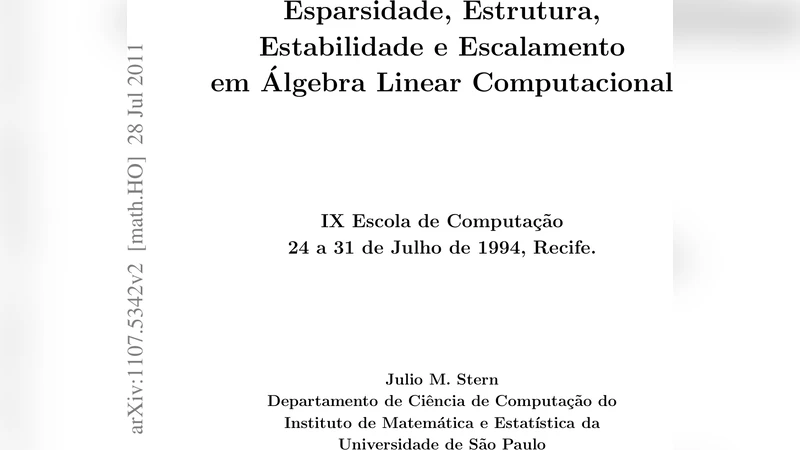
Sparsity, Structure, Scaling and Stability in Computational Linear Algebra - Textbook from the IX School of Computer Science, held on July 24-31 of 1994 at Recife, Brazil. Esparsidade, Estrutura, Escalamento e Estabilidade em Algebra Linear Computacional - Livro texto da IX Escola de Computacao, realizada nos dias 24 a 31 de Julho de 1994 em Recife, Brasil. This textbook is written in Portuguese Language.
💡 Research Summary
The textbook “Sparsity, Structure, Scaling and Stability in Computational Linear Algebra” is a comprehensive compilation of lecture notes delivered at the IX School of Computing in Recife, Brazil, in July 1994. It is organized around four pillars that dominate modern large‑scale linear algebra: sparsity, structure, scaling, and numerical stability.
The opening sections motivate the subject by pointing out that most scientific and engineering applications involve matrices whose non‑zero entries are a tiny fraction of the total size, and that exploiting both the low density (sparsity) and any regular pattern (structure) is essential for performance. The authors stress the interdisciplinary nature of the topic, linking graph theory, hypergraph theory, parallel processing, and numerical analysis.
Chapter 2 introduces the classic LU factorization (Gaussian elimination, pivoting, Doolittle’s method) and immediately discusses the fill‑in problem that arises when a sparse matrix is factorized. The fill‑in is modeled using permutation graphs and elimination trees, and the chapter presents complexity estimates and the “factorization lemma”.
Chapter 3 provides a concise primer on graph theory: basic definitions, order relations, depth‑first search, symmetric graphs, and the Hungarian algorithm. This material underpins later sections where matrix sparsity patterns are represented as graphs or hypergraphs.
Chapters 4 and 5 treat asymmetric and symmetric sparse elimination, respectively. For asymmetric matrices, the authors describe local fill‑in minimization, pre‑positioning, and the P3 heuristic. For symmetric matrices, elimination trees, chordal graphs, and ordering heuristics (minimum degree, nested dissection) are detailed.
Chapter 6 discusses block structures. It defines block‑triangular and block‑angular forms, introduces hypergraph partitioning for detecting block structures, and shows how QR and Cholesky factorizations can be performed block‑wise. Applications to least‑squares, quadratic programming, and projector construction are illustrated.
Chapter 7 focuses on parallelism. It examines data distribution strategies for shared‑memory and distributed‑memory machines, the impact of sparsity and structure on load balancing, and communication‑avoiding techniques. The authors analyze parallel efficiency metrics and give examples of parallel implementations of the previously described algorithms.
Chapter 8 addresses scaling issues inherent in floating‑point arithmetic. It explains how large variations in magnitude cause rounding errors, presents row and column scaling techniques, and analyzes their effect on condition numbers.
Chapter 9 is devoted to numerical stability. Using norm‑based perturbation theory, the book evaluates the stability of LU, QR, and Cholesky factorizations, discusses growth factors, and recommends pivoting and scaling strategies to mitigate error propagation.
Chapter 10 tackles the “basis update” problem: efficiently updating the inverse (or factorization) of a matrix when a single column (or row) is replaced. This is crucial for iterative optimization methods and network flow algorithms that repeatedly modify a system matrix.
Throughout the text, the authors advocate the use of high‑level languages such as MATLAB, FORTRAN‑90, and C/C++ for prototyping and testing. Each chapter includes exercises, sample code, and references to both classic and contemporary literature.
In sum, the book offers a unified treatment that connects theoretical concepts (graph‑based representations, perturbation analysis) with practical algorithmic techniques (fill‑in reduction, block factorizations, parallel execution) and provides the tools needed to develop efficient, stable solvers for large sparse and structured linear systems.
Comments & Academic Discussion
Loading comments...
Leave a Comment