On exact categories and applications to triangulated adjoints and model structures
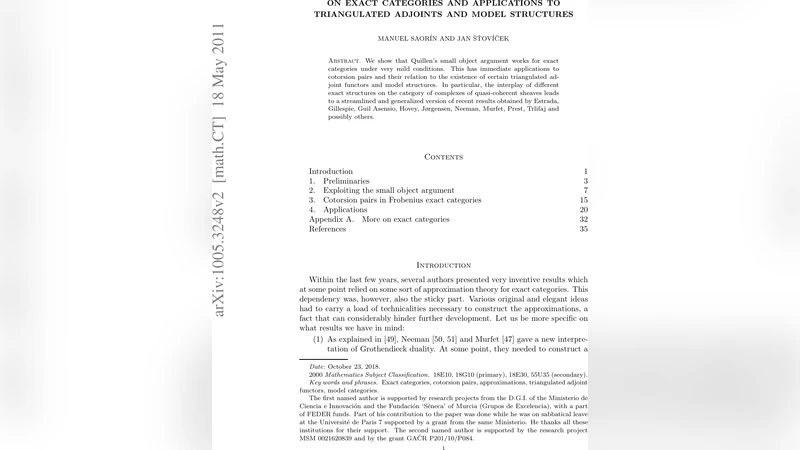
We show that Quillen’s small object argument works for exact categories under very mild conditions. This has immediate applications to cotorsion pairs and their relation to the existence of certain triangulated adjoint functors and model structures. In particular, the interplay of different exact structures on the category of complexes of quasi-coherent sheaves leads to a streamlined and generalized version of recent results obtained by Estrada, Gillespie, Guil Asensio, Hovey, J{\o}rgensen, Neeman, Murfet, Prest, Trlifaj and possibly others.
💡 Research Summary
The paper establishes that Quillen’s Small Object Argument (SOA), a cornerstone of modern homotopical algebra, can be carried out in any exact category under very mild hypotheses. The authors identify two essential conditions: (1) the existence of push‑outs of admissible monomorphisms (i.e., exact inflations) and (2) a set of “small” objects that is λ‑filtered for some regular cardinal λ. These conditions are satisfied in virtually all naturally occurring exact categories, such as module categories, categories of chain complexes, and, crucially, the category of complexes of quasi‑coherent sheaves.
The first major result shows that, given a set I of small admissible monomorphisms, one can construct I‑cell complexes and factor any morphism as an I‑cofibration followed by an I‑trivial fibration, exactly as in the classical Quillen setting. The proof adapts the transfinite construction of the classical SOA to the exact context, using the fact that push‑outs of admissible monomorphisms remain admissible and that the transfinite composition of admissible monomorphisms stays admissible.
With the SOA in hand, the authors turn to cotorsion pairs in exact categories. They prove that if a set of objects generates a class 𝔄 (by taking all extensions and retracts) and a set of morphisms generates a class 𝔅 (as right orthogonal), then (𝔄,𝔅) forms a complete cotorsion pair. This result removes many technical restrictions that previously appeared in the literature (e.g., the need for the ambient category to be Grothendieck or to possess enough projectives/injectives). The construction of the associated approximation sequences is obtained directly from the factorisations supplied by the SOA.
The third section connects cotorsion pairs to the existence of adjoint functors between triangulated categories. By passing to the derived category D(𝔈) of an exact category 𝔈, the authors show that a complete cotorsion pair (𝔄,𝔅) whose heart coincides with a t‑structure’s heart yields a pair of adjoint functors: the inclusion of the heart into D(𝔈) admits a left (or right) adjoint given by the cotorsion‑pair approximation. This provides a conceptual proof of many known adjunctions (for example, the derived functor of the inclusion of complexes of flat modules into all complexes) and supplies a systematic method for producing new adjoints.
The fourth and perhaps most impactful part of the paper deals with model structures. Building on Hovey’s “three‑fold” correspondence (cofibrantly generated model structures ↔ two compatible cotorsion pairs), the authors consider a single underlying exact category equipped with two distinct exact structures, say 𝔈₁ and 𝔈₂. For each exact structure they construct a complete cotorsion pair (𝔄₁,𝔅₁) and (𝔄₂,𝔅₂) using the SOA. Intersecting the cofibrant classes (𝔄₁∩𝔄₂) and the fibrant classes (𝔅₁∩𝔅₂) yields the cofibrant and fibrant objects of a model structure whose weak equivalences are those morphisms that are simultaneously weak equivalences in both exact structures. This “double‑exact‑structure” technique subsumes many previously known model structures on complexes of quasi‑coherent sheaves, including those constructed by Estrada, Gillespie, Guil Asensio, Hovey, Jørgensen, Neeman, Murfet, Prest, Trlifaj, and others. In particular, the authors recover the flat‑model structure, the injective model structure, and the pure‑derived model structure as special cases, while also providing a unified framework that can be applied to new exact structures (e.g., the “stalkwise” exact structure on sheaf complexes).
The paper concludes by emphasizing that the combination of the Small Object Argument in exact categories and the cotorsion‑pair machinery furnishes a powerful, unified toolkit. This toolkit simultaneously addresses three central problems in modern homological algebra: (i) constructing functorial factorizations, (ii) producing adjoint functors between derived or triangulated categories, and (iii) building cofibrantly generated model structures. By removing unnecessary hypotheses and by exploiting the flexibility of multiple exact structures, the authors open the door to systematic exploration of new homotopical and triangulated phenomena in a wide variety of algebraic and geometric contexts.
Comments & Academic Discussion
Loading comments...
Leave a Comment