Algorithmic and Complexity Results for Cutting Planes Derived from Maximal Lattice-Free Convex Sets
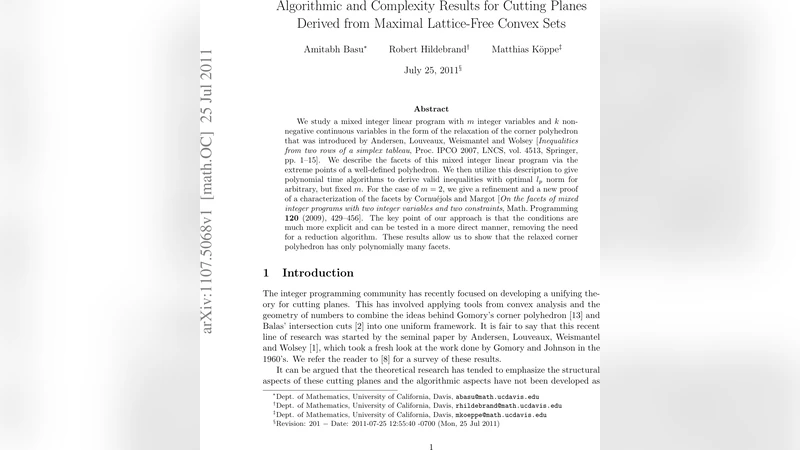
We study a mixed integer linear program with m integer variables and k non-negative continuous variables in the form of the relaxation of the corner polyhedron that was introduced by Andersen, Louveaux, Weismantel and Wolsey [Inequalities from two rows of a simplex tableau, Proc. IPCO 2007, LNCS, vol. 4513, Springer, pp. 1–15]. We describe the facets of this mixed integer linear program via the extreme points of a well-defined polyhedron. We then utilize this description to give polynomial time algorithms to derive valid inequalities with optimal l_p norm for arbitrary, but fixed m. For the case of m=2, we give a refinement and a new proof of a characterization of the facets by Cornuejols and Margot [On the facets of mixed integer programs with two integer variables and two constraints, Math. Programming 120 (2009), 429–456]. The key point of our approach is that the conditions are much more explicit and can be tested in a more direct manner, removing the need for a reduction algorithm. These results allow us to show that the relaxed corner polyhedron has only polynomially many facets.
💡 Research Summary
The paper investigates a mixed‑integer linear program (MILP) that arises as the relaxation of the classic corner polyhedron. The model consists of m integer variables and k non‑negative continuous variables linked by the equation
x = f + Σ_{j=1}^k r_j s_j, x ∈ ℤ^m, s_j ≥ 0,
where f and the rays r_j are rational. This formulation, introduced by Andersen, Louveaux, Weismantel and Wolsey, captures cutting‑plane generation from multiple rows of a simplex tableau.
The authors first observe that the convex hull conv(R_f) of all feasible s‑vectors is a full‑dimensional blocking polyhedron. Consequently every non‑trivial valid inequality can be written as γ·s ≥ 1 with γ ≥ 0. To describe the set of all such γ vectors, they introduce the dual (blocking) polyhedron conv(R_f)^∨ = {γ ≥ 0 | γ·s ≥ 1 ∀ s ∈ conv(R_f)}. By enumerating all bases I ⊆ {1,…,k} of size m (i.e., subsets of rays that span ℝ^m) they define, for each integer point x with x−f in the cone generated by {r_j | j∈I}, the coefficients s_j(x,I) that express x−f as a non‑negative combination of the basis rays. Proposition 3.2 shows that a vector γ is valid iff for every basis I and every integer x in the corresponding cone the inequality Σ_{j∈I} γ_j s_j(x,I) ≥ 1 holds. This condition is equivalent to the fact that the Minkowski functional of the polyhedron M_γ = conv{f + r_j γ_j | γ_j > 0} + cone{r_j | γ_j = 0} contains no integer point in its interior.
Although the description initially involves infinitely many constraints (one for each integer point), Theorem 3.3 proves that it suffices to enforce the constraints only for the extreme points of the polyhedron X(I) = {x ∈ ℤ^m | x−f ∈ cone({r_j | j∈I})}. Since X(I) is itself a rational polyhedron, its extreme points are finitely many and can be enumerated in polynomial time when m is fixed. Thus conv(R_f)^∨ can be represented by a polynomial‑size system.
With this explicit representation the authors turn to the algorithmic problem of finding the “best’’ cutting plane according to an ℓ_p norm of the coefficient vector γ. For any fixed m they give a polynomial‑time algorithm that, for each basis I, enumerates the extreme points of X(I), formulates the corresponding linear (for p = 1 or ∞) or convex (for general p) optimization problem, and selects the γ of minimum ℓ_p norm. For the ℓ_1 and ℓ_∞ norms the problem reduces to a linear program with polynomially many constraints; for other p they propose a convex program that remains polynomial because the number of constraints is polynomial.
The paper then focuses on the special case m = 2. Using Lovász’s classification of maximal lattice‑free convex sets in the plane (splits, three types of triangles, and quadrilaterals), the authors give a refined, fully explicit set of necessary conditions for a valid inequality to define a facet of conv(R_f). These conditions replace the intricate reduction algorithm used by Cornuéjols and Margot with direct tests on the data. Moreover, when a candidate inequality fails the test, the authors show how to express it as a convex combination of other valid inequalities, which yields a constructive proof that the so‑called triangle closure is a polyhedron—a long‑standing open question.
The main structural result, Theorem 6.2, proves that the number of facets of the relaxed corner polyhedron is polynomial in the input size when m = 2. Building on the explicit facet conditions, Theorem 6.3 presents a polynomial‑time algorithm that enumerates all facets for the two‑dimensional case. The algorithm systematically generates all maximal lattice‑free sets of each type, computes their Minkowski functionals, and extracts the corresponding extreme points of the dual polyhedron.
In summary, the paper provides (i) a clean polyhedral description of all valid inequalities for the relaxed corner polyhedron, (ii) polynomial‑time procedures for obtaining optimal ℓ_p‑norm cuts for any fixed number of integer variables, (iii) a new, direct facet‑characterization for the two‑variable case that eliminates the need for reduction algorithms, and (iv) a proof that the relaxed corner polyhedron possesses only polynomially many facets, together with an explicit enumeration algorithm. These contributions bridge the gap between structural theory and practical cutting‑plane generation, offering tools that can be incorporated into modern MILP solvers for stronger, theoretically‑grounded cuts.
Comments & Academic Discussion
Loading comments...
Leave a Comment