Prandtl and the G"ottingen School
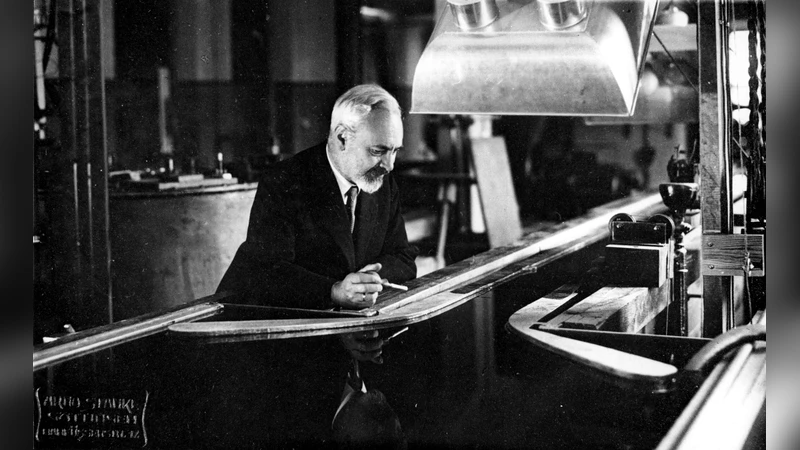
This is a historical review of “Prandtl and the G"ottingen School” from his first work in 1898 to after WWII. We report the development of the boundary layer theory and the investigations that lead Ludwig Prandtl in the spring of 1945 to use a energy cascade model to derive for fully developed turbulence the Kolmogrov length scale. Working at the end of WWII he was not aware of the work by Kolmogorov. Thus Ludwig Prandtl was before Onsager, von Weiz"acker, and Heisenberg in rederiving parts of K41 theory. In our historical analysis we rely heavily on exchanges between Ludwig Prandtl with Theodore von K'arm'an and Goeffrey Ingram Taylor and on the original notes by Ludwig Prandtl and others.
💡 Research Summary
The paper provides a comprehensive historical review of Ludwig Prandtl’s scientific activities from his first work in 1898 through the end of World War II, focusing on his role within the Göttingen School and his pioneering contributions to boundary‑layer theory and turbulence. It begins by situating Göttingen as a hub of mathematics and applied mechanics, highlighting the influence of Gauss, Klein, Hilbert, and Minkowski, and describing how Klein’s vision of an “Institute for Applied Mathematics and Mechanics” brought together Prandtl, Carl Runge, and other engineers in 1904.
Prandtl’s arrival in Göttingen coincided with the formulation of the boundary‑layer concept, which he presented at the 1904 International Congress of Mathematicians in Heidelberg. The paper traces the early reception of this idea, noting that it required years of elaboration before its quantitative power was demonstrated by Blasius’s 1908 solution for laminar flow over a flat plate. The authors emphasize that the boundary‑layer theory was not merely a qualitative picture but a singular perturbation framework that later became a cornerstone of modern fluid dynamics.
The narrative then shifts to the internal dynamics of the Göttingen School. Klein’s seminars (1903‑1904, 1907‑1908) served as a crucible for discussing hydraulic versus hydrodynamic explanations of flow phenomena, and they attracted young talents such as Theodore von Kármán, Max Munk, Johann Nikuradse, and Walter Tollmien. In these settings, Prandtl’s early thoughts on turbulence emerged. A handwritten manuscript dated 3 October 1910, titled “Turbulence I: Vortices within laminar motion,” reveals that Prandtl already envisaged vortex generation in the boundary layer as a friction‑driven roll‑up process, predating many later vortex‑dynamics theories.
The paper details several experimental milestones that cemented Prandtl’s reputation as an engineer‑scientist. The 1912–1914 sphere‑drag experiments, prompted by discrepancies between Göttingen and Eiffel wind‑tunnel data, led Prandtl to propose that a turbulent boundary layer delays separation and reduces wake size, thereby lowering drag. He verified this by introducing trip wires and roughness elements, visualizing the effect with smoke. These studies directly linked turbulence to practical aerodynamic performance and foreshadowed modern flow‑control strategies.
During World I, turbulence became a military problem. Prandtl’s institute was tasked with investigating the drag of bomb shapes, struts, and wires, and with understanding the sudden drag increase on falling bombs. The authors describe how Sommerfeld’s request about bomb drag sparked a systematic program to measure drag coefficients across fluids and Reynolds numbers, leading to the identification of a universal drag coefficient ψ for high‑Reynolds‑number flows.
The most striking contribution discussed is Prandtl’s 1945 “working program for a theory of turbulence.” In the final months of the war, Prandtl introduced an energy‑cascade model that assumed a continuous transfer of kinetic energy from large to small eddies. By dimensional analysis he derived a characteristic length scale that matches the Kolmogorov microscale (ℓ ≈ (ν³/ε)¹⁄⁴). The authors emphasize that Prandtl derived this result independently, without knowledge of Kolmogorov’s 1941 papers, and therefore preceded the work of Kolmogorov, Onsager, von Weizsäcker, and Heisenberg in re‑deriving core elements of K41 theory.
The paper also highlights Prandtl’s broader methodological legacy. He consistently blended rigorous mathematical analysis with extensive wind‑tunnel and field experiments, embodying a “data‑driven theory” approach that anticipates contemporary turbulence modeling. His introduction of the Prandtl number (ν/α) as a dimensionless ratio linking momentum and heat diffusion remains a fundamental parameter in heat‑transfer and turbulent‑flow correlations.
In conclusion, the authors argue that the Göttingen School, under Prandtl’s leadership, forged a unique synthesis of pure mathematics, applied mechanics, and experimental aerodynamics that shaped 20th‑century fluid dynamics. Prandtl’s early boundary‑layer work, his systematic study of vortex generation, his wartime turbulence program, and his independent derivation of the Kolmogorov length scale collectively demonstrate that he was a true forerunner of modern turbulence theory. The paper thus repositions Prandtl not only as the father of boundary‑layer theory but also as a pioneering architect of the statistical description of turbulence that would later be formalized by Kolmogorov and his successors.
Comments & Academic Discussion
Loading comments...
Leave a Comment