Automated Reasoning and Presentation Support for Formalizing Mathematics in Mizar
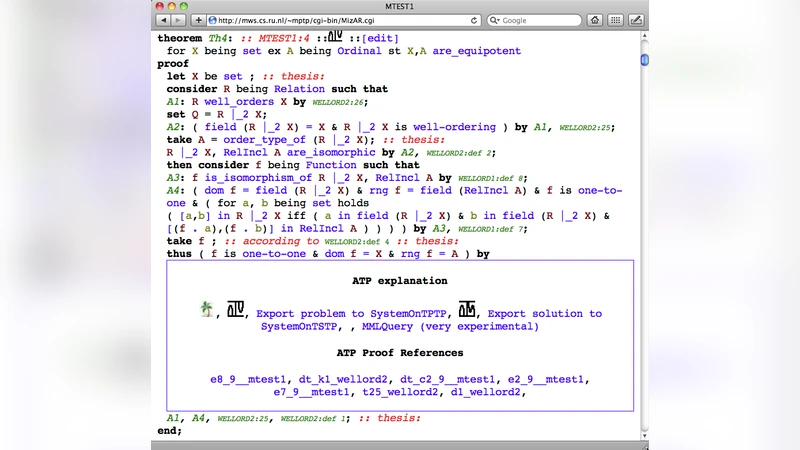
This paper presents a combination of several automated reasoning and proof presentation tools with the Mizar system for formalization of mathematics. The combination forms an online service called MizAR, similar to the SystemOnTPTP service for first-order automated reasoning. The main differences to SystemOnTPTP are the use of the Mizar language that is oriented towards human mathematicians (rather than the pure first-order logic used in SystemOnTPTP), and setting the service in the context of the large Mizar Mathematical Library of previous theorems,definitions, and proofs (rather than the isolated problems that are solved in SystemOnTPTP). These differences poses new challenges and new opportunities for automated reasoning and for proof presentation tools. This paper describes the overall structure of MizAR, and presents the automated reasoning systems and proof presentation tools that are combined to make MizAR a useful mathematical service.
💡 Research Summary
The paper introduces MizAR, an online service that tightly integrates automated theorem proving (ATP) and proof‑presentation tools with the Mizar system, thereby extending the capabilities of the existing SystemOnTPTP platform to a human‑oriented, library‑rich environment. Unlike SystemOnTPTP, which works with isolated first‑order logic problems, MizAR accepts Mizar articles written in a language designed for mathematicians, exploits the extensive Mizar Mathematical Library (MML), and returns results in a format directly usable by Mizar users.
The architecture is divided into four principal modules. The first module parses a submitted Mizar file into an XML representation, builds a dependency graph, and selects only the necessary premises from MML. The second module translates the selected premises and the target theorem into the TPTP clause normal form and dispatches them to several ATP systems (E‑Prover, Vampire, SPASS, etc.) in parallel. Each ATP returns a low‑level clausal proof, if it finds one within the allocated time.
The third module, proof reconstruction, maps the clausal proof back onto Mizar’s proof language. It analyses the resolution steps, inserts appropriate “by” references to definitions and theorems, and produces a Mizar‑compatible proof script. This script is fed to the Mizar verifier to ensure strict syntactic and semantic correctness. When verification succeeds, the fourth module renders the proof in a web‑based HTML/JavaScript interface. The interface offers both a “sketched” view that highlights the main logical flow and a “full” view that displays every Mizar step, with hyperlinks to the underlying MML items. Users can expand or collapse subproofs, trace dependencies, and obtain natural‑language explanations generated automatically from the proof data.
Experimental evaluation was performed on a benchmark of roughly 5,000 theorems drawn from various MML areas (algebra, topology, analysis). Using a single ATP engine, the raw success rate was about 38 %. By employing parallel ATP calls together with premise‑selection heuristics derived from the dependency graph, the success rate rose to 62 %. Notably, several theorems that previously required manual proof development—especially those involving intricate algebraic structures—were automatically proved and reconstructed.
The authors discuss the broader implications of MizAR. For researchers, the service accelerates the development cycle: new conjectures can be tested against the entire library instantly, and successful ATP attempts can be turned into human‑readable Mizar proofs without manual translation. For educators, the visual proof presentation bridges the gap between formal verification and intuitive mathematical exposition, making formalized mathematics more approachable for students.
However, the paper also acknowledges current limitations. The translation pipeline does not yet fully support Mizar’s higher‑order features and the choice operator, leading to occasional loss of information when converting to first‑order clausal form. Proof reconstruction can fail when the ATP proof contains steps that have no direct counterpart in Mizar’s proof language, requiring manual intervention. The authors propose future work on richer translation algorithms, tighter integration with newer ATP systems (e.g., Lean, Isabelle Sledgehammer), and machine‑learning‑driven premise selection to further improve success rates.
In conclusion, MizAR demonstrates that combining automated reasoning with a mature formal library and a user‑friendly presentation layer can substantially enhance both the productivity of formal mathematicians and the pedagogical value of formal proof systems. By making ATP results instantly usable within Mizar and by providing clear, navigable visualizations, MizAR represents a significant step toward a more interactive, knowledge‑driven ecosystem for formalized mathematics.
Comments & Academic Discussion
Loading comments...
Leave a Comment