K-Theories for Certain Infinite Rank Bundles
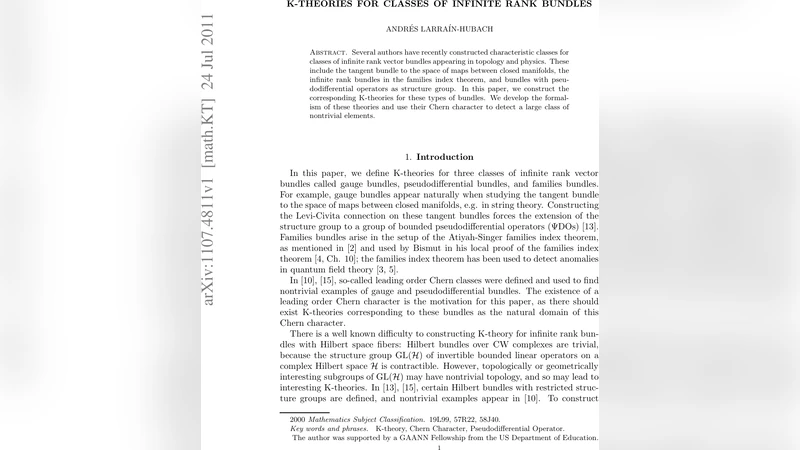
Several authors have recently constructed characteristic classes for classes of infinite rank vector bundles appearing in topology and physics. These include the tangent bundle to the space of maps between closed manifolds, the infinite rank bundles in the families index theorem, and bundles with pseudodifferential operators as structure group. In this paper, we construct the corresponding K-theories for these types of bundles. We develop the formalism of these theories and use their Chern character to detect a large class of nontrivial elements.
💡 Research Summary
The paper develops K‑theory for three important classes of infinite‑rank vector bundles that arise in topology and mathematical physics: gauge bundles, bundles whose structure group consists of zero‑order pseudodifferential operators (ΨDO bundles), and families bundles that appear in the Atiyah‑Singer families index theorem. The authors begin by explaining why ordinary K‑theory of Hilbert bundles is trivial—because the full general linear group GL(H) is contractible—and argue that interesting K‑theories can only be obtained by restricting the structure group to subgroups with non‑trivial topology.
For gauge bundles, the structure group is the group G(N,E) of continuous (or smooth) gauge transformations of a finite‑rank Hermitian bundle E→N. By gluing Sobolev completions Γ^s(N,E) over a base CW‑complex X with transition maps in G(N,E), one obtains a Hilbert bundle whose K‑theory K_G(N)(X) is shown to be naturally isomorphic to the ordinary K‑theory of the product X×N. This is proved in Lemma 3 and Corollary 2, and the isomorphism is realized by the pull‑back functor π^*:K(X×N)→K_G(N)(X).
For families bundles, the structure group is Diff(N,E), the group of pairs (φ,f) where φ is a diffeomorphism of the fiber N and f is a bundle isomorphism covering φ. The authors construct a Grothendieck group K_Diff^M(X) for bundles of the form π^*(E) where π:M→X is a locally trivial fibration with fiber N. Lemma 1 shows that K_Diff^M(X) is canonically isomorphic to K(M), the ordinary K‑theory of the total space of the fibration. By taking a direct limit over all possible fibrations M→X, they define K_Diff(X) and prove Corollary 2 that K_Diff(X) ≅ ⨁_{
Comments & Academic Discussion
Loading comments...
Leave a Comment