Enhancing Knowledge Sharing Between Educational Portals
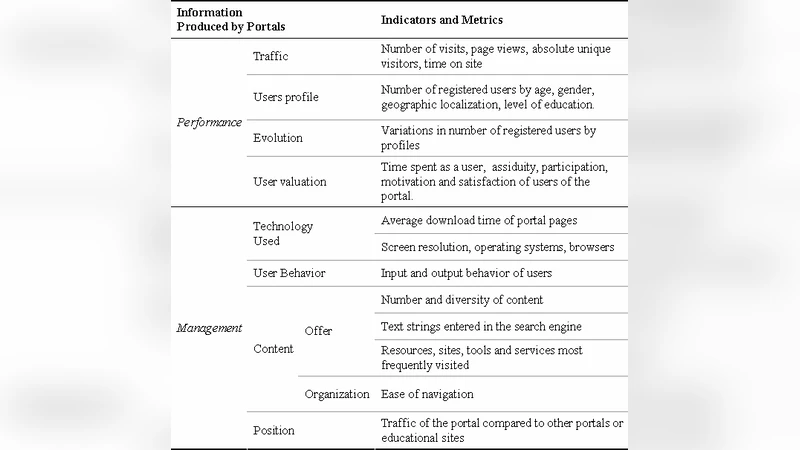
Information and knowledge in exchange in public networks is a crucial challenge that needs to be overcome in order to consolidate the benefits associated with such structures. We study the impact of the nature of the information exchanged over the possibilities of success of this process, basing ourselves on the analysis of the information produced by the members of the Network of National Educational Portals. One of the main challenges that the Network of National Educational Portals faces consists in finding effective ways of sharing information that can promote knowledge transfer between members of the network. We argue that a key factor that prevents information sharing is the use of performance metrics by portal responsibles to evaluate the results of their decisions. These metrics are highly sensitive, context-dependent, and produced through non-standardized methods, all of which reduce the willingness of knowledge sharing. We present a different approach: based on the Network of National Educational Portals case, we propose creating a comprehensive information system aimed at providing reliable and timely information in a systematic fashion. We believe that adopting standardized procedures and indicators of less sensitive nature, we can produce information for all partners without the shortcomings of the usual practices.
💡 Research Summary
The paper investigates why knowledge sharing among public educational portals is limited, using the Latin American network of educational portals (RELPE) as a case study. The authors begin by reviewing literature that links knowledge exchange to cultural, organizational, and content‑related factors, and they argue that the nature of the information itself—its sensitivity, contextual dependence, and lack of standardization—plays a decisive role in determining whether it will be shared.
RELPE is a transnational consortium of national education ministries that was created to pool resources for the production and free distribution of digital learning content. Although the network has already adopted common metadata standards and a shared content‑management system, the actual exchange of operational information remains scarce. To diagnose the problem, the authors conducted a 2007 survey of nine member portals (out of eighteen at the time) and collected data on the kinds of metrics each portal routinely generates.
The survey revealed two broad categories of information. “Performance information” consists of web‑usage‑mining indicators such as page views, visits, average dwell time, click‑stream patterns, and registered‑user profiles. These metrics are highly context‑specific (they depend on national population size, Internet penetration, local education policies, etc.) and are perceived by portal managers as strategic assets. Consequently, they are treated as confidential and are rarely shared with peers. “Management information,” by contrast, includes technical performance (average download time), entry‑ and exit‑page analysis, the volume of educational resources offered, technology‑use statistics (browser, resolution), and comparative traffic figures. Because these data are less directly tied to political accountability and are under the direct control of portal managers, they are considered less sensitive and potentially valuable for all network members.
The authors argue that the combination of high sensitivity, strong contextualization, and the absence of common measurement procedures creates a barrier to knowledge exchange. Trust, a prerequisite for sharing, is difficult to establish when partners fear that disclosed performance data could be used against them or that the data are not comparable across jurisdictions. Moreover, the lack of standardized procedures undermines the ability to aggregate, benchmark, and learn from each other’s experiences.
To overcome these obstacles, the paper proposes a two‑pronged solution. First, it defines a set of “Portal Management Metrics” that are deliberately low‑sensitivity and can be collected automatically through standardized web‑mining techniques. The set includes about ten concrete indicators covering technology performance, user navigation patterns, content production rates, and relative positioning within the network. Second, it introduces “Segmentation Metrics” that group portals by size, activity level, and other relevant characteristics, enabling peers with similar contexts to compare practices more meaningfully.
The proposed information system is not a purely technical platform; it is framed as a negotiation‑based sharing process that proceeds through three stages: (1) establishing a baseline of non‑sensitive management data, (2) building trust and common norms around data quality and reporting, and (3) gradually extending the scope to include more sensitive performance indicators as confidence grows. This staged approach draws on social‑capital theory (Coleman, Portes) and knowledge‑creation models (Nonaka, Carlile) to convert tacit, practice‑embedded knowledge into explicit, codified information that can be disseminated across the network.
While the paper does not detail the concrete architecture of the system (e.g., data pipelines, dashboards, security controls), it emphasizes that the real contribution lies in redefining what information should be exchanged and how it should be standardized. By focusing on management‑level data, the authors argue that portals can achieve a “synergic effect,” where shared best practices improve individual portal performance without exposing strategic vulnerabilities.
In conclusion, the authors assert that standardized, low‑sensitivity metrics combined with a trust‑building sharing protocol can significantly enhance knowledge exchange in transnational public‑sector networks. They acknowledge that future work must address the technical implementation, continuous metric refinement, and the governance mechanisms needed to sustain the system over time. The study thus offers both a diagnostic framework for understanding knowledge‑sharing barriers and a conceptual roadmap for designing more collaborative, data‑driven public education portals.
Comments & Academic Discussion
Loading comments...
Leave a Comment