Iterative Constructions and Private Data Release
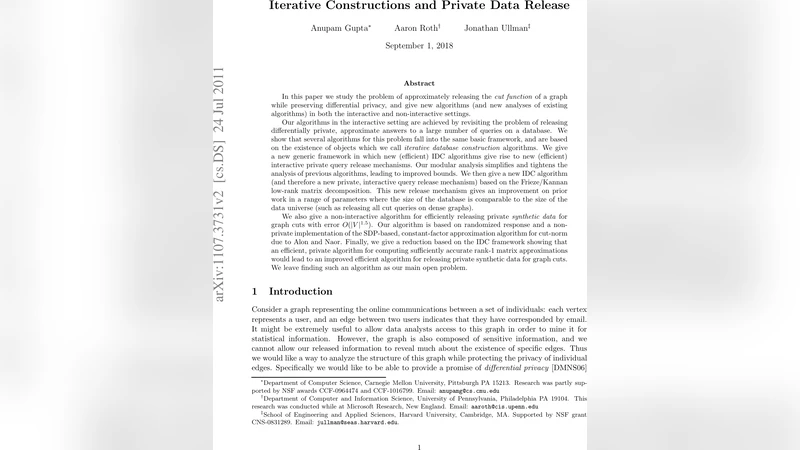
In this paper we study the problem of approximately releasing the cut function of a graph while preserving differential privacy, and give new algorithms (and new analyses of existing algorithms) in both the interactive and non-interactive settings. Our algorithms in the interactive setting are achieved by revisiting the problem of releasing differentially private, approximate answers to a large number of queries on a database. We show that several algorithms for this problem fall into the same basic framework, and are based on the existence of objects which we call iterative database construction algorithms. We give a new generic framework in which new (efficient) IDC algorithms give rise to new (efficient) interactive private query release mechanisms. Our modular analysis simplifies and tightens the analysis of previous algorithms, leading to improved bounds. We then give a new IDC algorithm (and therefore a new private, interactive query release mechanism) based on the Frieze/Kannan low-rank matrix decomposition. This new release mechanism gives an improvement on prior work in a range of parameters where the size of the database is comparable to the size of the data universe (such as releasing all cut queries on dense graphs). We also give a non-interactive algorithm for efficiently releasing private synthetic data for graph cuts with error O(|V|^{1.5}). Our algorithm is based on randomized response and a non-private implementation of the SDP-based, constant-factor approximation algorithm for cut-norm due to Alon and Naor. Finally, we give a reduction based on the IDC framework showing that an efficient, private algorithm for computing sufficiently accurate rank-1 matrix approximations would lead to an improved efficient algorithm for releasing private synthetic data for graph cuts. We leave finding such an algorithm as our main open problem.
💡 Research Summary
The paper addresses the problem of releasing the cut function of a graph under differential privacy (DP), providing new algorithms and analyses for both interactive and non‑interactive settings. The authors observe that many existing private query‑release mechanisms—such as the Median Mechanism, Online Multiplicative Weights, and Offline Multiplicative Weights—share a common structure that can be abstracted as an “Iterative Database Construction” (IDC) process. An IDC maintains a hypothesis database and, whenever a query reveals a significant discrepancy between the hypothesis and the true database, updates the hypothesis using a DP‑protected step (typically adding Laplace noise). By formalizing this abstraction, the paper offers a modular analysis that simplifies and tightens the error bounds of prior work.
A central contribution is a new IDC algorithm based on the Frieze‑Kannan low‑rank matrix decomposition. The adjacency matrix of a graph can be approximated by a sum of a small number of cut matrices; this low‑rank representation allows the IDC to update only a few coefficients rather than the entire data vector. When the database size n is comparable to the universe size |X| (e.g., dense graphs where |E|≈|V|²), the Frieze‑Kannan IDC achieves an error of O(n^{1/4}·(log k)^{1/2}) per query, improving over the O(√n) error of earlier mechanisms. The paper presents a detailed comparison (Table 1) showing that the new bounds dominate previous ones for the regime of interest.
In the non‑interactive setting, the authors construct a private synthetic graph that approximates all cut queries with error O(|V|^{1.5}). The construction proceeds in three stages: (1) apply randomized response to each edge to obtain an ε‑DP noisy adjacency matrix; (2) use the Alon‑Naor SDP‑based constant‑factor approximation for the cut‑norm (run without privacy constraints) to find a feasible solution that respects the noisy constraints; (3) invoke the linear‑constraint synthetic data generation technique of Barak et al. and Dwork et al. to convert the feasible solution into an explicit synthetic graph. This yields a synthetic dataset whose cut answers are within the stated error bound and can be generated in time polynomial in |V|².
Finally, the paper establishes a reduction from the problem of privately computing accurate rank‑1 matrix approximations to the problem of privately releasing synthetic cut data. If an efficient (ε,δ)‑DP algorithm could output a sufficiently accurate rank‑1 approximation of any symmetric matrix, then, via the IDC framework, one could obtain a private synthetic graph with substantially better error guarantees than O(|V|^{1.5}). The existence of such an algorithm remains an open question and is highlighted as the main direction for future work.
Overall, the work unifies several private query‑release mechanisms under a single IDC paradigm, introduces a novel low‑rank‑based IDC that excels for dense graphs, provides a practical non‑interactive synthetic data method, and connects matrix approximation to private data release, thereby advancing both the theory and practice of differential privacy for graph analytics.
Comments & Academic Discussion
Loading comments...
Leave a Comment