Recovering Compressively Sampled Signals Using Partial Support Information
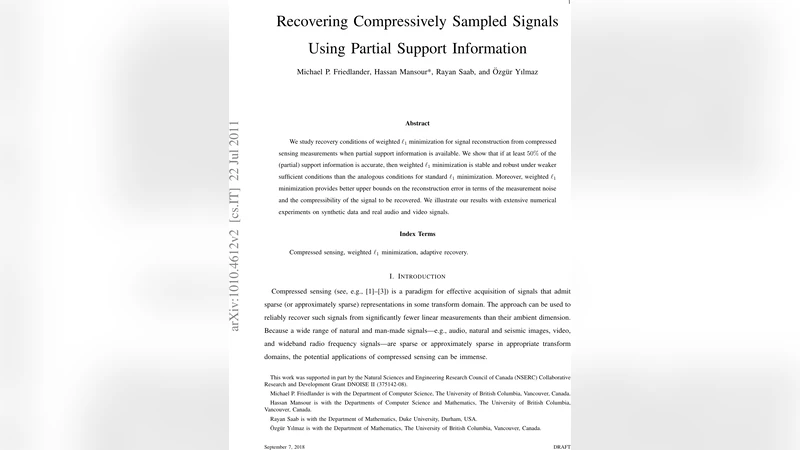
In this paper we study recovery conditions of weighted $\ell_1$ minimization for signal reconstruction from compressed sensing measurements when partial support information is available. We show that if at least 50% of the (partial) support information is accurate, then weighted $\ell_1$ minimization is stable and robust under weaker conditions than the analogous conditions for standard $\ell_1$ minimization. Moreover, weighted $\ell_1$ minimization provides better bounds on the reconstruction error in terms of the measurement noise and the compressibility of the signal to be recovered. We illustrate our results with extensive numerical experiments on synthetic data and real audio and video signals.
💡 Research Summary
The paper investigates the recovery guarantees of weighted ℓ₁ minimization when partial support information about a sparse signal is available. The authors consider the standard compressed sensing model y = Φx + e, where x ∈ ℝⁿ is k‑sparse (or compressible), Φ ∈ ℝ^{m×n} is the measurement matrix, and e denotes measurement noise. In many practical scenarios a prior estimate of the support, denoted by (\widehat{T}), can be obtained (for example from previous frames in video, from anatomical priors in medical imaging, or from a coarse reconstruction). The quality of this estimate is measured by the accuracy parameter α = |T ∩ (\widehat{T})| / |T|, i.e., the fraction of true support indices that are correctly identified.
The authors formulate a weighted ℓ₁ minimization problem:
\
Comments & Academic Discussion
Loading comments...
Leave a Comment