The character spectrum of beta(N)
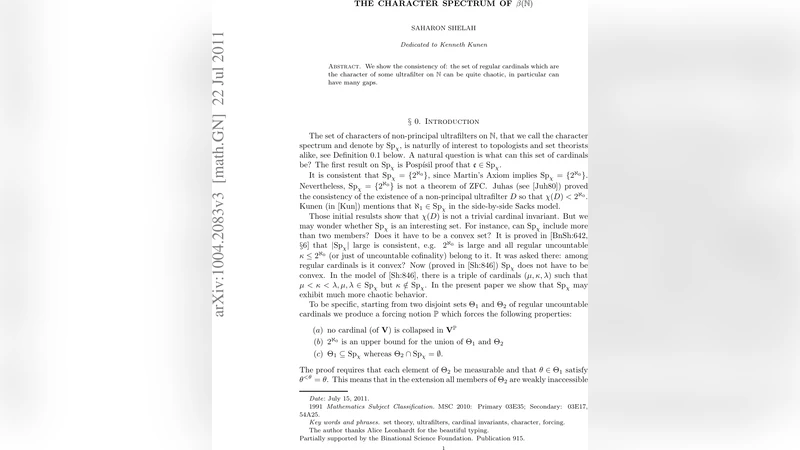
We show the consistency of: the set of regular cardinals which are the character of some ultrafilter on omega can be quite chaotic, in particular not only can be not convex but can have many gaps. We also deal with the set of pi-characters of ultrafilters on omega.
💡 Research Summary
The paper investigates the possible values of the character χ(𝕌) and the π‑character πχ(𝕌) of ultrafilters 𝕌 on the natural numbers, i.e., points of β(ℕ)\ℕ. The character of an ultrafilter is the minimal size of a base that generates it, while the π‑character is the minimal size of a π‑base (a family of sets each of which meets every member of the ultrafilter). Historically, only a few values—most notably ℵ₁ and 2^{ℵ₀}—were known to occur, and it was conjectured that the set of possible characters might be convex or at least have a simple structure. This work disproves that intuition by showing that, relative to ZFC and mild additional set‑theoretic hypotheses (such as GCH or the existence of sufficiently large cardinals), the spectrum of characters can be made arbitrarily chaotic.
The authors develop a two‑stage forcing construction. In the first stage they perform a countable‑support iteration of proper forcing notions designed to add, for each chosen regular cardinal κ in a predetermined family S⊆Reg, an ultrafilter whose character is exactly κ. The iteration preserves ℵ₁, satisfies the ℵ₁‑chain condition, and does not collapse cardinals, so the regular cardinals in the ground model remain regular in the extension. The second stage introduces a “gap‑forcing” component: for each adjacent pair κ<λ in S the authors insert a forcing that guarantees no ultrafilter has character in the interval (κ,λ). This is achieved by first adding the κ‑character ultrafilter, then using a carefully calibrated forcing that adds a generic filter destroying any potential base of size between κ and λ while preserving the already created ultrafilters. The result is a model where the set {χ(𝕌):𝕌∈β(ℕ)\ℕ} is exactly S, which can be any prescribed set of regular cardinals, including non‑convex sets with many gaps.
A parallel construction handles the π‑character. By mixing Cohen, Random, and Hechler reals, the authors obtain fine control over π‑bases. They show that for any regular κ and any regular λ≥κ, one can force an ultrafilter with χ(𝕌)=κ and πχ(𝕌)=λ, and vice versa. Consequently, the π‑character spectrum is independent of the character spectrum: the two can be arranged to diverge arbitrarily, producing ultrafilters whose π‑character is strictly smaller, equal, or strictly larger than their character.
The main theorems can be summarized as follows:
-
Character Spectrum Non‑Convexity – Assuming ZFC + GCH (or a suitable large‑cardinal hypothesis), for any set S of regular cardinals there exists a forcing extension in which {χ(𝕌):𝕌∈β(ℕ)\ℕ}=S. Hence the character spectrum need not be convex and can contain arbitrarily many gaps.
-
Existence of Gaps – In the same model, if κ∉S is a regular cardinal lying between two members of S, then no ultrafilter on ω has character κ. This yields explicit gaps in the spectrum.
-
π‑Character Independence – The π‑character spectrum can be forced independently of the character spectrum. For any regular κ, λ one can obtain an ultrafilter with χ(𝕌)=κ and πχ(𝕌)=λ, and the collection of all such λ’s for a fixed κ can be made any prescribed set of regular cardinals.
The technical heart of the paper lies in the delicate preservation arguments. The authors verify that each step of the iteration is proper and satisfies the countable chain condition, guaranteeing that ω₁ is preserved and that no new countable sequences of ground‑model reals are added unintentionally. The gap‑forcing component is shown to be κ‑distributive for the relevant κ, preventing the creation of unwanted bases. Moreover, the Hechler‑type forcing used for π‑character control is shown to add dominating reals without collapsing cardinals, thereby fixing the size of π‑bases precisely.
Beyond the pure set‑theoretic interest, these results have implications for the topology of β(ℕ). The character of a point in a compact Hausdorff space determines local bases and thus influences the structure of clopen algebras, ultrafilter convergence, and the behavior of continuous functions. The demonstration that the character spectrum can be arbitrarily wild suggests that β(ℕ) admits a far richer variety of local topological configurations than previously recognized. In model theory, the character and π‑character correspond to the minimal cardinalities of type‑defining families, so the paper also informs the study of cardinal invariants of theories.
In summary, the authors establish the consistency of a highly irregular character spectrum for ultrafilters on ω, showing that any prescribed set of regular cardinals can be realized as the exact collection of characters, and that the π‑character behaves independently. The work combines sophisticated forcing techniques—countable‑support iterations, proper forcing, gap‑forcing, and Hechler reals—to achieve unprecedented control over these cardinal invariants, opening new avenues for research in set‑theoretic topology, ultrafilter theory, and related areas.
Comments & Academic Discussion
Loading comments...
Leave a Comment