Packing 3-vertex paths in claw-free graphs and related topics
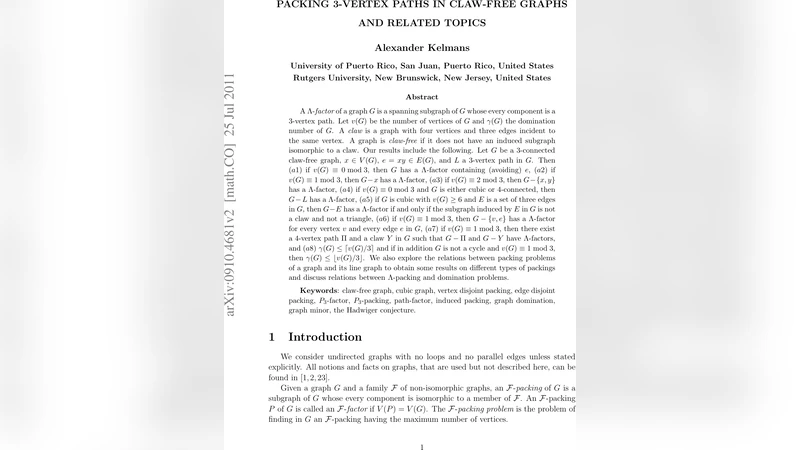
An L-factor of a graph G is a spanning subgraph of G whose every component is a 3-vertex path. Let v(G) be the number of vertices of G and d(G) the domination number of G. A claw is a graph with four vertices and three edges incident to the same vertex. A graph is claw-free if it has no induced subgraph isomorphic to a claw. Our results include the following. Let G be a 3-connected claw-free graph, x a vertex in G, e = xy an edge in G, and P a 3-vertex path in G. Then (a1) if v(G) = 0 mod 3, then G has an L-factor containing (avoiding) e, (a2) if v(G) = 1 mod 3, then G - x has an L-factor, (a3) if v(G) = 2 mod 3, then G - {x,y} has an L-factor, (a4) if v(G) = 0 mod 3 and G is either cubic or 4-connected, then G - P has an L-factor, (a5) if G is cubic with v(G) > 5 and E is a set of three edges in G, then G - E has an L-factor if and only if the subgraph induced by E in G is not a claw and not a triangle, (a6) if v(G) = 1 mod 3, then G - {v,e} has an L-factor for every vertex v and every edge e in G, (a7) if v(G) = 1 mod 3, then there exist a 4-vertex path N and a claw Y in G such that G - N and G - Y have L-factors, and (a8) d(G) < v(G)/3 +1 and if in addition G is not a cycle and v(G) = 1 mod 3, then d(G) < v(G)/3. We explore the relations between packing problems of a graph and its line graph to obtain some results on different types of packings. We also discuss relations between L-packing and domination problems as well as between induced L-packings and the Hadwiger conjecture. Keywords: claw-free graph, cubic graph, vertex disjoint packing, edge disjoint packing, 3-vertex factor, 3-vertex packing, path-factor, induced packing, graph domination, graph minor, the Hadwiger conjecture.
💡 Research Summary
The paper investigates spanning subgraphs whose components are all 3‑vertex paths, called L‑factors, in the class of 3‑connected claw‑free graphs. By exploiting the structural restrictions imposed by the absence of an induced K1,3 (a claw), the authors obtain a comprehensive set of existence theorems that cover all possible residues of the vertex count modulo 3, as well as several stronger results for special subclasses such as cubic (3‑regular) and 4‑connected graphs.
The first group of results (a1–a3) establishes a “mod‑3” framework. If the order v(G) is a multiple of three, then for any edge e the graph contains an L‑factor that either includes or avoids e. When v(G) ≡ 1 (mod 3), deleting any single vertex x yields a graph G−x that admits an L‑factor; when v(G) ≡ 2 (mod 3), deleting a pair of vertices {x, y} (not necessarily adjacent) produces a graph with an L‑factor. These statements show that the only obstruction to an L‑factor is the parity condition on the number of vertices, and that 3‑connectivity guarantees enough redundancy to recover a perfect 3‑path packing after the removal of a small set of vertices.
The second set of theorems (a4) strengthens the above for cubic or 4‑connected claw‑free graphs. In these cases, even after removing an arbitrary 3‑vertex path P, the remaining graph still possesses an L‑factor. This demonstrates a remarkable robustness: the highly regular structure of cubic claw‑free graphs (and the additional connectivity in the 4‑connected case) prevents a single path deletion from breaking the 3‑path factorability.
Result (a5) gives a precise characterization for cubic claw‑free graphs when three edges are removed simultaneously. The graph G−E has an L‑factor if and only if the three edges do not induce a claw or a triangle. This “if and only if” condition pinpoints the minimal forbidden configurations for L‑factor preservation in the cubic setting, linking the problem to classic cut‑set concepts.
The next two statements (a6, a7) address the case v(G) ≡ 1 (mod 3) in a more refined way. (a6) asserts that for any vertex v and any edge e, the graph G−{v, e} still contains an L‑factor, showing that the removal of a vertex together with an unrelated edge never destroys the packing. (a7) goes further by guaranteeing the existence of a 4‑vertex path N and a claw Y such that deleting either N or Y leaves an L‑factor. Thus even the deletion of a small induced claw, which is the only forbidden induced subgraph for the class, does not prevent a perfect 3‑path packing.
Result (a8) connects L‑factorability with domination. It proves that every 3‑connected claw‑free graph satisfies d(G) < v(G)/3 + 1, and if the graph is not a simple cycle and v(G) ≡ 1 (mod 3) then the stronger bound d(G) < v(G)/3 holds. Since an L‑factor partitions the vertex set into triples, any dominating set must intersect each triple, yielding the bound. The authors thus provide a new quantitative link between packing and domination in this graph family.
Beyond these core theorems, the paper explores several auxiliary themes. By passing to the line graph L(G), the authors translate L‑factor problems into matching problems, exploiting the fact that in a claw‑free graph the line graph inherits a simplified structure (no induced claws, limited triangles). This perspective yields alternative proofs and suggests algorithmic approaches based on matching algorithms. The authors also discuss induced L‑packings (where the 3‑vertex paths must be induced subgraphs) and relate them to the Hadwiger conjecture. They show that in claw‑free graphs, the existence of large complete minors imposes constraints on induced L‑packings, offering a novel bridge between minor theory and path‑factor problems.
Overall, the paper delivers a thorough treatment of 3‑vertex path packings in claw‑free graphs, delivering exact existence criteria, robustness under deletions, precise forbidden configurations for cubic graphs, and quantitative domination bounds. The results deepen the understanding of how the claw‑free condition interacts with connectivity and regularity to guarantee rich factorisations, and they open avenues for algorithmic exploitation (via line‑graph matchings) and for further theoretical connections to domination theory and graph minors.
Comments & Academic Discussion
Loading comments...
Leave a Comment