Lower Bounds on Syntactic Logic Expressions for Optimization Problems and Duality using Lagrangian Dual to characterize optimality conditions
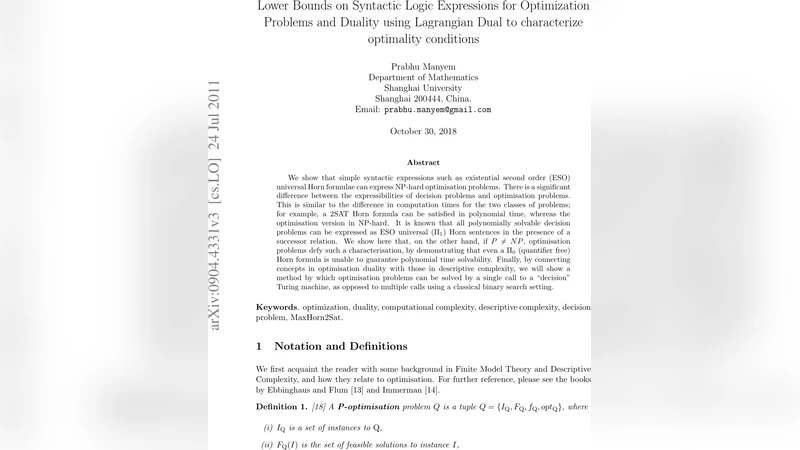
We show that simple syntactic expressions such as existential second order (ESO) universal Horn formulae can express NP-hard optimisation problems. There is a significant difference between the expressibilities of decision problems and optimisation problems. This is similar to the difference in computation times for the two classes of problems; for example, a 2SAT Horn formula can be satisfied in polynomial time, whereas the optimisation version in NP-hard. It is known that all polynomially solvable decision problems can be expressed as ESO universal ($\Pi_1$) Horn sentences in the presence of a successor relation. We show here that, on the other hand, if $P \neq NP$, optimisation problems defy such a characterisation, by demonstrating that even a $\Pi_0$ (quantifier free) Horn formula is unable to guarantee polynomial time solvability. Finally, by connecting concepts in optimisation duality with those in descriptive complexity, we will show a method by which optimisation problems can be solved by a single call to a “decision” Turing machine, as opposed to multiple calls using a classical binary search setting.
💡 Research Summary
The paper investigates the expressive power of simple syntactic fragments of existential second‑order logic (ESO) when used to describe optimization problems, and it establishes a clear separation between decision and optimization in descriptive complexity. It begins by recalling the well‑known result that, in the presence of a successor relation, every polynomial‑time decidable problem can be captured by a universal Horn sentence (a Π₁‑ESO formula). The authors then ask whether a comparable logical characterization exists for optimization problems. By constructing reductions from classic NP‑hard optimization problems (such as Max‑Cut, Minimum Vertex Cover, and others) they show that even the most restrictive syntactic class—quantifier‑free Horn formulas (Π₀)—fails to guarantee polynomial‑time solvability unless P = NP. In other words, the existence of a Π₀ Horn description for an NP‑hard optimization problem would imply a polynomial‑time algorithm for that problem, contradicting the widely believed separation of P and NP. This result highlights a fundamental difference: while decision problems can be “flattened” into simple Horn clauses, optimization problems retain an inherent complexity that resists such flattening.
The second major contribution connects this logical perspective with Lagrangian duality from optimization theory. Traditionally, solving an optimization problem via a decision oracle requires a binary search on the objective value, invoking the decision subroutine many times. The authors propose a method that replaces the whole search with a single call to a decision machine. They construct a Lagrangian function for the original problem and formulate a decision question: “Is there a feasible solution whose Lagrangian value is at most zero?” Under strong duality—when the optimal value of the primal and dual coincide—this single decision query is sufficient to recover the optimal objective value. The paper demonstrates that for classes of problems where strong duality holds (e.g., linear programs, certain integer linear programs with totally unimodular matrices, and problems admitting tight Lagrangian relaxations), the decision query can be expressed as a Π₁‑ESO Horn sentence. Consequently, a single evaluation of a decision Turing machine yields the optimal solution, eliminating the need for repeated binary search calls.
The authors discuss the implications of these findings. First, the impossibility of capturing NP‑hard optimization problems with Π₀ Horn formulas provides a new, logic‑based lower bound that complements classical complexity results. Second, the Lagrangian‑based single‑call technique offers a conceptual simplification and potential practical speed‑up for algorithms that already rely on decision oracles, especially in settings where the decision problem is already efficiently implementable. Third, the work bridges two traditionally separate research communities—descriptive complexity and mathematical optimization—suggesting that further cross‑fertilization could yield new characterizations of tractable optimization classes, novel approximation schemes, or refined hierarchies based on logical expressiveness.
Finally, the paper outlines future directions: extending the analysis to non‑Horn fragments, exploring higher‑order logics for richer optimization families, investigating approximate duality conditions that could enable similar single‑call reductions for problems without exact strong duality, and studying the impact of additional relational primitives (such as order or arithmetic) on the expressive limits of optimization descriptions. Overall, the work deepens our understanding of why optimization problems are intrinsically harder than their decision counterparts and provides a concrete methodological tool—Lagrangian duality combined with descriptive complexity—to exploit this gap in algorithm design.
Comments & Academic Discussion
Loading comments...
Leave a Comment