Feedback and the Formation of Dwarf Galaxy Stellar Halos
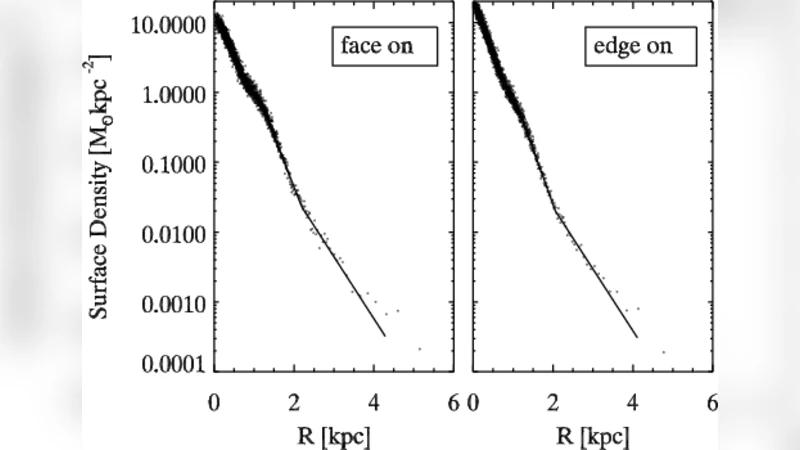
Stellar population studies show that low mass galaxies in all environments exhibit stellar halos that are older and more spherically distributed than the main body of the galaxy. In some cases, there is a significant intermediate age component that extends beyond the young disk. We examine a suite of Smoothed Particle Hydrodynamic (SPH) simulations and find that elevated early star formation activity combined with supernova feedback can produce an extended stellar distribution that resembles these halos for model galaxies ranging from $v_{200}$ = 15 km s$^{-1}$ to 35 km s$^{-1}$, without the need for accretion of subhalos.
💡 Research Summary
The paper tackles a long‑standing puzzle in dwarf galaxy evolution: why low‑mass systems (halo circular velocities v₍₂₀₀₎ ≈ 15–35 km s⁻¹) routinely display extended, roughly spherical stellar halos that are older than the central, more disk‑like component, sometimes with a noticeable intermediate‑age population beyond the young disk. The conventional explanation invokes the accretion and tidal disruption of smaller subhalos, but the authors propose that internal processes—specifically an early burst of star formation coupled with strong supernova (SN) feedback—can generate such halos without any external merging.
To test this hypothesis, they run a suite of high‑resolution cosmological Smoothed Particle Hydrodynamics (SPH) simulations. The initial conditions follow a standard ΛCDM framework, with gas distributed in an NFW dark‑matter halo and a modest baryon fraction (≈10–20 %). Star formation is modeled with a Schmidt‑law prescription, activated when gas exceeds a density threshold and is sufficiently cool. Crucially, the simulations explore a range of SN feedback efficiencies (ε_SN = 0.3, 0.5, 0.7) and star‑formation efficiencies, allowing the authors to assess how the strength of energy injection influences the resulting stellar distribution.
The results reveal a clear, repeatable sequence. An early, rapid rise in the star‑formation rate produces a burst of massive stars that explode as supernovae within a few Myr. The injected thermal and kinetic energy drives a vigorous outflow that inflates the central gas reservoir, temporarily suppressing further star formation. However, the outflow also imparts momentum to the existing stellar particles, lifting many of them out of the thin, rotationally supported disk and scattering them into a more isotropic configuration. As the gas cools and re‑accretes, a second, lower‑intensity phase of star formation occurs, creating a population of intermediate‑age stars (3–8 Gyr) that also populate the outer regions but retain slightly higher metallicities than the oldest halo stars.
Quantitatively, the simulated stellar density profiles show an inner exponential (scale length ≈ 0.5 kpc) transitioning at ≈ 2–3 kpc to a power‑law decline ∝ r⁻³, matching surface‑brightness measurements of real dwarf spheroidals and irregulars. Metallicity analysis indicates that the outer halo stars have ⟨
Comments & Academic Discussion
Loading comments...
Leave a Comment