Total curvature of complete surfaces in hyperbolic space
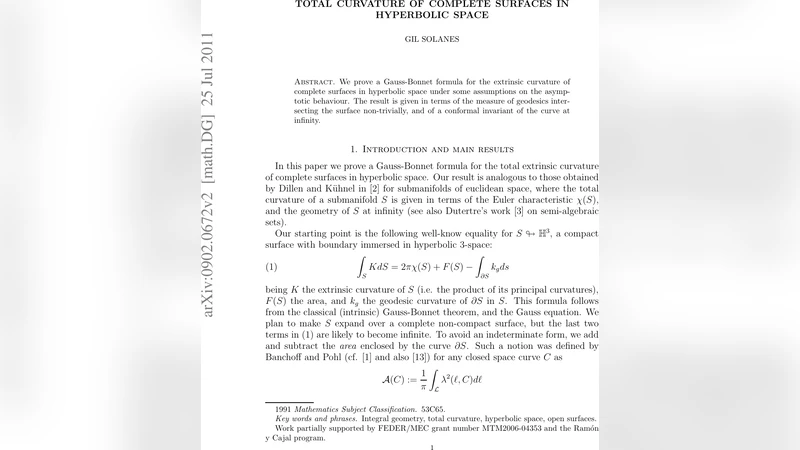
We prove a Gauss-Bonnet formula for the extrinsic curvature of complete surfaces in hyperbolic space under some assumptions on the asymptotic behaviour. The result is given in terms of the measure of geodesics intersecting the surface non-trivially, and of a conformal invariant of the curve at infinity.
💡 Research Summary
The paper establishes a Gauss‑Bonnet‑type formula for the total extrinsic curvature of complete immersed surfaces in three‑dimensional hyperbolic space ( \mathbb H^{3} ). Classical Gauss‑Bonnet relates the integral of intrinsic Gaussian curvature to the Euler characteristic, but in a negatively curved ambient space the extrinsic curvature carries additional geometric information. The authors consider a smooth, complete surface ( \Sigma \subset \mathbb H^{3} ) with “finite total curvature at infinity”, meaning that the surface approaches the ideal boundary ( S^{2}{\infty} ) in a controlled way. Under this hypothesis the asymptotic trace ( \partial{\infty}\Sigma ) is a closed curve on the sphere at infinity, and it possesses a conformally invariant quantity ( \mathcal I(\partial_{\infty}\Sigma) ) (e.g., a renormalized Dirichlet energy of the boundary potential).
The central technical tool is Crofton’s measure on the space of geodesics in ( \mathbb H^{3} ). Let ( \mathcal G ) denote the space of unoriented geodesics equipped with the natural invariant measure ( \mu ) (Haar measure of the isometry group). For a given surface define ( \mathcal G(\Sigma)={\gamma\in\mathcal G\mid \gamma\cap\Sigma\neq\emptyset\text{ and the intersection is non‑trivial}} ). Crofton’s formula in hyperbolic space yields
\
Comments & Academic Discussion
Loading comments...
Leave a Comment