Finding Deceptive Opinion Spam by Any Stretch of the Imagination
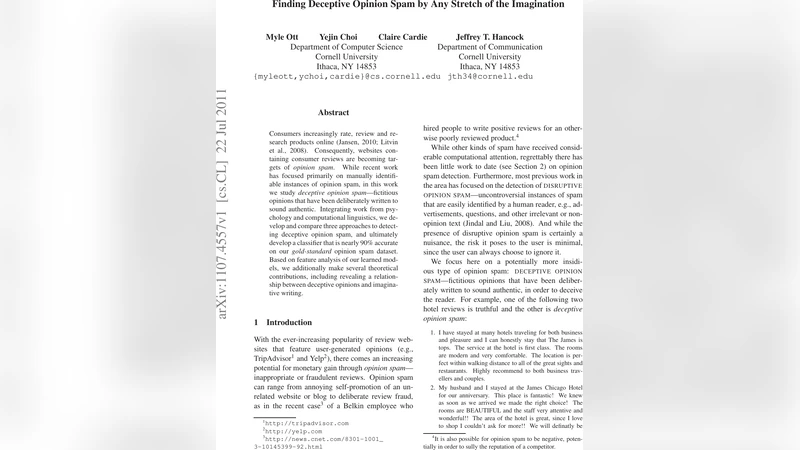
Consumers increasingly rate, review and research products online. Consequently, websites containing consumer reviews are becoming targets of opinion spam. While recent work has focused primarily on manually identifiable instances of opinion spam, in this work we study deceptive opinion spam—fictitious opinions that have been deliberately written to sound authentic. Integrating work from psychology and computational linguistics, we develop and compare three approaches to detecting deceptive opinion spam, and ultimately develop a classifier that is nearly 90% accurate on our gold-standard opinion spam dataset. Based on feature analysis of our learned models, we additionally make several theoretical contributions, including revealing a relationship between deceptive opinions and imaginative writing.
💡 Research Summary
The paper tackles the problem of detecting deceptive opinion spam—fabricated reviews that are intentionally written to appear authentic. Unlike prior work that focused on easily identifiable spam (e.g., advertisements, duplicate reviews), this study concentrates on the more insidious form of spam that fools human readers. The authors propose three complementary modeling perspectives: (a) a standard text‑classification approach using n‑gram features (unigrams, bigrams, trigrams) fed into linear classifiers such as SVM or logistic regression; (b) a psycholinguistic approach that incorporates linguistic cues known from deception research, including the frequency of negations, affective word usage, reduced self‑referencing, and other LIWC‑derived metrics; and (c) a genre‑identification perspective that treats deceptive reviews as a “imaginative” genre and truthful reviews as an “informative” genre, extracting genre‑specific lexical and syntactic patterns (e.g., exaggerated adjectives, exclamation marks, metaphorical language).
To evaluate these approaches, the authors construct the first publicly available gold‑standard dataset for deceptive opinion spam. They collect 400 truthful hotel reviews from TripAdvisor (5‑star, popular Chicago hotels) and 400 deceptive reviews generated via Amazon Mechanical Turk. Turkers were instructed to assume the role of a hotel marketing employee and write a positive but fake review. Quality control involved filtering out submissions that were too short, plagiarized, or off‑topic, and ensuring a realistic distribution of length and writing time. The final dataset contains 800 reviews (balanced between truthful and deceptive) with comparable length distributions.
Human performance is measured using three undergraduate volunteers who labeled a subset of 160 reviews (four hotels). The judges achieved an average accuracy of only 58%, displaying a strong “truth bias” (tending to label reviews as truthful). Meta‑judges based on majority vote or a skeptical rule (any judge flags as deceptive) performed only marginally better, confirming that humans are poor at this task.
Automatic classification experiments employ 10‑fold cross‑validation. The pure n‑gram model reaches about 84% accuracy (F1 ≈ 0.86). Models using only psycholinguistic features or only genre features achieve lower accuracies (≈78% and ≈76% respectively). However, a hybrid model that combines n‑gram and psycholinguistic features attains 89.5% accuracy and an F1 score of 0.92, a statistically significant improvement over the baselines and far superior to human judges. Feature‑weight analysis reveals that deceptive reviews heavily employ exaggerated positive adjectives (“fantastic”, “beautiful”, “wonderful”), exclamation marks, and other imaginative language, whereas truthful reviews contain more concrete, service‑oriented descriptions. This finding challenges earlier deception literature that emphasized emotional suppression in liars; instead, deceptive opinion spam appears to deliberately amplify positive affect to persuade readers.
The paper’s contributions are fourfold: (1) creation and public release of a large, balanced dataset of deceptive and truthful hotel reviews; (2) systematic comparison of three detection paradigms, demonstrating that a combined n‑gram + psycholinguistic model yields near‑90% accuracy; (3) empirical evidence that human judges perform near chance on this task, underscoring the need for automated methods; and (4) theoretical insight linking deceptive opinion spam to imaginative writing, suggesting a novel genre‑based framing of deception detection.
Limitations include the domain specificity (hotel reviews only), potential differences between Turker‑generated fake reviews and real‑world spam authored by professional writers, and reliance on relatively shallow feature engineering. Future work could expand the dataset to other product categories, explore deep neural language models (e.g., BERT, GPT) for automatic feature extraction, and investigate human‑machine collaborative systems for real‑time spam detection. Overall, the study provides a solid methodological foundation and compelling empirical results that advance the state of deceptive opinion spam detection.
Comments & Academic Discussion
Loading comments...
Leave a Comment