Timing and spectral study of XB 1254-690 using new RXTE PCA data
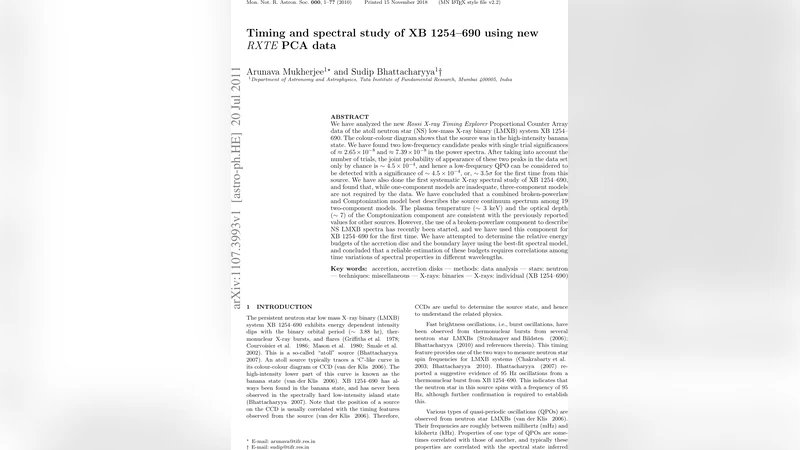
We have analyzed the new Rossi X-ray Timing Explorer Proportional Counter Array data of the atoll neutron star (NS) low-mass X-ray binary (LMXB) system XB 1254-690. The colour-colour diagram shows that the source was in the high-intensity banana state. We have found two low-frequency candidate peaks with single trial significances of ~ 2.65 X 10^{-8} and ~ 7.39 X 10^{-8} in the power spectra. After taking into account the number of trials, the joint probability of appearance of these two peaks in the data set only by chance is ~ 4.5 X 10^{-4}, and hence a low-frequency QPO can be considered to be detected with a significance of ~ 4.5 X 10^{-4}, or, ~ 3.5\sigma for the first time from this source. We have also done the first systematic X-ray spectral study of XB 1254-690, and found that, while one-component models are inadequate, three-component models are not required by the data. We have concluded that a combined broken-powerlaw and Comptonization model best describes the source continuum spectrum among 19 two-component models. The plasma temperature (~ 3 keV) and the optical depth (~ 7) of the Comptonization component are consistent with the previously reported values for other sources. However, the use of a broken-powerlaw component to describe NS LMXB spectra has recently been started, and we have used this component for XB 1254-690 for the first time. We have attempted to determine the relative energy budgets of the accretion disc and the boundary layer using the best-fit spectral model, and concluded that a reliable estimation of these budgets requires correlations among time variations of spectral properties in different wavelengths.
💡 Research Summary
This paper presents a comprehensive timing and spectral analysis of the atoll-type neutron‑star low‑mass X‑ray binary XB 1254‑690 using Rossi X‑ray Timing Explorer (RXTE) Proportional Counter Array (PCA) observations obtained between 16 January and 13 March 2008. The total exposure is 283 ks (good time 257 ks). The authors first construct colour‑colour (CCD) and hardness‑intensity (HID) diagrams using PCU2 data. Both diagrams show that the source remained in the high‑intensity “banana” branch throughout the observations, confirming previous reports that XB 1254‑690 never visits the low‑intensity island state.
Timing analysis
Good Xenon mode data were divided into 250 s segments and power spectra were computed up to a Nyquist frequency of 128 Hz. Two low‑frequency quasi‑periodic oscillation (QPO) candidates were identified: a stronger peak at 64.01 Hz (rms ≈ 0.83 %) and a weaker one at 48.63 Hz (rms ≈ 1.3 %). The single‑trial probabilities, derived from the χ² distribution with 320 degrees of freedom, are 2.65 × 10⁻⁸ and 7.39 × 10⁻⁸ respectively. Accounting for the total number of trials (60 spectra × 8000 frequencies = 4.8 × 10⁵) reduces the significance to ≈2.5σ for the stronger peak and ≈3.5σ for the weaker one. By treating the two detections as independent events, the joint probability of both arising by chance is ≈4.5 × 10⁻⁴, i.e. a ≈3.5σ detection. This constitutes the first reported QPO from XB 1254‑690. Both QPOs appear when the source is in the lower‑banana part of the CCD, suggesting a link between spectral state and low‑frequency variability.
Spectral analysis
Standard‑2 data from the same PCU2 were used to fit the 2.5–18 keV continuum. The authors systematically tested 19 two‑component models built from the following building blocks: blackbody (bbody), multicolour disc blackbody (diskbb), thermal Comptonisation (comptt), power‑law, cutoff power‑law, and broken power‑law (bknpower). Single‑component models (e.g., cutoffpl) gave poor fits (χ²ν ≈ 3.23 for 33 dof). Among the two‑component models, the combination of a broken power‑law plus a thermal Comptonisation component (bknpower + comptt) provided the best description (χ²ν ≈ 1.02 for 31 dof). The comptt parameters are electron temperature kTₑ ≈ 3 keV and optical depth τ ≈ 7, values consistent with those found in other neutron‑star LMXBs. The broken‑power‑law component, introduced here for a neutron‑star system for the first time, likely approximates a complex Comptonisation spectrum or a mixture of Comptonised and non‑thermal emission.
Energy budget considerations
Using the best‑fit model, the authors attempted to separate the contributions of the accretion disc and the boundary layer. However, the degeneracy between model components prevents a robust estimate from a single X‑ray band alone. They argue that simultaneous multi‑wavelength monitoring (optical/UV/IR) of spectral variability is required to break this degeneracy and to quantify the relative energy release in the disc versus the boundary layer.
Conclusions
- The detection of two low‑frequency QPOs (≈50–65 Hz) with a joint significance of ~3.5σ represents the first QPO discovery in XB 1254‑690.
- A systematic spectral survey shows that a broken power‑law plus thermal Comptonisation model best reproduces the 2.5–18 keV continuum, with plasma parameters (kTₑ ≈ 3 keV, τ ≈ 7) in line with other atoll sources.
- The broken‑power‑law component, though phenomenological, provides a useful empirical description of complex high‑energy curvature in neutron‑star LMXBs.
- Determining the disc‑boundary‑layer energy budget demands coordinated, time‑resolved, multi‑band observations.
Overall, the paper advances our understanding of the timing behaviour and spectral composition of XB 1254‑690, introduces a novel phenomenological model component for neutron‑star binaries, and outlines the observational steps needed to disentangle the energetics of the accretion flow.
Comments & Academic Discussion
Loading comments...
Leave a Comment