The use of statistical methods for the search for new physics at the LHC (in Russian)
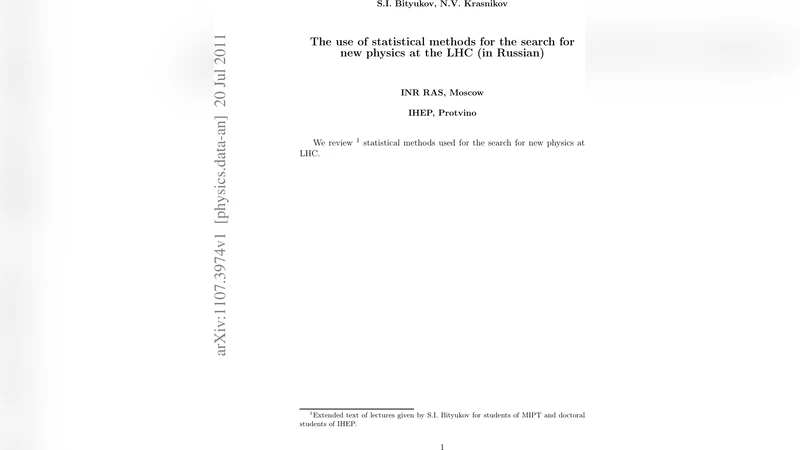
We review statistical methods used for the search for new physics at LHC.
💡 Research Summary
**
The manuscript “The use of statistical methods for the search for new physics at the LHC” is a comprehensive lecture‑style review aimed at graduate students, post‑doctoral researchers, and analysts working on the CMS and ATLAS experiments. It is written in Russian but the content is presented here in English. The authors, S.I. Bityukov and N.V. Krasnikov, organize the material into seven chapters that progress from the fundamentals of probability theory to the practical implementation of statistical tools in high‑energy physics (HEP) data analysis.
Chapter 1 – Foundations of Probability
The first chapter introduces the Kolmogorov axioms, conditional probability, Bayes’ theorem, random variables, probability density functions (PDFs), cumulative distribution functions (CDFs), and characteristic functions. The exposition uses intuitive examples such as coin tossing and drawing balls from an urn to illustrate discrete and continuous probability concepts. This groundwork is essential for later sections where more sophisticated statistical models are built.
Chapter 2 – Core Statistical Paradigms
Chapter 2 contrasts the frequentist and Bayesian approaches. In the frequentist subsection the authors discuss confidence intervals, the construction of upper limits for Poisson‑distributed counts, and the concept of expected limits (often denoted CLs in LHC analyses). The Bayesian subsection explains prior distributions, posterior inference, and credible intervals, emphasizing how the choice of prior influences the final result. Numerical illustrations show how both paradigms are applied to typical LHC counting experiments.
Chapter 3 – Parameter Estimation
Maximum‑likelihood estimation (MLE) is presented as the central frequentist tool. The authors derive the likelihood function for signal‑plus‑background models, introduce the profile‑likelihood ratio as a test statistic, and discuss its asymptotic chi‑square behavior (Wilks’ theorem). The chapter also covers the Fisher information matrix, the construction of confidence regions for multi‑parameter problems, and the treatment of nuisance parameters.
Chapter 4 – Systematic Uncertainties
Systematics are treated in depth. The authors describe three main strategies: (i) treating background normalisation as an auxiliary measurement, (ii) incorporating nuisance parameters directly into the likelihood with constraint terms (Gaussian, log‑normal, etc.), and (iii) the Kuzins‑Hayland averaging method for correlated systematics. Detailed examples show how to propagate detector‑related uncertainties (energy scale, resolution) into the final signal strength estimate.
Chapter 5 – Hypothesis Testing
The fifth chapter focuses on testing the null hypothesis “no new physics” against the alternative “signal present”. It reviews p‑value computation, the Neyman‑Pearson lemma, the construction of test statistics such as q0 (background‑only) and qμ (signal‑plus‑background), and the use of the CLs method to avoid exclusion of signal models with low sensitivity. The “look‑elsewhere effect” is explained, together with techniques (trials factor, global p‑value) to correct for scanning over multiple mass hypotheses. Bayesian model comparison via Bayes factors is also presented.
Chapter 6 – Combination of Results
Combining measurements from different channels, experiments, or even different colliders is essential for increasing sensitivity. The authors discuss analytic combination of Gaussian results, the general BLUE (Best Linear Unbiased Estimator) method, combined likelihood fits (both frequentist and Bayesian), and the treatment of correlated systematic uncertainties across experiments. Real‑world examples from CMS‑ATLAS joint Higgs searches illustrate the impact of each combination technique on the final exclusion limits.
Chapter 7 – Statistical Software for HEP
The final chapter surveys the software ecosystem built around ROOT. RooStats is described as the primary library for constructing likelihood models, performing profile‑likelihood scans, and computing confidence intervals. The Bayesian Analysis Toolkit (BAT) is introduced for Markov‑Chain Monte‑Carlo (MCMC) sampling of posterior distributions. Sample code snippets, workflow diagrams, and best‑practice recommendations enable readers to translate the theoretical material directly into analysis code.
Critical Assessment
The manuscript excels as an educational resource: it balances rigorous mathematical definitions with concrete HEP examples, making it suitable for newcomers who need a “one‑stop” reference. By covering both frequentist and Bayesian paradigms, it respects the diversity of statistical cultures within the LHC collaborations. The inclusion of systematic‑uncertainty handling and result‑combination strategies reflects the real challenges faced in modern searches for physics beyond the Standard Model.
However, the text is primarily a review and does not present original research. Proofs of advanced theorems (e.g., the full derivation of Wilks’ theorem for non‑regular models) are omitted, which may limit its usefulness for theorists interested in methodological development. Moreover, emerging machine‑learning‑based inference techniques (e.g., likelihood‑free inference, neural density estimation) are not covered, reflecting the manuscript’s focus on traditional statistical tools.
Conclusion
Overall, the paper provides a thorough, well‑structured overview of the statistical machinery employed in LHC new‑physics searches. Its pedagogical style, extensive numerical examples, and direct connection to the ROOT‑based software stack make it a valuable reference for graduate students, post‑doctoral researchers, and analysts engaged in high‑energy physics data interpretation.
Comments & Academic Discussion
Loading comments...
Leave a Comment