Stable, scalable, decentralized P2P file sharing with non-altruistic peers
P2P systems provide a scalable solution for distributing large files in a network. The file is split into many chunks, and peers contact other peers to collect missing chunks to eventually complete the entire file. The so-called `rare chunk’ phenomenon, where a single chunk becomes rare and prevents peers from completing the file, is a threat to the stability of such systems. Practical systems such as BitTorrent overcome this issue by requiring a global search for the rare chunk, which necessitates a centralized mechanism. We demonstrate a new system based on an approximate rare-chunk rule, allowing for completely distributed file sharing while retaining scalability and stability. We assume non-altruistic peers and the seed is required to make only a minimal contribution.
💡 Research Summary
The paper addresses a fundamental stability problem in peer‑to‑peer (P2P) file‑sharing systems: the “rare‑chunk” phenomenon, where a single chunk becomes scarce, causing peers to remain in the system for a long time and potentially leading to unbounded growth of the population. Existing solutions such as BitTorrent mitigate this by using a centralized tracker that constantly identifies the rarest chunk and forces peers to download it first. While effective, the tracker is a single point of failure and contradicts the fully decentralized nature of P2P networks.
The authors propose a completely distributed protocol that approximates the rare‑chunk‑first rule using only local information and a bounded number of random samples. The system model assumes:
- A file is split into k chunks.
- Peers arrive according to a Poisson process with rate λ and leave immediately after acquiring all k chunks.
- Exactly one seed (the only peer that initially possesses all chunks) is always present.
- Each peer can, at rate 1, sample up to three peers (with replacement) from the current population, including itself.
Based on a peer’s current chunk inventory, three distinct behaviors are defined:
-
Peers with no chunks: Sample three peers, identify “rare matches” (chunks that appear exactly once among the three sampled peers and are missing from the requester), and download one of them uniformly at random. If no rare match exists, the peer does nothing this slot.
-
Peers with 1 ≤ #chunks ≤ k‑2: Sample a single peer, and if any missing chunk is present, download one of those matches uniformly. No rarity condition is required.
-
Peers with k‑1 chunks: Sample three peers and download the missing chunk only if every chunk the peer already possesses appears at least twice in the sample (i.e., the sample confirms that the remaining chunk is not the only copy of any other chunk). Otherwise the peer waits.
The first rule prevents newcomers from immediately taking a common chunk, thereby preserving diversity early on. The third rule protects the last remaining copies of any chunk from disappearing when a peer is about to leave, effectively forcing a minimal “altruistic” behavior without explicit incentives.
The system state is captured by counts S_i (peers possessing chunk i), S_0 (peers with no chunks), \bar S_i = S – S_i (peers lacking chunk i), and \bar T_i (peers missing only chunk i). The dynamics form a continuous‑time Markov chain whose generator matrix q(x, x′) is defined by the above transition rules.
Stability is proved using Foster‑Lyapunov criteria. Two Lyapunov functions are constructed:
-
For low arrival rates (λ ≤ k/3) the simple function L₁ = ∑ \bar S_i suffices. Lemma 4.2 provides a lower bound on the total download rate r, showing that the drift ΔL₁ = kλ − r becomes negative once the system size exceeds a constant threshold.
-
For higher arrival rates (λ > k/3) a composite Lyapunov function L = C·L₁ + L₂ is used, where L₂ captures exponential terms of the form Σ S_i e^{S_i} − S_0 e^{S_0}. By carefully selecting the constant C (e.g., C = 108·e·k³) and employing Lemmas 4.1 and 4.2 to bound r from below, the authors show that ΔL < −ε for all sufficiently large states, guaranteeing positive recurrence for any λ.
The proof hinges on two key lemmas:
- Lemma 4.1 establishes r ≥ S·(d_{S+i})/2 ≥ S·k/2, where d_{S+i} is the virtual download rate for chunk i.
- Lemma 4.2 gives r ≥ min_i S_i · 2/(3k) when the total number of peers S ≥ 12.
These bounds ensure that the aggregate download capacity grows at least linearly with the number of peers, preventing the system from collapsing under high load.
The authors also discuss extensions:
- m‑sampling: increasing the sample size from 3 to an arbitrary m > 3. The same stability proof carries over with minor adjustments to the constants.
- Original rare‑chunk rule (all peers sample three and only download a rare match). While a Lyapunov function can be found for the special case of k = 2, a general proof remains open; nevertheless, simulations suggest it is stable.
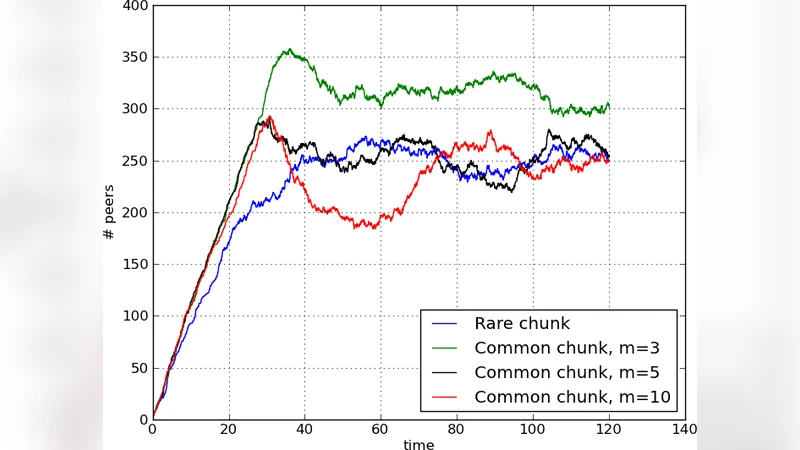
Simulation results for k = 20, λ = 10, and m ∈ {3, 5, 10} confirm that all variants converge to a steady‑state population. The stricter m = 3 rule yields slightly higher average peer count because peers with k‑1 chunks linger longer, but all configurations remain stable.
In summary, the paper makes three major contributions:
- A practical, fully distributed protocol that approximates the rare‑chunk‑first principle using only three random samples and local state.
- A rigorous stability proof for any arrival rate and any number of chunks, based on an unconventional Lyapunov function.
- A demonstration of robustness through both analytical extensions (m‑sampling) and empirical simulations.
By eliminating the need for a centralized tracker while preserving scalability and stability, this work offers a compelling blueprint for future P2P file‑sharing systems that must operate in highly dynamic, non‑altruistic environments.
Comments & Academic Discussion
Loading comments...
Leave a Comment