Nonstandard Analysis in Topology
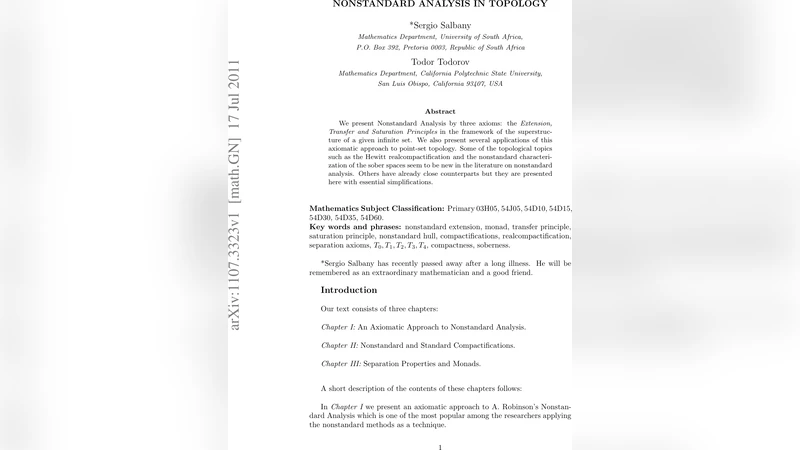
We present Nonstandard Analysis by three axioms: the {\em Extension, Transfer and Saturation Principles} in the framework of the superstructure of a given infinite set. We also present several applications of this axiomatic approach to point-set topology. Some of the topological topics such as the Hewitt realcompactification and the nonstandard characterization of the sober spaces seem to be new in the literature on nonstandard analysis. Others have already close counterparts but they are presented here with essential simplifications.
💡 Research Summary
The paper “Nonstandard Analysis in Topology” develops a self‑contained axiomatic framework for nonstandard analysis (NSA) based on three fundamental principles—Extension, Transfer, and Saturation—together with the Axiom of Choice, all formulated within the superstructure V(S) of an infinite set S. After a brief review of the superstructure construction (V₀(S)=S, V_{k+1}(S)=V_k(S)∪P(V_k(S))) and the bounded‑quantifier language L(V(S)), the authors define a nonstandard model as a pair (∗S, V(∗S)) equipped with a mapping A↦∗A satisfying: (1) Extension (∗s=s for every standard element s), (2) Transfer (every bounded‑quantifier formula true in the standard universe remains true after replacing each constant by its ∗‑image), and (3) κ‑Saturation (any family of internal sets with the finite‑intersection property indexed by a set of cardinal ≤κ has non‑empty intersection). The degree of saturation κ is left to the user; in topological applications κ is taken at least as large as the cardinality of a base of the topology.
With this machinery the authors turn to point‑set topology. For a topological space (X,T) they consider the nonstandard extension (∗X, sT), where sT is the topology generated by basic opens of the form ∗G with G∈T. The space (∗X, sT) is compact (though generally non‑Hausdorff), contains (X,T) densely, and every continuous real‑valued function f on X admits a unique continuous extension ∗f on (∗X, sT).
The central construction is the “nonstandard hull” bX_Φ = e_Φ/∼_Φ associated with a family Φ of continuous real‑valued functions on X. One first defines the Φ‑finite points e_Φ⊆∗X as those points whose values under all functions in Φ are finite (i.e., belong to the standard part of ∗ℝ). An equivalence relation ∼_Φ identifies two points whenever they agree on every φ∈Φ. The quotient bX_Φ equipped with the quotient topology bT is Hausdorff. By varying Φ the authors recover all Hausdorff compactifications of (X,T) in a uniform way:
- Φ = C_b(X,ℝ) (all bounded continuous functions) yields the Stone–Čech compactification βX.
- Φ = C(X,ℝ) (all continuous functions) yields the Hewitt realcompactification νX.
- Intermediate choices of Φ give intermediate compactifications, providing a clean, axiom‑free description that avoids the weak (LS) topology traditionally used in nonstandard compactifications.
The paper emphasizes that the topology sT is finer than the LS‑topology, allowing the authors to bypass the weak topology entirely and thereby simplify the construction of compactifications.
In the second part the authors study separation axioms and sobriety via monads. For a point x∈X the monad μ(x)=⋂{∗U : U∈T, x∈U} captures the nonstandard “infinitesimal neighbourhood” of x. They show:
- T₀ ⇔ distinct points have distinct monads.
- T₁ ⇔ each monad reduces to the singleton {x}.
- Regularity, complete regularity, normality, and compactness can all be expressed as simple statements about the interaction of monads with internal sets or about the behaviour of nonstandard extensions of continuous functions.
- Sobriety receives a new nonstandard characterisation: a space is sober iff every non‑standard “generic point” (i.e., a minimal non‑empty internal closed set) is the monad of a unique standard point. This result appears to be new in the literature.
The authors also present two novel monad‑based compactness criteria that differ from Robinson’s classic theorem, linking saturation with the existence of non‑empty intersections of internal families and with boundedness of nonstandard extensions of real‑valued functions.
Finally, the consistency of the three axioms is sketched via an ultrapower construction, and the role of the Axiom of Choice in guaranteeing the existence of sufficiently saturated models is discussed. Throughout, the paper stresses that the axiomatic approach not only clarifies the logical foundations of NSA but also yields streamlined proofs and new insights in topology, notably the nonstandard description of Hewitt realcompactification and the sober‑space characterisation. The work thus bridges model‑theoretic techniques with classical point‑set topology, offering both a pedagogical resource and a springboard for further research.
Comments & Academic Discussion
Loading comments...
Leave a Comment