Hate networks revisited: time and user interface dependence study of user emotions in political forum
The paper presents analysis of time evolution within am Internet political forum, characterized by large political differences and high levels of emotions. The study compares samples of discussions gathered at three periods separated by important events. We focus on statistical aspects related to emotional content of communication and changes brought by technologies that increase or decrease the direct one-to-one discussions. We discuss implications of user interface aspects on promoting communication across a political divide.
💡 Research Summary
The paper investigates how the structure of “hate networks” and the emotional tone of user interactions evolve over time in a highly polarized Polish political forum, and how changes in the forum’s user interface (UI) affect these dynamics. Data were collected from the discussion sections of the news portal gazeta.pl at four distinct moments: January 2009 (JAN09), July 2010 (JUL10), and two parallel collections in February 2011 – one from the “new” UI (FEB11) and one from the “old” UI (FEB11Q). The “old” UI (forum.gazeta.pl) retained a one‑click reply function and displayed comments in a tree‑like structure, making direct user‑to‑user exchanges visually obvious. The “new” UI (www.gazeta.pl) removed the reply button, presenting all comments in a flat list beneath the article, thereby obscuring any reply relationships.
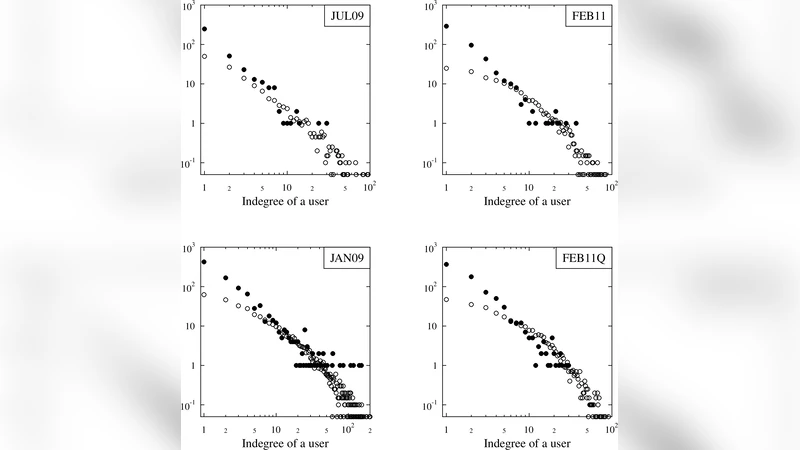
Network analysis treats each registered nickname as a node and each comment directed at another user as a directed edge. Comments addressed only to the news article are considered isolated nodes. The authors report basic network metrics for each dataset (number of nodes, edges, average degree, size of the largest connected component, proportion of isolated users). In the “old” UI datasets (JAN09 and FEB11Q) the largest component includes more than 60 % of users, indicating a percolating network that bridges the two opposing political camps. In contrast, the “new” UI datasets (JUL10 and FEB11) show a dramatically smaller giant component (about one‑third the size), four times more isolated users, and six times fewer edges, despite a comparable total number of posts. This demonstrates that UI design directly influences the formation of a cohesive discussion network.
Temporal trends reveal that the number of pairwise exchanges (multiple edges between the same two users) fell by a factor of eight between JAN09 and JUL10, coinciding with the UI change. The authors also examine user activity: a small core of 58 users appears in all four datasets and averages 27 posts each, far above the overall average of 4 posts per user, suggesting that long‑term participants drive much of the network’s connectivity.
Emotional analysis relies on the thumbs‑up/down scoring system introduced in JUL10 and FEB11. The authors categorize comments as positive, negative, or neutral and compute the distribution of sentiment scores. JUL10, collected immediately after a contentious presidential election, exhibits the highest proportion of negative sentiment, reflecting heightened political tension. In the “old” UI, extended “quarrels” (alternating replies between two users) are common; many dyads exchange ten or more consecutive posts, creating emotionally charged sub‑threads. The longest quarrels disappear in the “new” UI, where the maximum length is four posts, indicating that the lack of a visible reply mechanism suppresses sustained emotional confrontations.
Political affiliation is inferred from the content of users’ posts. Despite the news portal’s overt pro‑Civic Platform (PO) bias, supporters of the rival Law and Justice party (PiS) are well represented across all datasets. The proportion of PO‑aligned posts dominates, but the presence of PiS supporters remains stable, showing that the forum serves as a battleground where opposing camps can still encounter each other, especially when the UI facilitates direct replies.
The paper concludes that (1) the structural properties of political discussion forums are not static; they evolve with time and external events (e.g., elections), (2) UI features that make one‑to‑one interactions easy to perform and visualize dramatically increase both network connectivity and the intensity of emotional exchanges, and (3) removing such features leads to more isolated, article‑centric commenting and a reduction in the visibility of cross‑camp dialogue. These findings have practical implications for designers of online deliberation platforms: preserving mechanisms that encourage direct, traceable exchanges can foster richer, albeit more contentious, public discourse, while their removal may dampen engagement and limit exposure to opposing viewpoints. The study thus highlights the pivotal role of interface design in shaping the social dynamics and emotional climate of polarized online communities.
Comments & Academic Discussion
Loading comments...
Leave a Comment