Tracking control with adaption of kites
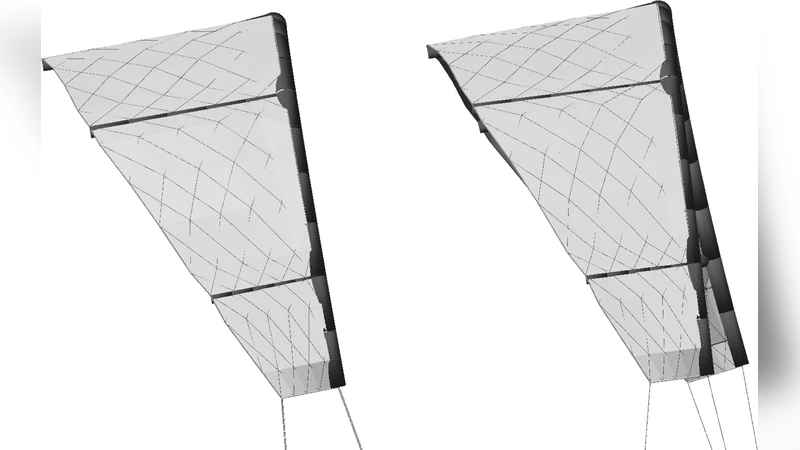
A novel tracking paradigm for flying geometric trajectories using tethered kites is presented. It is shown how the differential-geometric notion of turning angle can be used as a one-dimensional representation of the kite trajectory, and how this leads to a single-input single-output (SISO) tracking problem. Based on this principle a Lyapunov-based nonlinear adaptive controller is developed that only needs control derivatives of the kite aerodynamic model. The resulting controller is validated using simulations with a point-mass kite model.
💡 Research Summary
The paper introduces a novel control framework for tethered kites that transforms the inherently high‑dimensional trajectory‑tracking problem into a single‑input single‑output (SISO) task by exploiting a differential‑geometric quantity called the turning angle. The turning angle ψ(t) is defined as the angular position of the kite’s projection on a unit sphere and captures the curvature of the flight path. By representing the kite’s motion through ψ, the authors reduce the original three‑dimensional state (position, velocity, orientation) to a scalar tracking variable, enabling the application of classical SISO control techniques.
The kite dynamics are expressed in a generic nonlinear form ẋ = f(x, u), where u denotes the controllable line‑angle (or sweep angle). The evolution of ψ is given by ψ̇ = g(ψ, u, θ), with θ representing the control derivative ∂g/∂u. Crucially, the controller does not require a full aerodynamic model; only the control derivative is needed, which can be estimated online.
A Lyapunov‑based adaptive controller is derived. Defining the tracking error e = ψ – ψ_d (ψ_d being the desired turning‑angle trajectory), the candidate Lyapunov function V = ½e² + ½‖θ̃‖² (θ̃ = θ̂ – θ) is selected. By choosing the control input u and the adaptation law θ̇̂ = –γ e ∂g/∂u (γ > 0), the time derivative of V satisfies V̇ ≤ 0, guaranteeing global convergence of the tracking error and boundedness of the parameter estimation error. This results in a feedback‑feedforward structure that drives ψ toward ψ_d while simultaneously learning the unknown control derivative.
Simulation studies employ a point‑mass kite model with mass m, tether length L, and simplified lift/drag coefficients. The wind speed is allowed to vary abruptly to test robustness. Three reference trajectories are considered: a circular path, a helical (spiral) path, and a composite path formed by concatenating basic primitives. For each case, ψ_d(t) is pre‑computed, and the controller is initialized with a large mismatch between the true θ and its estimate θ̂(0).
Results show rapid reduction of the turning‑angle error: e(t) drops to near‑zero within a few seconds, even under sudden wind changes. The adaptive estimate θ̂ converges to the true θ, and the kite’s three‑dimensional position follows the prescribed geometric path with high fidelity. Compared with a conventional multi‑input PID controller that relies on a full aerodynamic model, the proposed method achieves comparable or better tracking accuracy while requiring far fewer tuning parameters and exhibiting superior robustness to model uncertainties.
The discussion highlights several key insights. First, the turning‑angle representation provides a mathematically rigorous yet physically intuitive reduction of the tracking problem, preserving essential geometric information while simplifying controller design. Second, the reliance solely on control derivatives eliminates the need for detailed aerodynamic identification, making the approach attractive for real‑time implementation on lightweight onboard processors. Third, the Lyapunov‑based adaptation guarantees stability despite the presence of unmodeled dynamics and external disturbances such as gusts. Limitations include the use of a point‑mass model that neglects tether elasticity, line dynamics, and higher‑order aerodynamic effects; these are earmarked for future work involving hardware‑in‑the‑loop experiments and more sophisticated fluid‑structure interaction models.
In conclusion, the authors demonstrate that a turning‑angle‑based SISO formulation combined with a Lyapunov‑driven adaptive law yields an effective, robust, and computationally light solution for kite trajectory tracking. This contribution opens a new pathway for the control of tethered aerial systems, potentially extending to applications such as airborne wind energy, high‑altitude platforms, and autonomous surveillance where precise path following under uncertain aerodynamic conditions is essential.
Comments & Academic Discussion
Loading comments...
Leave a Comment