Orientations and Connective Structures on 2-vector Bundles
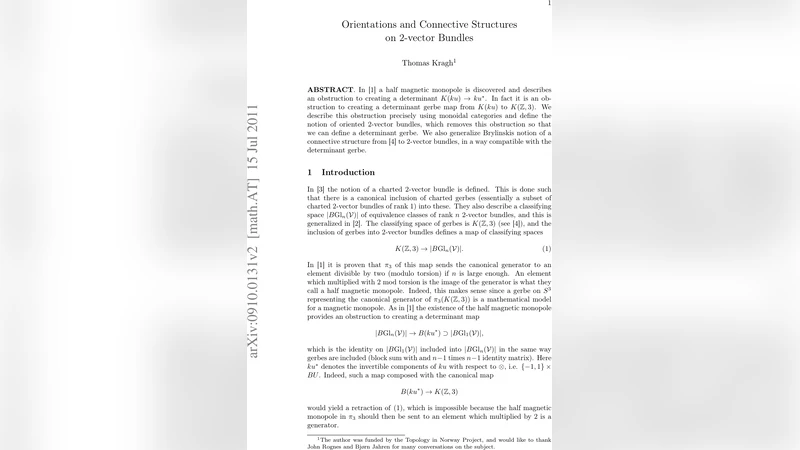
In work by Ausoni, Dundas and Rognes a half magnetic monopole is discovered and describes an obstruction to creating a determinant K(ku) \to ku*. In fact it is an obstruction to creating a determinant gerbe map from K(ku) to K(Z,3). We describe this obstruction precisely using monoidal categories and define the notion of oriented 2-vector bundles, which removes this obstruction so that we can define a determinant gerbe. We also generalize Brylinskis notion of a connective structure to 2-vector bundles, in a way compatible with the determinant gerbe.
💡 Research Summary
The paper tackles a subtle obstruction that has long prevented the construction of a determinant‐type map from the algebraic K‑theory of the connective complex K‑theory spectrum, K(ku), to both the underlying ring spectrum ku* and the third integral Eilenberg–Mac Lane space K(ℤ,3). This obstruction was first identified by Ausoni, Dundas and Rognes in the form of a “half magnetic monopole”: a non‑trivial class in H³(K(ku);ℤ₂) that blocks the usual determinant line bundle construction and, consequently, the existence of a determinant gerbe map K(ku) → K(ℤ,3).
The authors reinterpret this obstruction in the language of monoidal categories. A 2‑vector bundle is modeled as a stack of 2‑categories (the 2‑category Vect₂) equipped with a monoidal product. In the un‑oriented setting the monoidal product fails to be strictly symmetric; the failure is measured precisely by the half‑monopole class. Because the determinant functor requires a symmetric monoidal structure to be additive on exact sequences, the lack of symmetry prevents the determinant from descending to a map of spectra.
To remove the obstruction the paper introduces the notion of an oriented 2‑vector bundle. Orientation is an extra discrete datum attached to each 1‑cell (the “line” part of the 2‑vector bundle) that lifts the underlying ℤ₂‑valued obstruction to a trivial class. Concretely, one chooses a coherent system of signs (or spin‑like structures) that compensates for the antisymmetry of the monoidal product. This extra structure upgrades the monoidal category to a symmetric monoidal one up to coherent homotopy, thereby restoring the additivity needed for a determinant. With orientation in place the authors construct a well‑defined determinant gerbe map
\
Comments & Academic Discussion
Loading comments...
Leave a Comment