Crystallization in large wireless networks
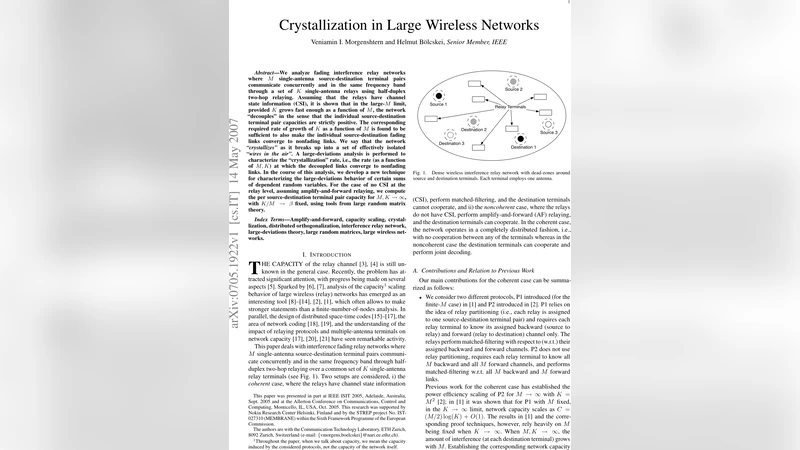
We analyze fading interference relay networks where M single-antenna source-destination terminal pairs communicate concurrently and in the same frequency band through a set of K single-antenna relays using half-duplex two-hop relaying. Assuming that the relays have channel state information (CSI), it is shown that in the large-M limit, provided K grows fast enough as a function of M, the network “decouples” in the sense that the individual source-destination terminal pair capacities are strictly positive. The corresponding required rate of growth of K as a function of M is found to be sufficient to also make the individual source-destination fading links converge to nonfading links. We say that the network “crystallizes” as it breaks up into a set of effectively isolated “wires in the air”. A large-deviations analysis is performed to characterize the “crystallization” rate, i.e., the rate (as a function of M,K) at which the decoupled links converge to nonfading links. In the course of this analysis, we develop a new technique for characterizing the large-deviations behavior of certain sums of dependent random variables. For the case of no CSI at the relay level, assuming amplify-and-forward relaying, we compute the per source-destination terminal pair capacity for M,K converging to infinity, with K/M staying fixed, using tools from large random matrix theory.
💡 Research Summary
The paper investigates the asymptotic behavior of a large fading interference relay network in which M single‑antenna source‑destination pairs communicate simultaneously over a common frequency band through K single‑antenna half‑duplex relays. Two operating regimes are considered: (i) relays possess full channel state information (CSI) and can perform optimal linear processing, and (ii) relays have no CSI and employ a simple amplify‑and‑forward (AF) protocol.
In the CSI‑aware case the authors first show that if the number of relays K grows sufficiently fast as a function of the number of user pairs M, the network “decouples”: each source‑destination pair attains a strictly positive ergodic capacity even as M → ∞. The required growth rate is identified as any super‑linear scaling K = ω(M) (e.g., K = M·log M or K = M^α with α > 1). Under this scaling, the effective end‑to‑end channel for each pair converges in probability to a deterministic, non‑fading gain. The authors term this phenomenon “crystallization,” meaning that the originally random, interference‑laden wireless medium behaves like a set of isolated, fixed‑gain wires in the air.
To quantify how fast the random links approach their deterministic limits, a large‑deviations analysis is carried out. Classical large‑deviation results apply only to sums of independent random variables, whereas the signal at each relay is a weighted sum of many fading coefficients that are statistically dependent because of the common relay processing matrix. The paper introduces a novel technique for handling such dependent sums, establishing exponential concentration bounds that reveal the crystallization rate as a function of (M, K). In particular, when K grows faster than M log M, the probability that any link deviates from its deterministic limit decays super‑exponentially in K, confirming that the network becomes effectively interference‑free with overwhelming probability.
In the second regime, where relays lack CSI, the authors adopt an AF strategy: each relay simply scales its received signal and forwards it in the second hop. The overall input‑output relation can then be expressed as a product of two random matrices (source‑to‑relay and relay‑to‑destination). By invoking tools from large random matrix theory—specifically the Marčenko‑Pastur law and free probability—the paper derives the limiting per‑pair capacity as M, K → ∞ with a fixed ratio β = K/M. The resulting expression shows that the per‑pair capacity scales as log (1 + γ · β/(1 + β)), where γ denotes the average SNR of the individual hops. Although this capacity is lower than the CSI‑aware case, it still grows linearly with the number of relays per user, confirming that massive relaying can compensate for the lack of CSI.
Beyond the core results, the paper discusses practical implications. The crystallization insight suggests that in dense future networks (e.g., massive IoT deployments, ultra‑dense 6G cells, UAV‑assisted relaying) it may be more cost‑effective to provision a large pool of inexpensive, low‑complexity relays rather than to invest heavily in sophisticated CSI acquisition at each relay. The derived growth conditions (K ≫ M) provide a concrete guideline for network planners: to guarantee non‑vanishing per‑user rates, the relay density must increase at least super‑linearly with the number of active user pairs.
The authors also outline several extensions: incorporating multi‑antenna relays (MIMO relaying), studying half‑duplex scheduling and asynchronous operation, and accounting for realistic CSI acquisition overhead. These directions would bridge the gap between the elegant asymptotic theory presented here and the constraints of real‑world deployments.
In summary, the paper makes three key contributions: (1) it establishes a rigorous decoupling condition for large interference relay networks with CSI, (2) it introduces a new large‑deviation framework for dependent random sums that quantifies the crystallization rate, and (3) it provides an exact asymptotic capacity formula for CSI‑free amplify‑and‑forward relaying using random matrix theory. Together, these results deepen our understanding of how massive relaying can transform a chaotic wireless environment into a set of virtually deterministic, interference‑free links, offering valuable design principles for the next generation of large‑scale wireless systems.