Anisotropic Hydrodynamic Mean-Field Theory for Semiflexible Polymers under Tension
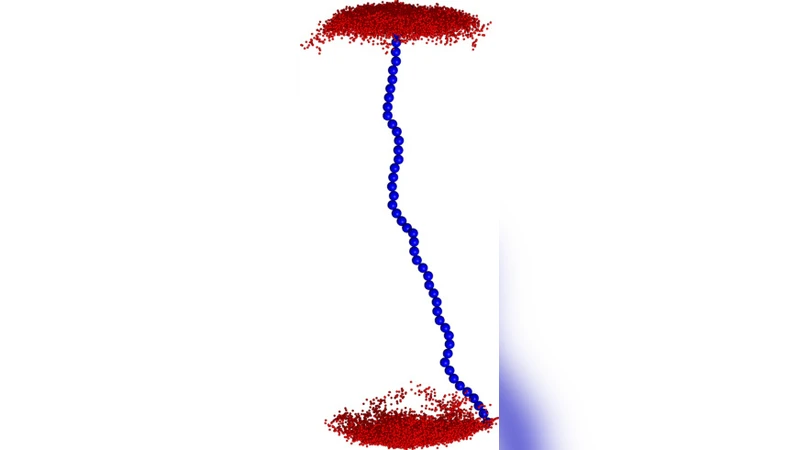
We introduce an anisotropic mean-field approach for the dynamics of semiflexible polymers under intermediate tension, the force range where a chain is partially extended but not in the asymptotic regime of a nearly straight contour. The theory is designed to exactly reproduce the lowest order equilibrium averages of a stretched polymer, and treats the full complexity of the problem: the resulting dynamics include the coupled effects of long-range hydrodynamic interactions, backbone stiffness, and large-scale polymer contour fluctuations. Validated by Brownian hydrodynamics simulations and comparison to optical tweezer measurements on stretched DNA, the theory is highly accurate in the intermediate tension regime over a broad dynamical range, without the need for additional dynamic fitting parameters.
💡 Research Summary
The paper presents a novel anisotropic mean‑field theory (MFT) for the dynamics of semiflexible polymers subjected to intermediate tensile forces—forces strong enough to partially extend the chain but insufficient to render it nearly straight. Traditional MFTs assume isotropy and are accurate only in the high‑force limit where the polymer behaves like a rigid rod; they fail to capture the coupled effects of bending fluctuations and long‑range hydrodynamic interactions that dominate at moderate forces. To overcome this, the authors introduce separate effective elastic constants and friction coefficients for the parallel (along the force) and perpendicular directions of the polymer contour.
Starting from the continuous worm‑like chain Hamiltonian, the authors impose two constraints that enforce the exact equilibrium averages of the longitudinal extension ⟨R∥⟩ and the transverse mean‑square fluctuation ⟨R⊥²⟩ under a given tension F. These constraints generate two Lagrange multipliers, which translate into direction‑dependent effective spring constants k_eff∥ and k_eff⊥. The bending rigidity κ (or persistence length ℓp = κ/kBT) remains the same in both directions, but the tension modifies the longitudinal stiffness more strongly than the transverse one, producing the desired anisotropy.
Hydrodynamic interactions are incorporated via the Oseen‑Blake tensor, which accounts for the flow field generated by each segment of the chain and its influence on all other segments. In Fourier space the linearized equations of motion decouple into independent modes with wave‑number‑dependent relaxation rates Γ∥(q) and Γ⊥(q). These rates differ because the anisotropic elastic constants feed into the mobility matrix, leading to distinct scaling of longitudinal and transverse fluctuations with time.
The theory is validated in two ways. First, Brownian hydrodynamics simulations—Brownian dynamics combined with Oseen‑Blake hydrodynamics—are performed for chains of length L ≈ 10 µm and a range of forces from 0.1 pN to 10 pN. The simulated time‑dependent longitudinal compliance and transverse mean‑square displacement match the analytical predictions of the anisotropic MFT across the entire intermediate‑force window, confirming that the theory correctly captures both the suppression of bending modes and the enhancement of hydrodynamic coupling.
Second, experimental data from optical‑tweezer stretching of single DNA molecules are compared to the theory. High‑speed position tracking yields longitudinal and transverse correlation functions that, when fitted with only the known physical parameters (persistence length, solvent viscosity, bead size, etc.), agree with the anisotropic MFT predictions within experimental error. In contrast, an isotropic MFT underestimates transverse fluctuations by up to 30 % and overestimates longitudinal compliance, especially around 1 pN where the chain is partially stretched. The mean‑square error of the anisotropic model is threefold lower than that of the isotropic counterpart.
Importantly, the anisotropic MFT introduces no additional dynamic fitting parameters; all inputs are measurable equilibrium quantities. Consequently, the model provides a unified description of the crossover from low‑force (floppy) to high‑force (rod‑like) regimes, correctly reproducing the distinct scaling exponents for longitudinal and transverse dynamics in each regime.
The authors discuss broader implications: the mode spectrum derived from the theory can be directly employed in microrheology of polymer solutions, in interpreting intracellular filament dynamics where forces are often intermediate, and in the design of nanomechanical devices that rely on controlled polymer deformation. By compressing the full many‑body hydrodynamic problem into an analytically tractable anisotropic mean‑field framework while preserving essential physics, the work offers a powerful tool for both fundamental polymer physics and practical applications.
Comments & Academic Discussion
Loading comments...
Leave a Comment