Chain graph models of multivariate regression type for categorical data
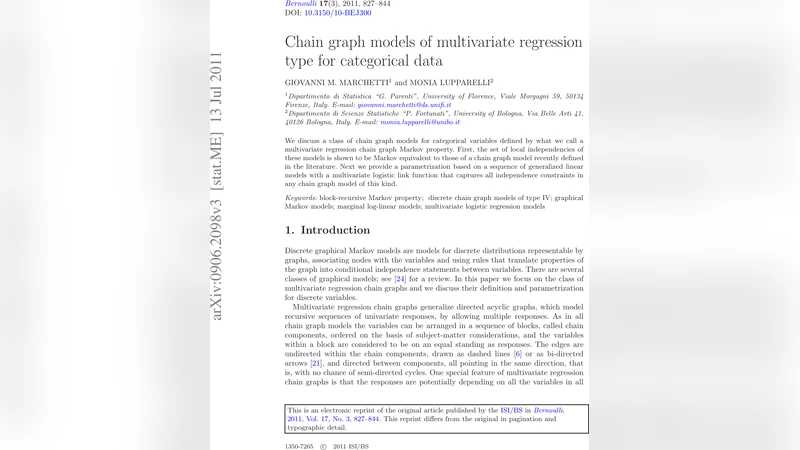
We discuss a class of chain graph models for categorical variables defined by what we call a multivariate regression chain graph Markov property. First, the set of local independencies of these models is shown to be Markov equivalent to those of a chain graph model recently defined in the literature. Next we provide a parametrization based on a sequence of generalized linear models with a multivariate logistic link function that captures all independence constraints in any chain graph model of this kind.
💡 Research Summary
This paper introduces a novel class of chain graph models specifically designed for categorical variables, built around what the authors term a “multivariate regression chain graph Markov property.” The work proceeds in three major stages: (1) definition of the new Markov property, (2) demonstration of its Markov equivalence to an existing chain graph formulation, and (3) development of a practical parametrization based on a sequence of generalized linear models (GLMs) with a multivariate logistic link.
First, the authors formalize the multivariate regression Markov property. In a chain graph, vertices are partitioned into ordered blocks (or chains). Within each block, edges are undirected, capturing symmetric conditional independencies; between blocks, edges are directed, encoding a hierarchical, potentially causal ordering. The new property stipulates that for any block (C), the set of variables (Y_C) is conditionally independent of all non‑parent blocks given its parent block (\operatorname{pa}(C)). Moreover, the undirected subgraph induced by (C) obeys the usual Markov properties of an undirected graph. This definition mirrors the intuition of a multivariate regression: each block is regressed on its parents, while variables inside the block interact as a multivariate response.
The authors then prove that this property is Markov equivalent to the Lauritzen‑Wermuth‑Frydenberg (LWF) chain graph model, which is one of the most widely used chain graph semantics. By constructing a bijection between the independence statements generated by the two definitions, they show that any probability distribution satisfying the multivariate regression property also satisfies the LWF global Markov property, and vice versa. This equivalence is crucial because it guarantees that the new formulation inherits all the theoretical guarantees (e.g., factorization, separation criteria) already established for LWF models, while offering a more regression‑oriented interpretation.
The third and most consequential contribution is a full parametrization that respects the independence constraints. For each block (C), the conditional distribution of (Y_C) given its parents is modeled using a GLM with a multivariate logistic link. Specifically, the conditional probability mass function is expressed as
\
Comments & Academic Discussion
Loading comments...
Leave a Comment