Residual noise covariance for Planck low-resolution data analysis
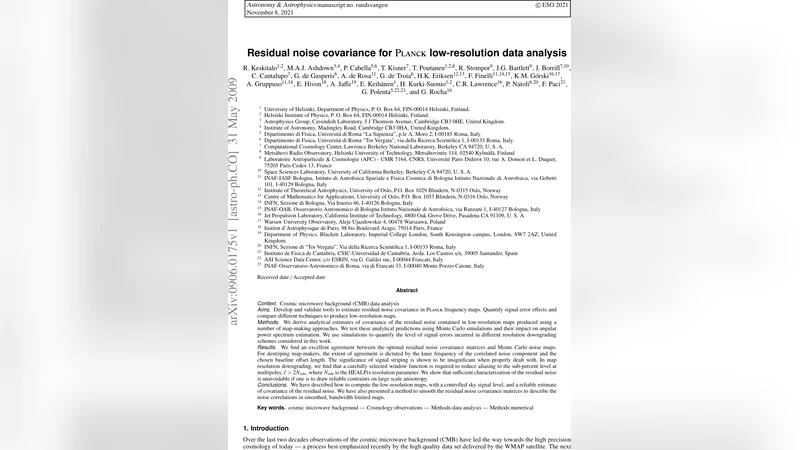
Aims: Develop and validate tools to estimate residual noise covariance in Planck frequency maps. Quantify signal error effects and compare different techniques to produce low-resolution maps. Methods: We derive analytical estimates of covariance of the residual noise contained in low-resolution maps produced using a number of map-making approaches. We test these analytical predictions using Monte Carlo simulations and their impact on angular power spectrum estimation. We use simulations to quantify the level of signal errors incurred in different resolution downgrading schemes considered in this work. Results: We find an excellent agreement between the optimal residual noise covariance matrices and Monte Carlo noise maps. For destriping map-makers, the extent of agreement is dictated by the knee frequency of the correlated noise component and the chosen baseline offset length. The significance of signal striping is shown to be insignificant when properly dealt with. In map resolution downgrading, we find that a carefully selected window function is required to reduce aliasing to the sub-percent level at multipoles, ell > 2Nside, where Nside is the HEALPix resolution parameter. We show that sufficient characterization of the residual noise is unavoidable if one is to draw reliable contraints on large scale anisotropy. Conclusions: We have described how to compute the low-resolution maps, with a controlled sky signal level, and a reliable estimate of covariance of the residual noise. We have also presented a method to smooth the residual noise covariance matrices to describe the noise correlations in smoothed, bandwidth limited maps.
💡 Research Summary
The paper addresses a critical problem in the analysis of Planck satellite data: the accurate characterization of residual noise in low‑resolution sky maps, which are essential for studies of large‑scale cosmic microwave background (CMB) anisotropies. The authors set out two main objectives. First, they develop analytical expressions for the covariance of the residual noise that remains after map‑making, and they validate these expressions against extensive Monte Carlo simulations. Second, they investigate how different map‑downgrading (resolution‑reduction) schemes affect the level of signal error and aliasing, and they propose practical methods to minimise these effects while preserving the scientific integrity of the maps.
To model the noise, the authors adopt a standard 1/f description characterised by a knee frequency and a spectral index. In the optimal map‑making framework, the full time‑ordered data are processed using a generalized least‑squares solution, which explicitly incorporates the time‑domain noise covariance matrix N. The resulting map estimator x̂ = (AᵀN⁻¹A)⁻¹AᵀN⁻¹d yields a residual‑noise covariance that can be written analytically in terms of the pointing matrix A and N. This approach provides a benchmark for the best possible noise description.
In contrast, destriping map‑makers approximate the low‑frequency noise by a set of constant offsets (baselines) defined over a chosen time interval L. The offsets are estimated by minimising the differences between intersecting scan rings, and the residual‑noise covariance is then a combination of the offset‑estimation error and the remaining high‑frequency white noise. The authors demonstrate, through Monte Carlo experiments, that the agreement between the analytical destriping covariance and the simulated noise maps depends strongly on two parameters: the knee frequency of the underlying 1/f noise and the baseline length L. When the knee frequency is low and L is short (e.g., ≤ 1 s), the destriping covariance matches the optimal one to within a few percent for multipoles ℓ < 30. As L increases, low‑frequency noise leaks into the maps, causing the destriping covariance to underestimate the true noise variance.
The paper then turns to the problem of downgrading high‑resolution maps (Nside = 2048) to low‑resolution formats (Nside = 16–32). A naïve averaging of high‑resolution pixels leads to significant aliasing: power from high‑ℓ modes contaminates the low‑ℓ regime, biasing cosmological parameter estimates. To mitigate this, the authors evaluate several window functions applied before the downgrade, including Gaussian and Hilbert‑type kernels. By smoothing the high‑resolution map with an appropriately chosen kernel and then performing a spherical‑harmonic truncation at ℓ = 2 Nside, they reduce aliasing to below the sub‑percent level for ℓ > 2 Nside. This result confirms that careful window selection is indispensable for preserving the fidelity of large‑scale CMB signals.
Finally, the authors address the representation of noise covariance in smoothed, bandwidth‑limited maps. The raw covariance matrix derived from the optimal or destriping methods contains strong pixel‑to‑pixel correlations that are computationally prohibitive at low resolution. They propose a two‑step smoothing procedure: first, transform the covariance into spherical‑harmonic space, apply the same low‑pass filter used for the map smoothing, and then transform back to pixel space. This yields a “smoothed” covariance that accurately captures the residual noise correlations after map smoothing, while remaining tractable for likelihood analyses.
Overall, the study provides a comprehensive toolkit for Planck low‑resolution data analysis. It confirms that optimal and well‑tuned destriping map‑makers can produce residual‑noise covariances that agree with Monte Carlo simulations to high precision, provided the baseline length and noise knee frequency are appropriately chosen. It also demonstrates that signal‑error control during map downgrading—through the use of suitable window functions—prevents aliasing that could otherwise compromise large‑scale anisotropy measurements. The smoothed covariance methodology ensures that the final low‑resolution, bandwidth‑limited maps retain a reliable noise model, which is essential for robust cosmological inference. These results are directly applicable to current Planck analyses and offer a blueprint for future CMB experiments that will rely on low‑resolution maps for probing the largest angular scales of the Universe.
Comments & Academic Discussion
Loading comments...
Leave a Comment