On an Efficient Marie Curie Initial Training Network
Collaboration in science is one of the key components of world-class research. The European Commission supports collaboration between institutions and funds young researchers appointed by these partner institutions. In these networks, the mobility of the researchers is enforced in order to enhance the collaboration. In this study, based on a real Marie Curie Initial Training Network, an algorithm to construct a collaboration network is investigated. The algorithm suggests that a strongly efficient expansion leads to a star-like network. The results might help the design of efficient collaboration networks for future Initial Training Network proposals.
💡 Research Summary
The paper investigates how to construct an efficient collaboration network for a Marie Curie Initial Training Network (ITN), a European Commission‑funded scheme that brings together multiple partner institutions and early‑stage researchers (ESRs). The authors model the network as an undirected graph with 14 partner nodes and 17 ESRs. Each ESR must visit two other partners, and the total length of these visits (in months) is used to define a “distance” between partners as the inverse of the summed visit durations. This distance quantifies the strength of collaboration: longer visits imply stronger ties.
Building on the Jackson‑Wolinsky connections model, the authors introduce three payoff values (δ) that depend on the type of link: experimental‑experimental (e‑e), computational‑computational (c‑c), and experimental‑computational (e‑c). The e‑c payoff is highest, reflecting the policy that interdisciplinary links are most valuable. All links share a uniform cost, and the individual payoff for a partner i is given by a sum over its direct links of (δ – cost) divided by the shortest distance to each other partner (Equation 1). The overall network value V(g) is the sum of all individual payoffs (Equation 2).
The goal is a “strongly efficient expansion”: starting from a founding sub‑network of four partners, the network is expanded by adding new partners in a way that maximizes V(g). Exhaustive enumeration of all possible expansions is computationally infeasible, so the authors propose a heuristic algorithm. The steps are:
- Compute the shortest‑distance matrix for the current network.
- Weight each distance by the appropriate δ (producing a weighted distance matrix).
- Order the new partners by the total mobility of their ESRs (i.e., the sum of their visit lengths), assuming that partners with longer ESR visits are more eager to collaborate.
- For each new partner, test all possible pairs of existing partners, temporarily add the two links, recompute the weighted distance matrix, and calculate the average weighted distance. Keep the pair that yields the smallest average.
- Repeat until all new partners are linked.
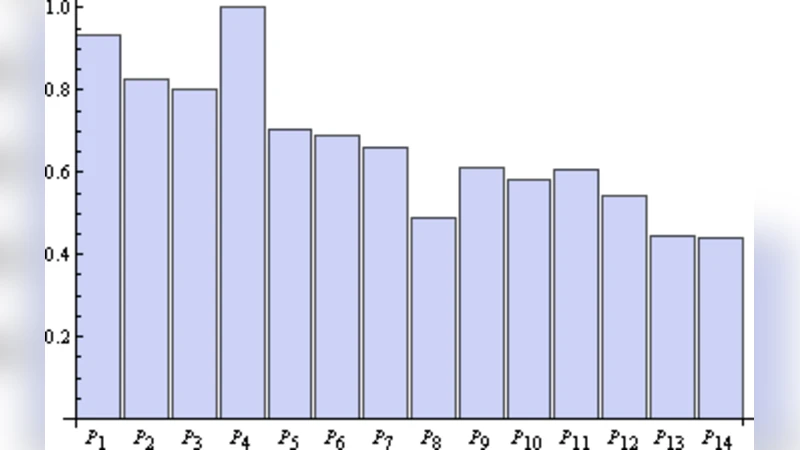
Applying this algorithm to the real ITN data (three new partners with two ESRs each, the rest with one ESR), the resulting network is star‑shaped. The computational partner P4 becomes the central hub, receiving a direct link from every new partner, while many new partners also connect to experimental partner P2. Individual payoff plots show that P4 and P2 achieve the highest normalized payoffs. Principal Component Analysis (PCA) of the final network confirms that the founding partners and their ESRs dominate the network’s structure; ESR 2 and ESR 4, in particular, are identified as critical because their long visits generate the strongest cross‑partner ties.
The study contributes three main insights: (i) translating ESR visit durations into a distance metric provides a concrete, time‑based measure of collaboration strength; (ii) differentiating payoffs by partner type captures the added value of interdisciplinary links; (iii) a simple, mobility‑driven heuristic can efficiently approximate the strongly efficient expansion without exhaustive search. Limitations include the assumption of uniform link cost, the focus on average weighted distance rather than multi‑objective criteria (e.g., budget constraints, geographic dispersion), and the lack of validation against actual project outcomes. Future work could incorporate variable costs, stochastic ESR mobility, and more sophisticated optimization techniques such as genetic algorithms or mixed‑integer programming.
In conclusion, the paper demonstrates that, under the specified cost‑benefit framework, a star‑shaped collaboration network maximizes the overall value of a Marie Curie ITN. This finding offers practical guidance for designing future ITN proposals, suggesting that concentrating links around a few highly connected, interdisciplinary partners can yield the most efficient and productive research consortium.
Comments & Academic Discussion
Loading comments...
Leave a Comment