Bi-Lipschitz equivalent metrics on groups, and a problem in additive number theory
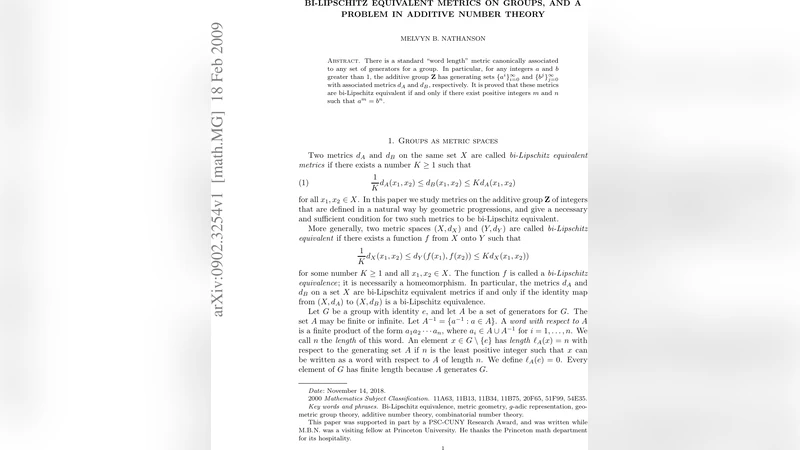
There is a standard “word length” metric canonically associated to any set of generators for a group. In particular, for any integers a and b greater than 1, the additive group of integers has generating sets {a^i}{i=0}^{\infty} and {b^j}{j=0}^{\infty} with associated metrics d_A and d_B, respectively. It is proved that these metrics are bi-Lipschitz equivalent if and only if there exist positive integers m and n such that a^m = b^n.
💡 Research Summary
The paper investigates the geometric relationship between two word‑length metrics on the additive group of integers ℤ that arise from distinct generating sets consisting of powers of fixed integers a > 1 and b > 1. For a generating set A = {aⁱ | i ≥ 0} one defines the word‑length ℓ_A(x) of an integer x as the minimal total absolute coefficient sum needed to express x as a finite ℤ‑linear combination of elements of A; the associated metric is d_A(x,y) = ℓ_A(x − y). The same construction yields d_B from B = {bʲ}. The central question is when these two metrics are bi‑Lipschitz equivalent, i.e. when there exists a constant C ≥ 1 such that for every x∈ℤ, \
Comments & Academic Discussion
Loading comments...
Leave a Comment