A Step towards an Easy Interconversion of Various Number Systems
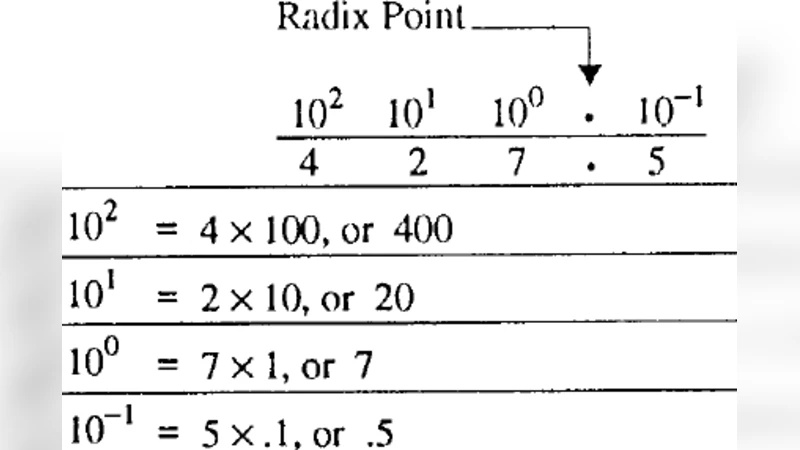
Any system that is used for naming or representing numbers is a number system, also known as numeral system. The modern civilization is familiar with decimal number system using ten digits. However digital devices and computers use binary number system instead of decimal number system, using only two digits namely, 0 and 1 based on the fundamental concept of the decimal number system. Various other number systems also used this fundamental concept of decimal number system, for example octal system and hexadecimal number systems using eight and sixteen digits respectively. The knowledge of number systems and their inter conversion is essential for understanding of computers. More over, successful programming for digital devices requires a precise understanding of data formats, number systems and their inter conversion. The inter conversion (a process in which things are each converted into the other) of number system requires allot of time and techniques to expertise. In this paper the interconversion of four most common number systems is taken under the consideration in tabulated form. It is a step towards the easy interconversion of theses number systems to understand as well as memorise it. The four number systems are binary, octal, decimal and hexadecimal.
💡 Research Summary
The paper “A Step towards an Easy Interconversion of Various Number Systems” addresses the pedagogical challenge of converting among the four most commonly used numeral systems in digital computing: binary (base‑2), octal (base‑8), decimal (base‑10), and hexadecimal (base‑16). The authors begin by outlining the historical context—humans naturally use decimal, while computers operate internally with binary—and note that octal and hexadecimal are often employed as compact representations of binary data in microprocessor design, data communication, and low‑level programming. After a brief review of basic concepts such as digits, positional weights, most‑significant‑digit (MSD) and least‑significant‑digit (LSD), the paper presents a generalized representation formula N = Σ A_i·B^i to emphasize the common structure across bases.
The core contribution is a three‑step conversion framework that dramatically reduces the procedural complexity traditionally associated with numeral‑system conversion. Step 1 treats decimal as the hub: converting decimal to binary, octal, or hexadecimal (and the reverse) using the well‑known repeated‑division method for integer parts and repeated‑multiplication for fractional parts. Step 2 uses binary as an intermediate to convert between binary and the other two non‑decimal bases. Here, the authors employ a “group‑replace” technique—grouping binary digits into triples for octal and quadruples for hexadecimal, then substituting each group with its corresponding digit. This method works identically for both integer and fractional portions, requiring only padding with leading or trailing zeros as needed. Step 3 handles the direct conversion between octal and hexadecimal, which is not straightforward; the authors again route the conversion through binary (octal → binary → hexadecimal, or the reverse), preserving the same grouping strategy.
To aid learning, the authors compile the entire process into tabular form. One table lists the binary, octal, and hexadecimal equivalents of decimal numbers 0‑15, providing a quick reference. A second table summarizes each conversion step, indicating the algorithm used for integer and fractional parts, and clarifying that the same method applies to both. By presenting the material in this compact, visual format, the authors claim that students can master all inter‑conversions within a single lecture hour, a stark contrast to the “more than 20 steps” cited in earlier textbooks.
While the paper succeeds in offering a clear, student‑friendly roadmap, it has notable limitations. No empirical study is provided to substantiate the claimed reduction in learning time; the effectiveness of the three‑step approach remains anecdotal. The discussion omits error handling for invalid inputs, and there is no analysis of computational complexity for large numbers, which could be relevant for software implementations. Moreover, the scope is confined to the four bases; the authors do not explore whether the same framework can be generalized to other radices (e.g., base‑3 or base‑5). Finally, the manuscript suffers from numerous typographical and grammatical errors, which detract from its professionalism.
In summary, the paper contributes a pedagogical tool—a three‑step, table‑driven methodology—for converting among binary, octal, decimal, and hexadecimal systems. Its strength lies in simplifying the learning process for beginners and providing a visual reference that can be readily incorporated into introductory computer‑science curricula. Future work should include controlled classroom experiments to measure learning gains, extensions to additional numeral systems, and the development of software utilities that embody the proposed conversion logic while handling edge cases and large‑scale data.
Comments & Academic Discussion
Loading comments...
Leave a Comment