Controller Synthesis for Robust Invariance of Polynomial Dynamical Systems using Linear Programming
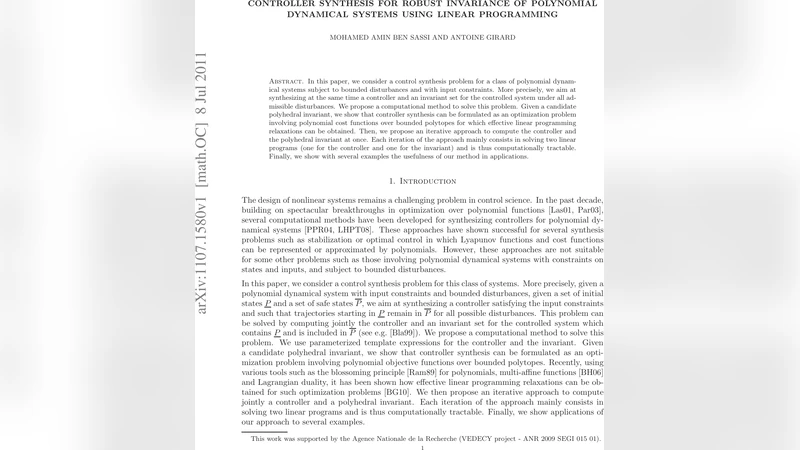
In this paper, we consider a control synthesis problem for a class of polynomial dynamical systems subject to bounded disturbances and with input constraints. More precisely, we aim at synthesizing at the same time a controller and an invariant set for the controlled system under all admissible disturbances. We propose a computational method to solve this problem. Given a candidate polyhedral invariant, we show that controller synthesis can be formulated as an optimization problem involving polynomial cost functions over bounded polytopes for which effective linear programming relaxations can be obtained. Then, we propose an iterative approach to compute the controller and the polyhedral invariant at once. Each iteration of the approach mainly consists in solving two linear programs (one for the controller and one for the invariant) and is thus computationally tractable. Finally, we show with several examples the usefulness of our method in applications.
💡 Research Summary
The paper addresses the simultaneous synthesis of a state feedback controller and a robust invariant set for polynomial dynamical systems subject to bounded disturbances and input constraints. The authors consider systems of the form ˙x = f(x,d) + g(x,d)u, where the disturbance d belongs to a compact polytope D and the control input u must lie in a compact polytope U. The state space is assumed to be a bounded hyper‑rectangle ℝ_X. The design goal is to find a polyhedral invariant set P that contains a given set of initial states ℙ and is contained in a given safe set ℙ, together with a controller h(x) that respects the input constraints for all x∈ℝ_X and guarantees that trajectories starting in P never leave P, regardless of the disturbance realization.
The methodology proceeds in two main stages. First, a template for the invariant set is fixed by selecting a finite set of outward normal vectors {γ_k} and introducing scalar parameters η_k that define the facets of P as γ_k·x ≤ η_k. Second, the controller is restricted to a polynomial template h(x)=H(x)θ, where H(x) is a known multivariate polynomial matrix and θ∈ℝ^q is the decision vector. Input constraints are expressed as linear inequalities α_U,l·H(x)θ ≤ β_U,l for all x∈ℝ_X; using the blossoming principle, these constraints reduce to a finite set of linear inequalities on the vertices of a lifted hyper‑rectangle, because the blossom of a polynomial is multi‑affine and attains its extrema at the vertices.
Robust invariance of P is equivalent to the condition that for each facet k, the Lie derivative of the facet function is non‑positive on the facet for all admissible disturbances: γ_k·(f(x,d)+g(x,d)h(x)) ≤ 0 for all x∈F_k, d∈D. Substituting the controller template yields a polynomial inequality in (x,d,θ). The authors apply the blossoming transformation to this polynomial, turning it into a multi‑affine function of lifted variables (z_x, z_d). The resulting optimization problem—maximising the violation of the facet inequality over the lifted polytope—is a polynomial optimization problem. By constructing the Lagrangian dual of the blossomed problem, they obtain a linear program whose optimal value provides a guaranteed lower bound on the original polynomial’s maximum. If this lower bound is non‑negative, the facet is certified as blocked.
The overall synthesis algorithm is iterative. Given an initial guess for η (e.g., the facets of ℙ), the first linear program solves for θ such that all input‑constraint inequalities hold. The second linear program, for each facet k, maximises the lower bound on the violation of the invariance condition and adjusts η_k accordingly (increasing η_k if the facet is not blocked). The two LPs are solved alternately until all facets are blocked and the input constraints are satisfied. Because each step involves only standard linear programs, the computational burden is modest; the authors report convergence within a handful of iterations on examples of up to three state dimensions and polynomial degrees up to three.
Key technical contributions include: (1) the systematic use of the blossoming principle to convert arbitrary multivariate polynomial constraints over bounded polytopes into multi‑affine forms whose extrema lie on vertices; (2) the derivation of a tight linear‑programming relaxation via Lagrangian duality that yields provable lower bounds for the original non‑convex problems; (3) an explicit template‑based formulation that decouples the design of the invariant geometry (through η) from the controller parameters (θ), enabling a tractable alternating optimisation scheme.
The paper presents several numerical case studies: a second‑order system with quadratic dynamics, a third‑order system with cubic terms, and examples with both single‑ and multi‑dimensional disturbances. In all cases the proposed method produces invariant polytopes that are at least as large as those obtained by sum‑of‑squares (SOS) techniques, while requiring significantly less computational time. The authors also discuss practical considerations such as the choice of facet normals, the degree of the controller template, and the sensitivity of convergence to the initial η.
Limitations are acknowledged. The approach relies on a polyhedral representation of the invariant set; non‑polyhedral shapes would require additional approximation. The quality of the solution depends on the richness of the chosen templates; overly restrictive templates may lead to infeasibility or overly conservative invariant sets. Moreover, while the LP relaxations provide lower bounds, they are not guaranteed to be tight, so the method may be conservative in some instances.
In summary, the paper delivers a novel, computationally efficient framework for robust invariant set synthesis and controller design for polynomial systems. By leveraging blossoming and linear‑programming duality, it transforms a class of hard polynomial optimization problems into a sequence of tractable LPs, thereby opening the door to scalable verification and synthesis tools for nonlinear control applications.
Comments & Academic Discussion
Loading comments...
Leave a Comment