Kernels for Below-Upper-Bound Parameterizations of the Hitting Set and Directed Dominating Set Problems
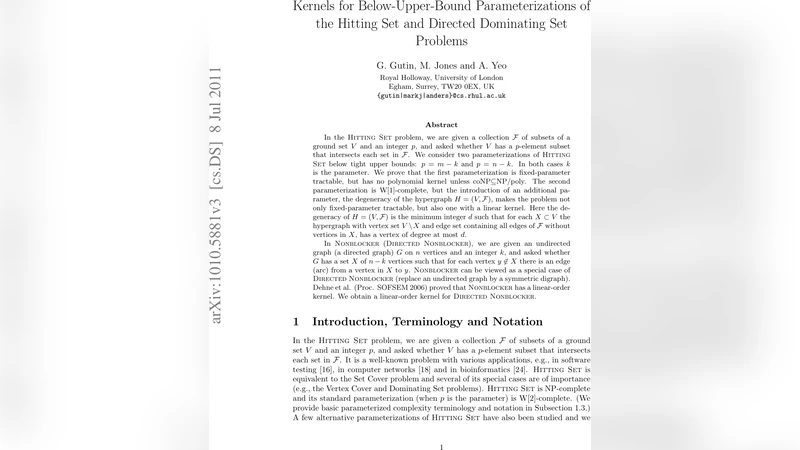
In the {\sc Hitting Set} problem, we are given a collection $\cal F$ of subsets of a ground set $V$ and an integer $p$, and asked whether $V$ has a $p$-element subset that intersects each set in $\cal F$. We consider two parameterizations of {\sc Hitting Set} below tight upper bounds: $p=m-k$ and $p=n-k$. In both cases $k$ is the parameter. We prove that the first parameterization is fixed-parameter tractable, but has no polynomial kernel unless coNP$\subseteq$NP/poly. The second parameterization is W[1]-complete, but the introduction of an additional parameter, the degeneracy of the hypergraph $H=(V,{\cal F})$, makes the problem not only fixed-parameter tractable, but also one with a linear kernel. Here the degeneracy of $H=(V,{\cal F})$ is the minimum integer $d$ such that for each $X\subset V$ the hypergraph with vertex set $V\setminus X$ and edge set containing all edges of $\cal F$ without vertices in $X$, has a vertex of degree at most $d.$ In {\sc Nonblocker} ({\sc Directed Nonblocker}), we are given an undirected graph (a directed graph) $G$ on $n$ vertices and an integer $k$, and asked whether $G$ has a set $X$ of $n-k$ vertices such that for each vertex $y\not\in X$ there is an edge (arc) from a vertex in $X$ to $y$. {\sc Nonblocker} can be viewed as a special case of {\sc Directed Nonblocker} (replace an undirected graph by a symmetric digraph). Dehne et al. (Proc. SOFSEM 2006) proved that {\sc Nonblocker} has a linear-order kernel. We obtain a linear-order kernel for {\sc Directed Nonblocker}.
💡 Research Summary
The paper investigates two classic combinatorial problems—Hitting Set and Nonblocker (including its directed variant)—under “below‑upper‑bound” parameterizations, where the solution size is expressed as the difference between a natural upper bound and a parameter k. For Hitting Set, the authors consider two such parameterizations: p = m − k (where m is the number of sets) and p = n − k (where n is the size of the ground set).
In the first case (p = m − k) the problem is shown to be fixed‑parameter tractable (FPT) with respect to k. The algorithm essentially removes all sets of size at most k, then exhaustively searches the remaining “large” sets, yielding a running time that is exponential only in k and polynomial in the input size. However, the authors prove a kernel lower bound: unless coNP ⊆ NP/poly, no polynomial‑size kernel exists for this parameterization. The proof uses a parameter‑preserving reduction from a known kernel‑hard problem, establishing that a polynomial kernel would collapse widely believed complexity classes.
The second parameterization (p = n − k) behaves dramatically differently. The authors prove that it is W
Comments & Academic Discussion
Loading comments...
Leave a Comment