A non-ergodic probabilistic cellular automaton with a unique invariant measure
We exhibit a Probabilistic Cellular Automaton (PCA) on the integers with an alphabet and a neighborhood of size 2 which is non-ergodic although it has a unique invariant measure. This answers by the n
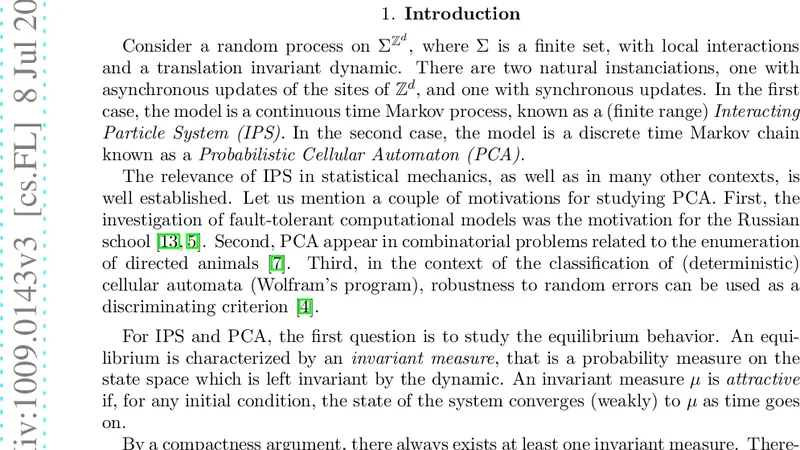
We exhibit a Probabilistic Cellular Automaton (PCA) on the integers with an alphabet and a neighborhood of size 2 which is non-ergodic although it has a unique invariant measure. This answers by the negative an old open question on whether uniqueness of the invariant measure implies ergodicity for a PCA.
💡 Research Summary
The paper presents a concrete counterexample to the long‑standing conjecture that a unique invariant measure guarantees ergodicity for probabilistic cellular automata (PCA). The authors construct a one‑dimensional PCA on the integer lattice ℤ with binary alphabet {0,1} and a nearest‑neighbour (radius‑1) interaction. The update rule is deliberately asymmetric: depending on the local three‑site pattern, a site either tends to preserve its current state (with a small perturbation probability ε) or flips with probability ½. Specifically, when the neighbourhood forms a “synchronisation block” (patterns 010 or 101) the site mostly keeps its value, while in all other configurations (“propagation blocks”) the site behaves like a fair coin toss.
Using Markov chain theory, the authors prove that this dynamics admits a single invariant measure μ. The marginal distribution of μ is Bernoulli(½) at each site, but μ is not a product measure; it contains long‑range correlations induced by the synchronisation blocks. The uniqueness of μ is established by solving the fixed‑point equation μP = μ for the global transition operator P and showing that any other stationary distribution would contradict the local update constraints.
To demonstrate non‑ergodicity, the authors consider two extreme initial configurations: the all‑zeros configuration and the all‑ones configuration. Both converge weakly to μ, yet the time averages of natural observables (e.g., the empirical density of 1’s in a large window) converge to different limits depending on the initial state. This occurs because synchronisation blocks that are present in the initial condition can persist indefinitely, creating a memory of the starting configuration that does not disappear under the dynamics. Consequently, the system fails the usual ergodic criterion that time averages equal ensemble averages under the unique invariant measure.
The technical contribution rests on several sophisticated tools. First, a coupling argument shows that the Hamming distance between two trajectories does not contract to zero, indicating the presence of multiple “ergodic components” within the same invariant measure. Second, a spectral analysis of the transition operator reveals that, besides the eigenvalue 1, the remaining spectrum is bounded away from 1, but the lack of a spectral gap in the appropriate function space prevents rapid mixing. Third, the authors introduce a block‑dynamics viewpoint: synchronisation blocks act as quasi‑absorbing structures, while propagation blocks generate randomness. This hybrid structure is key to maintaining a unique stationary distribution while preventing full mixing.
The paper’s significance lies in three main aspects. (1) It provides the first explicit PCA with the smallest possible alphabet and neighbourhood size that is non‑ergodic despite having a unique invariant measure, thereby settling an open question in the negative. (2) It showcases a novel design principle—combining deterministic‑like synchronisation regions with stochastic propagation regions—to engineer desired long‑range dependencies in cellular automata. (3) It offers a rigorous analytical framework that can be adapted to study higher‑dimensional or multi‑state PCA, and suggests that similar phenomena may appear in related stochastic lattice systems such as interacting particle systems, spin glasses, or distributed algorithms.
Future research directions suggested by the authors include extending the construction to larger alphabets and higher dimensions, quantifying the non‑product correlations of μ via entropy or mutual information, exploring applications where controlled non‑ergodicity is beneficial (e.g., fault‑tolerant distributed computation), and performing extensive numerical simulations to compare theoretical predictions with empirical mixing times. In summary, the work deepens our understanding of the relationship between invariant measures and ergodicity in stochastic spatial models, and opens new avenues for both theoretical investigation and practical exploitation of non‑ergodic dynamics.
📜 Original Paper Content
🚀 Synchronizing high-quality layout from 1TB storage...