Neutral stability height correction for ocean winds
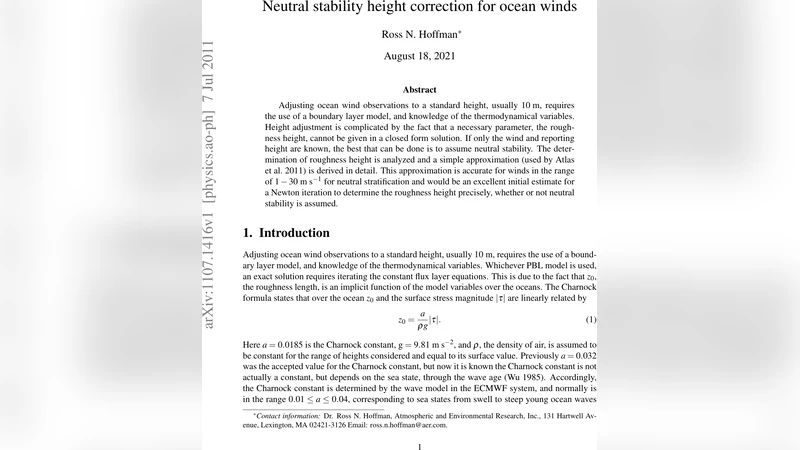
Adjusting ocean wind observations to a standard height, usually 10 m, requires the use of a boundary layer model, and knowledge of the thermodynamical variables. Height adjustment is complicated by the fact that a necessary parameter, the roughness height, cannot be given in a closed form solution. If only the wind and reporting height are known, the best that can be done is to assume neutral stability. The determination of roughness height is analyzed and a simple approximation (used by Atlas et al. 2011) is derived in detail. This approximation is accurate for winds in the range of 1 - 30 m/s for neutral stratification and would be an excellent initial estimate for a Newton iteration to determine the roughness height precisely, whether or not neutral stability is assumed.
💡 Research Summary
The paper addresses the practical problem of converting ocean wind observations made at arbitrary heights to a standard reference height of 10 m, a step required for consistent atmospheric and oceanographic analyses. The key difficulty lies in determining the surface roughness length, z₀, which links wind stress to the wind profile through the Charnock relationship (z₀ = a ρ g⁻¹ |τ|). Because τ itself depends on z₀ via the neutral drag coefficient, a closed‑form solution is unavailable and an iterative approach is normally required.
The author assumes neutral atmospheric stability (Richardson number Ri = 0) – the only realistic assumption when only wind speed and measurement height are known – and derives the governing equation for z₀:
z₀ = a g C_dn |V|², with C_dn = (k/ln(z/z₀))²
where k ≈ 0.4 is the von Kármán constant, V is the wind speed at height z, and a is the Charnock constant (typically 0.018–0.04). This implicit equation can be rewritten by introducing y = ln(z/z₀), which yields the compact form
y² e^(−y) = γ = (ak²/gz) V².
Given V and z, γ is directly computable, and the problem reduces to solving for y as a function of γ. By evaluating γ over a wide range of realistic z₀ values (spanning 10⁻⁹ – 10⁻² m) at a reference height of 10 m, the author finds that y varies almost linearly with log γ for the wind‑speed regime of interest (V ≤ 40 m s⁻¹). A simple linear regression yields
y ≈ c₀ + c₁ log γ, with c₀ = 3.7, c₁ = −1.165.
Substituting back gives an explicit approximation for the roughness length:
ẑ₀ = z exp
Comments & Academic Discussion
Loading comments...
Leave a Comment