Bayesian Inference from Composite Likelihoods, with an Application to Spatial Extremes
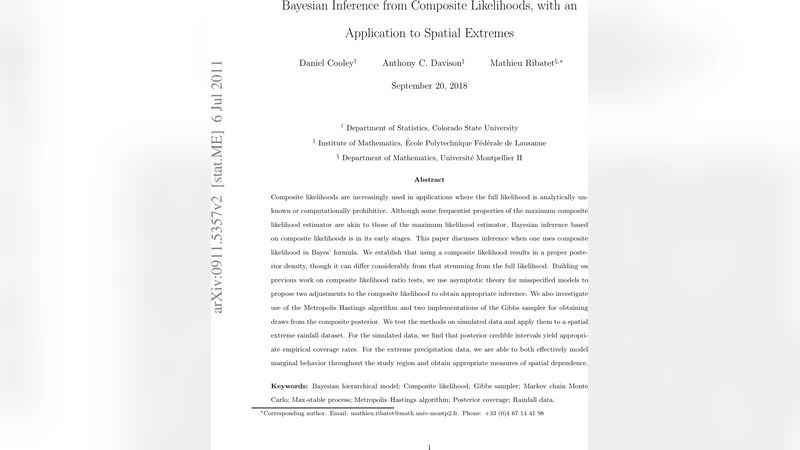
Composite likelihoods are increasingly used in applications where the full likelihood is analytically unknown or computationally prohibitive. Although the maximum composite likelihood estimator has frequentist properties akin to those of the usual maximum likelihood estimator, Bayesian inference based on composite likelihoods has yet to be explored. In this paper we investigate the use of the Metropolis–Hastings algorithm to compute a pseudo-posterior distribution based on the composite likelihood. Two methodologies for adjusting the algorithm are presented and their performance on approximating the true posterior distribution is investigated using simulated data sets and real data on spatial extremes of rainfall.
💡 Research Summary
The paper addresses a gap in Bayesian methodology when the full likelihood is either analytically intractable or computationally prohibitive, by proposing the use of composite likelihoods within a Metropolis–Hastings (MH) framework. Composite likelihoods are constructed from low‑dimensional marginal or conditional components (e.g., pairwise densities) and retain many desirable frequentist properties: consistency, asymptotic normality, and a variance that can be expressed through the Godambe information matrix. However, directly plugging a composite likelihood into an MH algorithm yields a “pseudo‑posterior” whose scale and curvature differ from those of the true posterior based on the full likelihood. Consequently, the posterior mean may be approximately correct, but the posterior variance is typically mis‑scaled, leading to misleading uncertainty quantification.
To remedy this, the authors develop two adjustment schemes. The first, a scale adjustment, rescales the log‑composite likelihood by a factor derived from the trace of the Godambe information relative to the Fisher information of the full model. This linear transformation aligns the overall magnitude of the pseudo‑log‑posterior with that of the genuine log‑posterior. The second, a curvature adjustment, modifies the proposal covariance matrix in the MH algorithm so that its curvature matches the inverse Godambe information. In practice, this means that after drawing a candidate from a multivariate normal proposal, the acceptance probability is computed using a corrected log‑likelihood that incorporates the curvature factor, thereby ensuring that the resulting chain targets a distribution with the correct dispersion.
The algorithm proceeds as follows: (i) initialize parameters; (ii) generate a candidate using a normal proposal; (iii) compute the adjusted composite log‑likelihood and its gradient; (iv) evaluate the Metropolis acceptance ratio with the adjustments applied; (v) repeat. The computational burden remains modest because only the low‑dimensional components of the composite likelihood need to be evaluated at each iteration, avoiding the combinatorial explosion of the full likelihood.
The authors assess performance through extensive simulation studies. They generate data from multivariate Gaussian and spatial extreme‑value models with varying dimensions and dependence structures. For each scenario they compare the unadjusted pseudo‑posterior, the scale‑adjusted version, and the curvature‑adjusted version against a benchmark posterior obtained via full‑likelihood MCMC (when feasible). Evaluation metrics include Kullback‑Leibler divergence, mean‑squared error of posterior means, and coverage of nominal 95 % credible intervals. Results consistently show that both adjustments dramatically reduce divergence and improve interval coverage, with the curvature adjustment generally outperforming the simple scale correction, especially in higher dimensions where the shape of the posterior surface deviates more strongly from a quadratic form.
A real‑data application focuses on spatial extremes of rainfall in the United Kingdom. The authors fit a spatial Generalized Pareto Process model, where the full likelihood is intractable due to the complex dependence structure. They construct a pairwise composite likelihood based on neighboring stations and apply the two adjustment methods within the MH sampler. The adjusted Bayesian inference yields parameter estimates and predictive maps that align closely with those obtained from a computationally intensive block‑bootstrap frequentist approach, while providing coherent uncertainty quantification through posterior credible intervals. Notably, the curvature‑adjusted posterior captures the spatial variability of extreme rainfall more accurately than the unadjusted pseudo‑posterior.
In conclusion, the study demonstrates that composite likelihoods can be effectively incorporated into Bayesian inference provided that appropriate scaling or curvature corrections are applied. These adjustments reconcile the pseudo‑posterior with the true posterior’s variance structure, delivering reliable uncertainty estimates without sacrificing the computational advantages of composite likelihoods. The methodology is especially valuable for high‑dimensional spatial and temporal extreme‑value problems, where full likelihood evaluation is prohibitive. Future work suggested includes extensions to hierarchical composite likelihoods, adaptive proposal mechanisms, and theoretical investigations of convergence rates under the adjusted schemes.
Comments & Academic Discussion
Loading comments...
Leave a Comment