Vortex Turbulence in Linear Schroedinger Wave Mechanics
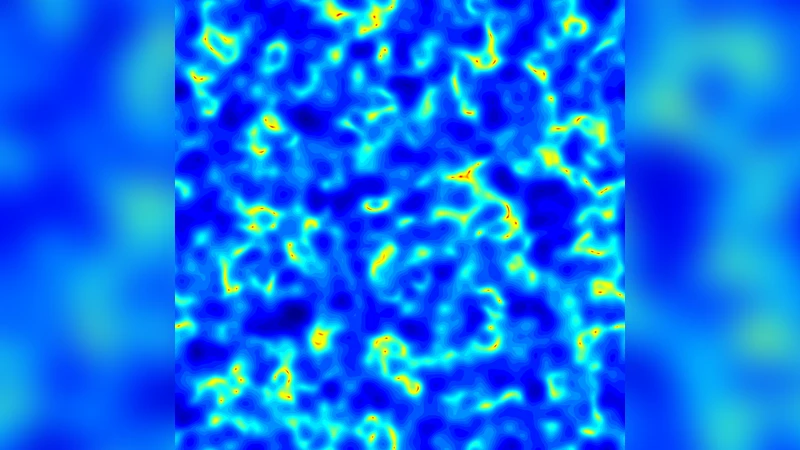
Quantum turbulence that exhibits vortex creation, annihilation and interactions is demonstrated as an exact solution of the time-dependent, free-particle Schr"odinger equation evolved from a smooth random-phased initial condition. Relaxed quantum turbulence in 2D and 3D exhibits universal scaling in the steady-state energy spectrum as k-1 in small scales. Due to the lack of dissipation, no evidence of the Kolmogorov-type forward energy cascade in 3D or the inverse energy cascade in 2D is found, but the rotational and potential flow components do approach equi-partition in the scaling regime. In addition, the 3D vortex line-line correlation exhibits universal behaviour, scaled as \Deltar^-2, where \Deltar is the separation between any two vortex line elements, in fully developed turbulence. We also show that the quantum vortex is not frozen to the matter, nor is the vortex motion induced by other vortices via Biot-Savart’s law. Thus, the quantum vortex is actually a nonlinear wave, propagating at a speed very different from a classical vortex.
💡 Research Summary
The authors present an exact, analytical study of quantum turbulence generated by the free‑particle Schrödinger equation. Starting from a smooth random‑phase wavefunction, the time evolution creates phase singularities where the complex amplitude vanishes; these singularities are identified as quantum vortices. By performing large‑scale numerical integrations in both two and three dimensions, the authors follow the system to a statistically steady state in which vortices are continuously created, annihilated, and interact.
A central result is the observation that, in the inertial‑range of large wave numbers (small physical scales), the kinetic‑energy spectrum follows a universal power law E(k) ∝ k⁻¹. This scaling is markedly different from the Kolmogorov spectrum (k⁻⁵⁄³) familiar from classical turbulence. The authors attribute the deviation to the absence of any dissipative mechanism: without viscosity there is no forward cascade in three dimensions and no inverse cascade in two dimensions. Consequently, the usual picture of a constant energy flux across scales does not apply.
The study further decomposes the flow into rotational (vortical) and potential (irrotational) components. In the scaling regime both components share the kinetic energy almost equally, indicating that quantum turbulence is a hybrid of vortex‑dominated and wave‑dominated motions. In three dimensions the line‑line correlation of vortex filaments decays as Δr⁻², a universal law that reflects a statistically self‑similar arrangement of vortex lines.
Perhaps the most striking finding concerns vortex dynamics. Classical vortices are “frozen‑in” to the fluid and move according to the Biot‑Savart law, i.e., they are advected by the velocity field generated by all other vortices. In contrast, the quantum vortices in this model are not attached to the matter density; they propagate as nonlinear wave excitations with a speed that can differ dramatically from the local fluid velocity. Their motion is governed by the evolution of the wave‑function phase rather than by a Biot‑Savart induced velocity field.
Overall, the paper demonstrates that a linear, non‑interacting Schrödinger equation can support a fully developed turbulent state with well‑defined statistical properties. The results highlight fundamental differences between quantum and classical turbulence—most notably the lack of dissipative cascades, the equipartition of rotational and potential energy, and the wave‑like nature of vortex motion. The work opens avenues for future investigations that introduce interactions, external potentials, or confinement, thereby bridging the gap between idealized quantum turbulence and realistic systems such as superfluid helium, atomic Bose‑Einstein condensates, and polariton fluids.
Comments & Academic Discussion
Loading comments...
Leave a Comment