Problem with almost everywhere equality
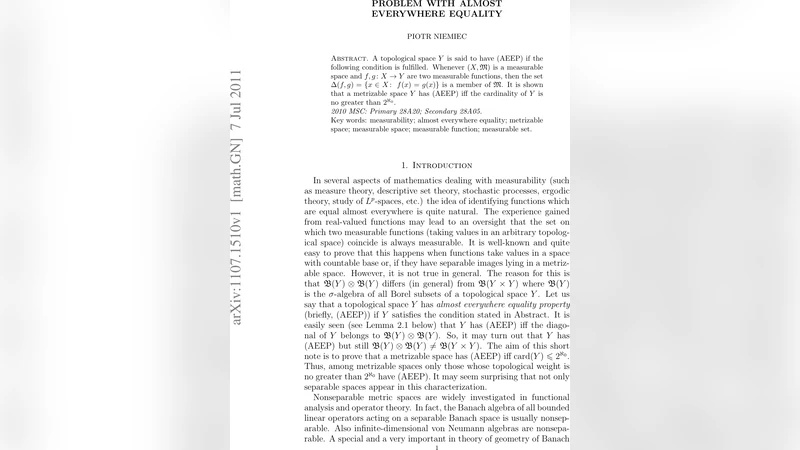
A topological space $Y$ is said to have (AEEP) if the following condition is fulfilled. Whenever $(X,\mathfrak{M})$ is a measurable space and $f, g: X \to Y$ are two measurable functions, then the set $\Delta(f,g) = {x \in X:\ f(x) = g(x)}$ is a member of $\mathfrak{M}$. It is shown that a metrizable space $Y$ has (AEEP) iff the cardinality of $Y$ is no greater than $2^{\aleph_0}$.
💡 Research Summary
The paper introduces and investigates a property of topological spaces called the Almost Everywhere Equality Property (AEEP). A space Y is said to have AEEP if for every measurable space (X, 𝔐) and every pair of measurable functions f, g : X → Y, the set of points where the functions agree,
Δ(f,g) = { x ∈ X : f(x) = g(x) },
belongs to the σ‑algebra 𝔐. In other words, the coincidence set of any two measurable maps into Y must itself be a measurable set. This requirement is stronger than the usual “equality almost everywhere” notion, which only demands that the complement of Δ(f,g) be a null set with respect to a given measure; AEEP insists that Δ(f,g) be measurable regardless of any underlying measure.
The main result of the paper is a precise characterization of metrizable spaces that enjoy AEEP: a metrizable space Y has AEEP if and only if its cardinality does not exceed the cardinality of the continuum, i.e. |Y| ≤ 2^{ℵ₀}. The proof proceeds in two directions.
(1) Sufficiency (|Y| ≤ 2^{ℵ₀} ⇒ AEEP).
If Y is metrizable and |Y| ≤ 2^{ℵ₀}, then Y can be embedded into the real line ℝ via a continuous injection. Since ℝ already satisfies AEEP (the coincidence set of two Borel‑measurable real‑valued functions is a Borel set), any two measurable maps f, g : X → Y can be written as f = φ∘f₁, g = φ∘g₁ where φ : ℝ → Y is the embedding and f₁, g₁ are ℝ‑valued measurable functions. Consequently, Δ(f,g) = Δ(f₁,g₁) is a Borel set and therefore belongs to 𝔐. The argument uses only the existence of a countable base for Y (which follows from metrizability) and the fact that the Borel σ‑algebra on ℝ is closed under countable operations, guaranteeing measurability of coincidence sets.
(2) Necessity (AEEP ⇒ |Y| ≤ 2^{ℵ₀}).
Assume Y is metrizable and |Y| > 2^{ℵ₀}. The authors construct a measurable space (X, 𝔐) and two measurable functions f, g : X → Y for which Δ(f,g) fails to be measurable. The construction starts with a set X of cardinality 2^{ℵ₀} equipped with a σ‑algebra that is the Borel σ‑algebra of a Polish space (for instance, the Cantor set). Inside X one selects a non‑Borel subset A of cardinality 2^{ℵ₀} (such subsets exist by standard descriptive‑set‑theoretic arguments). Define f to be constant equal to a point y₀∈Y on A and constant equal to a different point y₁∈Y on X\A; define g to be constantly y₀ on all of X. Both f and g are measurable because the preimages of singletons are either A, X\A, or X, all of which are measurable by construction. However, Δ(f,g) = A, which by choice is not a Borel set, and therefore Δ(f,g)∉𝔐. This contradiction shows that if Y has more than continuum many points, AEEP cannot hold.
The paper also discusses why metrizability is essential. In non‑metrizable spaces the equivalence may fail even when |Y| ≤ 2^{ℵ₀}, because the lack of a countable base prevents the reduction to ℝ‑valued functions. Conversely, for certain non‑metrizable spaces with small cardinality, AEEP can still hold, but additional topological constraints (e.g., being a continuous image of a Polish space) are required.
Beyond the central theorem, the authors explore several corollaries and extensions. They note that AEEP is preserved under continuous bijections and under taking closed subspaces, which allows the result to be applied to many classical function spaces (e.g., C(
Comments & Academic Discussion
Loading comments...
Leave a Comment