Homotopy categories and idempotent completeness, weight structures and weight complex functors
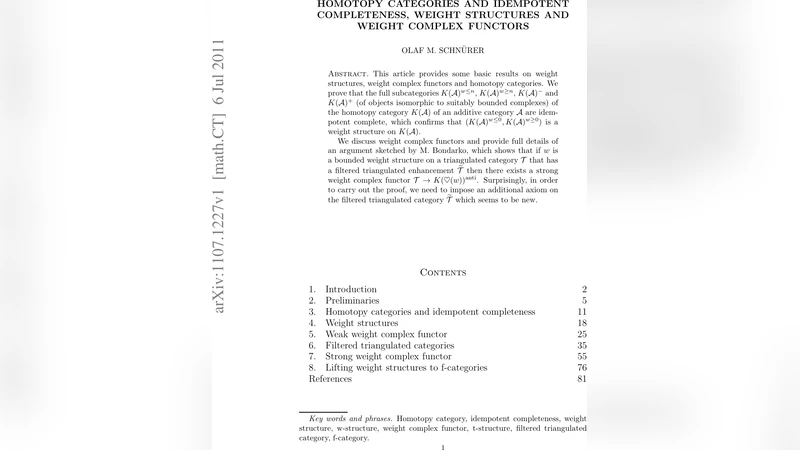
This article provides some basic results on weight structures, weight complex functors and homotopy categories. We prove that the full subcategories K(A)^{w < n}, K(A)^{w > n}, K(A)^- and K(A)^+ (of objects isomorphic to suitably bounded complexes) of the homotopy category K(A) of an additive category A are idempotent complete, which confirms that (K(A)^{w <= 0}, K(A)^{w >= 0}) is a weight structure on K(A). We discuss weight complex functors and provide full details of an argument sketched by M. Bondarko, which shows that if w is a bounded weight structure on a triangulated category T that has a filtered triangulated enhancement T’ then there exists a strong weight complex functor T -> K(heart(w))^{anti}. Surprisingly, in order to carry out the proof, we need to impose an additional axiom on the filtered triangulated category T’ which seems to be new.
💡 Research Summary
The paper is divided into two major parts, each addressing a foundational aspect of weight structures and weight complex functors in triangulated categories.
In the first part the author studies the homotopy category K(A) of an additive category A. For each integer n the full subcategories K(A)^{w ≤ n} and K(A)^{w ≥ n} consist of complexes that are isomorphic (in K(A)) to complexes concentrated in degrees ≤ n or ≥ n respectively. The main result (Theorem 3.1) shows that these subcategories are idempotent complete (Karoubian). The proof is constructive and relies on Thomason’s work on K‑theory of triangulated categories together with ideas of Balmer and Schlichting on the Grothendieck group of triangulated categories. By establishing that any idempotent endomorphism in K(A)^{w ≤ n} (or K(A)^{w ≥ n}) splits, the author proves that the pair (K(A)^{w ≤ 0}, K(A)^{w ≥ 0}) satisfies the defining axioms of a weight structure. Additional results show that K(A) itself is idempotent complete when A has countable coproducts, or when A is abelian; in these cases the proof follows from earlier work of Bökstedt–Neeman or from results of Balmer–Krause. Moreover, the Grothendieck groups K₀(K(A)), K₀(K(A)^{−}), and K₀(K(A)^{+}) all vanish for essentially small additive A.
The second part turns to weight complex functors. Given a bounded weight structure w on a triangulated category T with heart ♥ = T^{w ≤ 0} ∩ T^{w ≥ 0}, there is a canonical “weak” weight complex functor WC : T → K^{weak}(♥) constructed by choosing a weight decomposition triangle for each object and arranging the resulting “weight pieces” into a complex. This functor is additive and respects the translation, but it does not in general preserve distinguished triangles.
To obtain a “strong” weight complex functor, the author assumes that T admits a filtered triangulated enhancement e T (an f‑category in the sense of Beĭlinson). The key new ingredient is an additional axiom (fcat7) imposed on e T. Roughly, (fcat7) guarantees that any morphism in e T can be completed to a 3 × 3 diagram with the appropriate exactness properties; this axiom is used twice in the construction of the strong functor. Under the hypotheses that w is bounded and that e T satisfies (fcat7), Theorem 7.1 establishes the existence of a strong weight complex functor gWC : T → K(♥)^{anti}. Here K(♥)^{anti} is the same additive category as K(♥) but equipped with a “reversed” triangulated structure: a triangle X → Y → Z →
Comments & Academic Discussion
Loading comments...
Leave a Comment