Computing Distances between Probabilistic Automata
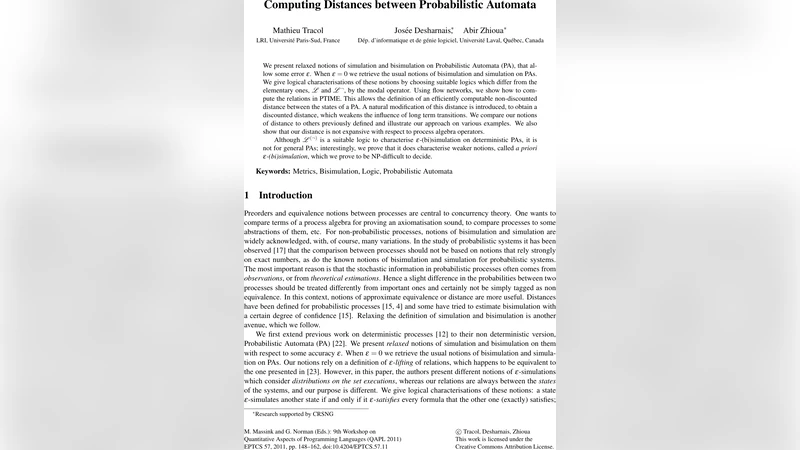
We present relaxed notions of simulation and bisimulation on Probabilistic Automata (PA), that allow some error epsilon. When epsilon is zero we retrieve the usual notions of bisimulation and simulation on PAs. We give logical characterisations of these notions by choosing suitable logics which differ from the elementary ones, L with negation and L without negation, by the modal operator. Using flow networks, we show how to compute the relations in PTIME. This allows the definition of an efficiently computable non-discounted distance between the states of a PA. A natural modification of this distance is introduced, to obtain a discounted distance, which weakens the influence of long term transitions. We compare our notions of distance to others previously defined and illustrate our approach on various examples. We also show that our distance is not expansive with respect to process algebra operators. Although L without negation is a suitable logic to characterise epsilon-(bi)simulation on deterministic PAs, it is not for general PAs; interestingly, we prove that it does characterise weaker notions, called a priori epsilon-(bi)simulation, which we prove to be NP-difficult to decide.
💡 Research Summary
The paper addresses the problem of quantitatively comparing states of Probabilistic Automata (PA), which are labelled transition systems where transitions lead to probability distributions and nondeterminism may be present. Classical simulation and bisimulation for PA require exact matching of probabilities, a requirement that is often too strict for real‑world systems where probabilities are estimated or observed with noise. To overcome this, the authors introduce ε‑relaxed notions of simulation and bisimulation.
An ε‑simulation relation R between states satisfies: whenever s R t and s can perform an a‑labelled transition to a sub‑distribution µ, there must exist a matching a‑labelled transition from t to a sub‑distribution ν such that for every set of states E, µ(E) ≤ ν(R(E)) + ε. The ε‑lifting of a relation, denoted µ Lε(R) ν, captures precisely this condition. The authors prove that their definition of ε‑lifting is equivalent to the classic weight‑function formulation and to a max‑flow condition in a specially constructed flow network N(µ,ν,R). In this network, source and sink are connected to the probabilities of µ and ν, while edges representing R have unit capacity. The maximal flow being at least µ(S) − ε is equivalent to µ Lε(R) ν. Consequently, checking ε‑simulation reduces to a polynomial‑time max‑flow computation.
The paper defines two monotone operators, Fε and Gε, on relations: Fε captures the one‑step simulation condition, while Gε adds symmetry to obtain bisimulation. The greatest fixed points of these operators, obtained by iterating from the universal relation, are the largest ε‑simulation and ε‑bisimulation relations. Because the automata are assumed finitely branching, these fixed points are reached after finitely many iterations, yielding a PTIME algorithm for the relations themselves.
On the logical side, two modal logics are introduced. Logic L lacks negation and contains formulas of the form ⟨a⟩≥δ φ, while L¬ adds classical negation. A relaxed semantics | = ε is defined, where a modal formula ⟨a⟩≥δ φ holds at a state s if there exists an a‑transition to a distribution µ such that µ(
Comments & Academic Discussion
Loading comments...
Leave a Comment