The traveling salesman problem on cubic and subcubic graphs
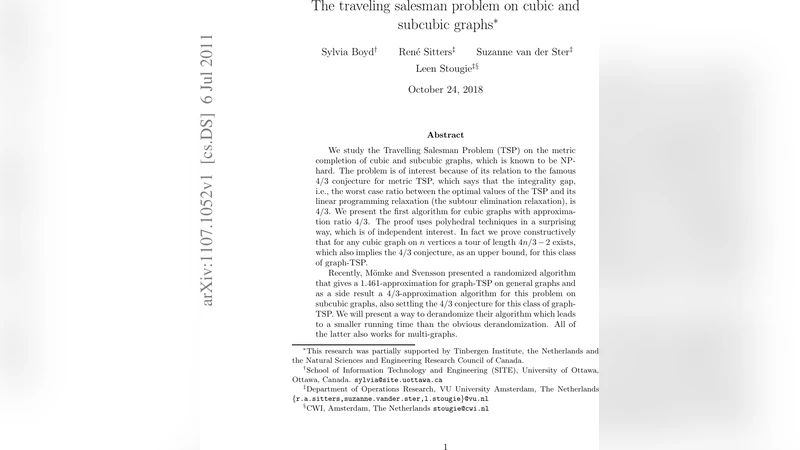
We study the Travelling Salesman Problem (TSP) on the metric completion of cubic and subcubic graphs, which is known to be NP-hard. The problem is of interest because of its relation to the famous 4/3 conjecture for metric TSP, which says that the integrality gap, i.e., the worst case ratio between the optimal values of the TSP and its linear programming relaxation (the subtour elimination relaxation), is 4/3. We present the first algorithm for cubic graphs with approximation ratio 4/3. The proof uses polyhedral techniques in a surprising way, which is of independent interest. In fact we prove constructively that for any cubic graph on $n$ vertices a tour of length 4n/3-2 exists, which also implies the 4/3 conjecture, as an upper bound, for this class of graph-TSP. Recently, M"omke and Svensson presented a randomized algorithm that gives a 1.461-approximation for graph-TSP on general graphs and as a side result a 4/3-approximation algorithm for this problem on subcubic graphs, also settling the 4/3 conjecture for this class of graph-TSP. We will present a way to derandomize their algorithm which leads to a smaller running time than the obvious derandomization. All of the latter also works for multi-graphs.
💡 Research Summary
The paper investigates the Traveling Salesman Problem (TSP) on the metric completion of graphs whose maximum degree is three, i.e., cubic and subcubic graphs. The authors focus on two intertwined goals: (i) to prove that every cubic graph on n vertices admits a TSP tour of length at most 4n/3 − 2, thereby establishing the long‑standing 4/3 conjecture for this class, and (ii) to provide efficient algorithms that achieve the same approximation ratio, both for simple graphs and for multigraphs.
The first part of the work builds on Petersen’s theorem, which guarantees a perfect matching in any bridgeless cubic graph. By removing a perfect matching one obtains a cycle cover. The classic “Approach 1/2” (contract cycles, add a doubled spanning tree, then expand) yields a tour of length n + 2k − 2 where k is the number of cycles, but this bound can be far from optimal. The authors introduce a polyhedral perspective: they consider the vector x* = (1/3)·χ_E (the all‑one vector scaled by 1/3) and show that x* lies in the perfect‑matching polytope. Moreover, they prove Lemma 1, which states that x* can be expressed as a convex combination of 3‑cut perfect matchings—matchings that intersect every 3‑edge cut in exactly one edge. This decomposition is obtained via Barahona’s O(n⁶) algorithm for enumerating perfect matchings. Because each 3‑cut perfect matching contributes exactly one edge to each cut, the average contribution per vertex is 1/3 of an edge, which translates into a guarantee that the total number of singleton vertices plus twice the number of cycles in the refined cover does not exceed n/3. Consequently the constructed spanning Eulerian multigraph has at most 4n/3 − 2 edges, and a shortcutting argument yields a TSP tour of the same length. This is a constructive proof that the integrality gap of the subtour elimination LP is at most 4/3 for cubic graph‑TSP, and it is the first algorithm achieving this ratio deterministically for cubic graphs.
The second major contribution concerns the recent randomized algorithm of Mömke and Svensson, which achieves a 1.461‑approximation for general graph‑TSP and a 4/3‑approximation for subcubic graphs. Their method selects a spanning tree T* and a perfect matching M* such that the intersection |M* ∩ T*| is small (≤ p). By doubling the edges of the intersection and deleting the non‑tree matching edges, one obtains an Eulerian subgraph with n + 2p edges. The randomization comes from sampling a perfect matching according to the convex combination of 3‑cut matchings described above; the expected value of p is bounded, giving the desired approximation.
The authors show how to derandomize this procedure more efficiently than the naïve enumeration of all extreme points of the convex combination (which would also be O(n⁶)). They observe that the convex combination can be interpreted as a probability distribution over a polynomial‑size set of matchings, and that the value of p can be minimized by solving a series of minimum‑cost perfect‑matching problems. By employing a binary search on a suitably defined cost parameter and using standard matching algorithms, they achieve an overall running time of O(n² log n). This derandomization works not only for simple subcubic graphs but also for multigraphs, and it extends to the general graph‑TSP case with only modest modifications.
The paper also discusses how to handle bridges: after removing bridges, the algorithm is applied to each bridgeless component, and the bridges are later re‑inserted (each counted twice) to maintain Eulerian parity.
In the broader context, the work improves upon earlier results: Christofides’ 3/2‑approximation, Gamarnik et al.’s 1.487‑approximation for 3‑edge‑connected cubic graphs, Aggarwal et al.’s simpler 4n/3‑approximation for the same class, and Gharan et al.’s 3/2 − ε randomized improvement for general graphs. By providing a deterministic 4/3‑approximation for cubic graphs and an O(n² log n) derandomization of the Mömke‑Svensson algorithm for subcubic graphs, the paper settles the 4/3 conjecture for these classes and offers a practically implementable algorithmic framework.
Overall, the paper’s key contributions are: (1) a constructive proof that every cubic graph admits a TSP tour of length ≤ 4n/3 − 2, confirming the 4/3 integrality‑gap bound for this class; (2) the introduction of a convex‑combination of 3‑cut perfect matchings as a powerful polyhedral tool; and (3) an efficient deterministic derandomization of the Mömke‑Svensson approach, reducing the runtime from O(n⁶) to O(n² log n) while preserving the 4/3‑approximation guarantee for subcubic (and multigraph) instances. These results advance both the theoretical understanding of the TSP integrality gap and the practical algorithmic landscape for low‑degree graph instances.
Comments & Academic Discussion
Loading comments...
Leave a Comment