QCDMAPT_F: Fortran version of QCDMAPT package
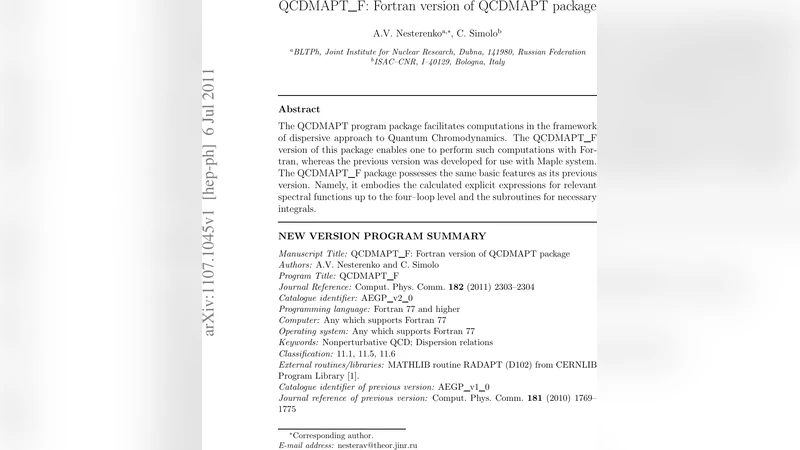
The QCDMAPT program package facilitates computations in the framework of dispersive approach to Quantum Chromodynamics. The QCDMAPT_F version of this package enables one to perform such computations with Fortran, whereas the previous version was developed for use with Maple system. The QCDMAPT_F package possesses the same basic features as its previous version. Namely, it embodies the calculated explicit expressions for relevant spectral functions up to the four-loop level and the subroutines for necessary integrals.
💡 Research Summary
The paper presents QCDMAPT_F, a Fortran‑based implementation of the QCDMAPT package that was originally written for the symbolic computer algebra system Maple. The QCDMAPT package is designed to facilitate calculations within the dispersive (or analytic) approach to Quantum Chromodynamics (QCD), a framework in which the strong coupling α_s(Q²) is analytically continued into the complex momentum plane and its spectral function ρ(σ) is used to reconstruct physical observables via a Källén‑Lehmann type representation.
In the one‑loop approximation the running coupling has a simple logarithmic form, and the corresponding spectral function can be obtained analytically with minimal effort. At higher loop orders (two‑, three‑, and four‑loop) the β‑function acquires additional coefficients, leading to a running coupling that involves nested logarithms and rational functions. Consequently, the explicit expressions for the spectral functions become cumbersome, containing many terms and special functions. While the original Maple version could generate these expressions symbolically, numerical evaluation of the resulting integrals proved to be computationally intensive and slowed down large‑scale studies.
QCDMAPT_F addresses these limitations by providing pre‑computed explicit formulas for the spectral functions up to the four‑loop level, together with Fortran subroutines that evaluate the necessary integrals. The implementation relies on the CERNLIB MathLib library, specifically subroutine D102, which offers high‑precision numerical integration. By delegating the integration to a well‑tested library routine, the package achieves both accuracy and speed.
The software distribution consists of three main files: the main program (QCDMAPT_F.f) and two example input files (QCDMAPT_F.i1 and QCDMAPT_F.i2). The main program defines the spectral functions, calls the integration subroutines, and computes the (M)APT (Modified Analytic Perturbation Theory) and APT expansion functions in both timelike and spacelike regimes. Users specify physical parameters—such as the QCD scale Λ_QCD, the number of active quark flavors, the momentum‑transfer range, and output options—in the input files. The program then prints the results to the screen and, optionally, writes them to data files covering a user‑defined kinematic interval.
Performance tests reported by the authors show that a full run with the sample input set (QCDMAPT_F.i2) completes in roughly one minute on a typical modern CPU, a time that scales modestly with the size of the kinematic grid. Because the code conforms to the Fortran 77 standard, it can be compiled with any Fortran 77 (or later) compiler on any operating system that supports the language. This makes the package suitable for integration into larger Fortran‑based analysis frameworks, high‑performance computing clusters, or parallel workflows.
A practical requirement is the installation of the CERNLIB MathLib library, which, although no longer actively maintained, remains available in many Linux distributions and can be built from source if necessary. The authors note that the current implementation is limited to the four‑loop β‑function coefficients and the associated mass‑scheme conventions used in the original QCDMAPT papers. Should higher‑order perturbative results become available, the package would need to be updated accordingly.
In summary, QCDMAPT_F delivers a robust, efficient, and portable tool for performing analytic QCD calculations at up to four‑loop accuracy. By moving from a symbolic environment to a compiled Fortran code base, it eliminates the bottlenecks associated with large‑scale numerical evaluations, while preserving the full functionality of the original Maple version. This makes it an attractive resource for theorists studying low‑energy QCD phenomena, phenomenologists performing global fits, and computational physicists requiring fast, reliable evaluations of analytic coupling functions across wide kinematic ranges.
Comments & Academic Discussion
Loading comments...
Leave a Comment