Integral Value Transformations: A Class of Discrete Dynamical Systems
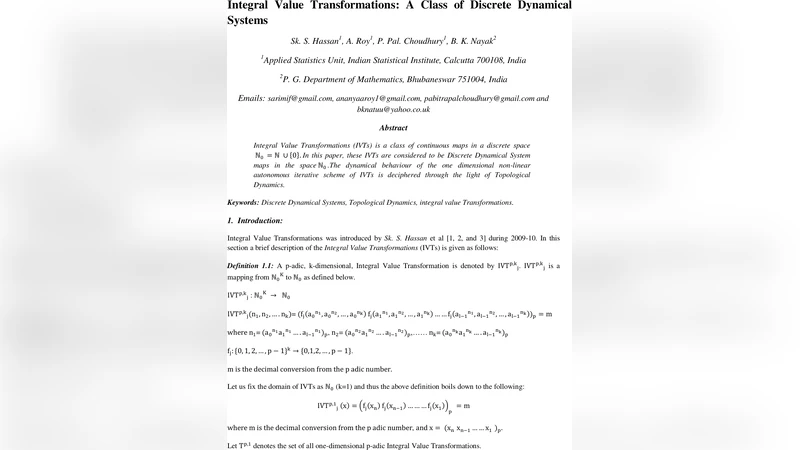
Here the Integral Value Transformations (IVTs) are considered to be Discrete Dynamical System map in the space\mathbb{N}_(0). In this paper, the dynamics of IVTs is deciphered through the light of Topological Dynamics.
💡 Research Summary
The paper introduces Integral Value Transformations (IVTs) as a new class of functions defined on the set of non‑negative integers ℕ₀. An IVT is constructed by first expressing a natural number in its p‑adic representation (for a fixed base p), then applying a digit‑wise rule (e.g., multiplication, addition, or a more complex mapping) to each p‑adic digit, and finally converting the transformed digit string back to a standard integer. The authors focus on the one‑dimensional case (k = 1) and treat each IVT as a map ℕ₀ → ℕ₀.
The central claim is that any IVT naturally defines a discrete dynamical system (DDS) on ℕ₀. The paper formalises this by showing that the set of IVTs together with the composition operation forms a semigroup acting on ℕ₀; consequently, iterating an IVT yields an orbit (the sequence of successive images of an initial point). Standard dynamical notions—fixed points, periodic points, and orbits—are defined in this context. A subclass of IVTs that behave like the Collatz map (even numbers are halved, odd numbers are transformed by a linear rule) is highlighted; these “Collatz‑like” IVTs exhibit finite orbits that always contain the points 0 and 1.
Stability analysis proceeds by linearising the non‑linear recurrence x_{n+1}=IVT(x_n) around a fixed point using a Taylor expansion. The linearised system takes the form x_{n+1}=a·x_n+b, where the eigenvalue a determines local behaviour: 0<a<1 gives monotone convergence, –1<a<0 yields damped oscillations, and |a|≥1 leads to divergence. To obtain global results, the authors invoke the Banach Fixed‑Point Theorem. They equip ℕ₀ with the p‑adic metric d(x,y)=p^{−ν_p(x−y)} (ν_p is the p‑adic valuation), which makes (ℕ₀,d) a complete metric space. If an IVT is a contraction (i.e., d(IVT(x),IVT(y))≤λ·d(x,y) for some λ∈(0,1)), then a unique fixed point exists and the iteration converges globally to it. This provides sufficient conditions for global stability of the underlying non‑linear system.
From a topological viewpoint, the authors endow ℕ₀ with the discrete topology (every subset is open) and the same p‑adic metric, turning it into a compact, totally disconnected space. They introduce the counting measure μ(A)=|A| as the natural σ‑finite measure on ℕ₀. For bijective IVTs, μ is preserved: μ(IVT^{-1}(A))=μ(A). The paper demonstrates that the identity IVT on the 2‑adic system is measure‑preserving and ergodic (no non‑trivial invariant sets of intermediate measure). In contrast, many Collatz‑like IVTs are not measure‑preserving because they map a finite set (e.g., {0}) onto an infinite set, decreasing the measure.
The notion of topological conjugacy is explored in depth. Two DDS (X,f) and (Y,g) are said to be conjugate if there exists a homeomorphism h:X→Y such that h∘f=g∘h. The authors construct explicit continuous surjections (factor maps) between various IVTs, showing that many seemingly different IVTs are actually topologically equivalent. For instance, IVTs defined by different digit‑wise rules can be related by a scaling homeomorphism h(x)=c·x (with c a p‑adic unit), establishing that they share identical orbit structures, fixed‑point sets, and stability properties.
A particularly insightful part of the paper decomposes any IVT into three elementary maps: (1) C, the conversion from a natural number to its p‑adic digit vector; (2) F, the digit‑wise transformation; and (3) C^{-1}, the inverse conversion back to a natural number. By analysing each component separately—C and C^{-1} are continuous bijections, while F carries the dynamical essence—the authors obtain a clearer picture of how the overall system behaves. This decomposition also facilitates the study of measure preservation, as the measure‑preserving property can be checked on each stage.
Throughout the manuscript, concrete examples for p=2 and p=3 illustrate the theory. In the binary case, the identity IVT is both measure‑preserving and ergodic; the Collatz‑like binary IVT produces orbits that eventually fall into the 0‑1 cycle. In the ternary case, a bijective but non‑Collatz IVT is shown to preserve measure, while a ternary Collatz‑like map fails to do so.
In summary, the authors successfully embed Integral Value Transformations within the established framework of discrete dynamical systems, topological dynamics, and metric fixed‑point theory. They provide rigorous criteria for the existence and uniqueness of fixed points, local and global stability conditions, and a thorough analysis of measure‑theoretic properties. Moreover, by establishing topological conjugacy between different IVTs, they demonstrate that the dynamical behaviour of a wide variety of digit‑wise transformations can be understood through a small set of canonical models. The work opens avenues for applying IVTs in areas such as cryptography, cellular automata, and the study of integer‑based chaotic processes.
Comments & Academic Discussion
Loading comments...
Leave a Comment