A note on the commutativity of inverse limit and orbit map
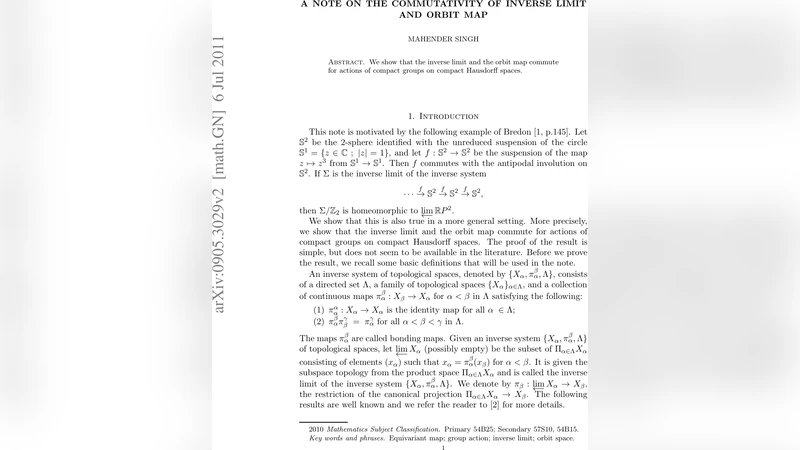
We show that the inverse limit and the orbit map commute for actions of compact groups on compact Hausdorff spaces.
💡 Research Summary
The paper investigates the relationship between two fundamental constructions in topology and group actions: the inverse limit of a system of spaces and the orbit space (quotient) of a group action. While it is well known that for certain special cases—such as finite groups, cyclic groups, or particular types of bonding maps—the operations of taking an inverse limit and passing to the orbit space can be interchanged, a general statement for compact groups acting on compact Hausdorff spaces has been missing. The author fills this gap by proving that, under the sole hypotheses that the acting group (G) is compact and each space (X_i) in the inverse system is compact Hausdorff, the two procedures commute.
The setting is a directed inverse system ({X_i, p_{ij}}{i\ge j}) where each (X_i) carries a continuous action of the compact group (G). The bonding maps (p{ij}:X_i\to X_j) are assumed to be (G)-equivariant, i.e. (p_{ij}(g\cdot x)=g\cdot p_{ij}(x)) for all (g\in G) and (x\in X_i). For each (i) the orbit map (\pi_i:X_i\to X_i/G) is a closed surjection because compact groups act properly on compact Hausdorff spaces; consequently each quotient (X_i/G) is again compact Hausdorff. The equivariance of the bonding maps induces canonical maps (\bar p_{ij}:X_i/G\to X_j/G) making ({X_i/G,\bar p_{ij}}) an inverse system of quotients.
The first technical step is to endow the inverse limit (\varprojlim X_i) with a natural (G)-action defined coordinatewise: for a point (x=(x_i){i\in I}) and (g\in G) set (g\cdot x=(g\cdot x_i){i\in I}). Continuity follows from the continuity of each individual action and the product topology. The associated orbit map (\Pi:\varprojlim X_i\to (\varprojlim X_i)/G) is again a closed surjection.
Two canonical maps are then constructed: \
Comments & Academic Discussion
Loading comments...
Leave a Comment