Cyclic homology of braided Hopf crossed products
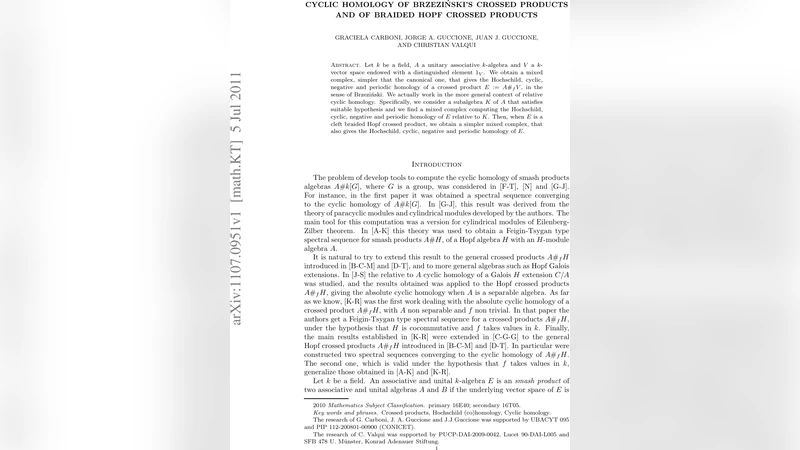
Let k be a field, A a unitary associative k-algebra and V a k-vector space endowed with a distinguished element 1_V. We obtain a mixed complex, simpler that the canonical one, that gives the Hochschild, cyclic, negative and periodic homology of a crossed product E:=A#_f V, in the sense of Brzezinski. We actually work in the more general context of relative cyclic homology. Specifically, we consider a subalgebra K of A that satisfies suitable hypothesis and we find a mixed complex computing the Hochschild, cyclic, negative and periodic homology of E relative to K. Then, when E is a cleft braided Hopf crossed product, we obtain a simpler mixed complex, that also gives the Hochschild, cyclic, negative and periodic homology of E.
💡 Research Summary
The paper addresses the computation of Hochschild, cyclic, negative, and periodic homology for Brzeziński’s crossed products (E = A#{f}V) and, in particular, for cleft braided Hopf crossed products. Starting from a field (k), a unital associative (k)-algebra (A), and a (k)-vector space (V) equipped with a distinguished element (1{V}), the authors recall Brzeziński’s construction: a twisting map (\chi: V\otimes A \to A\otimes V) and a normal cocycle (F: V\otimes V \to A\otimes V) satisfying compatibility and twisted module conditions. Under these hypotheses (A#_{f}V) becomes an associative algebra with unit (1#1).
The first major contribution is the construction of a mixed complex ((X_{\bullet}, d, D)) that is homotopy equivalent to the canonical normalized mixed complex ((C_{\bullet}(E), b, B)). This new complex is considerably smaller because it exploits the tensor product structure (A\otimes V) and eliminates redundant components while preserving the Hochschild boundary (b) and Connes operator (B). The authors work relatively: they fix a subalgebra (K\subseteq A) that is stable under (\chi) and such that (F) takes values in (K\otimes V). The mixed complex ((X_{\bullet}, d, D)) then computes the Hochschild, cyclic, negative, and periodic homology of (E) relative to (K). When (K) is separable, these relative groups coincide with the absolute ones.
Theorem 6.2 establishes the homotopy equivalence between ((X_{\bullet}, d, D)) and the canonical mixed complex, and as a corollary the authors derive four spectral sequences converging to the cyclic homology of the (K)-algebra (E). Two of these generalize the Feigin–Tsygan type sequences found in earlier works (
Comments & Academic Discussion
Loading comments...
Leave a Comment