Atmospheric Response to Fukushima Daiichi NPP (Japan) Accident Reviled by Satellite and Ground observations
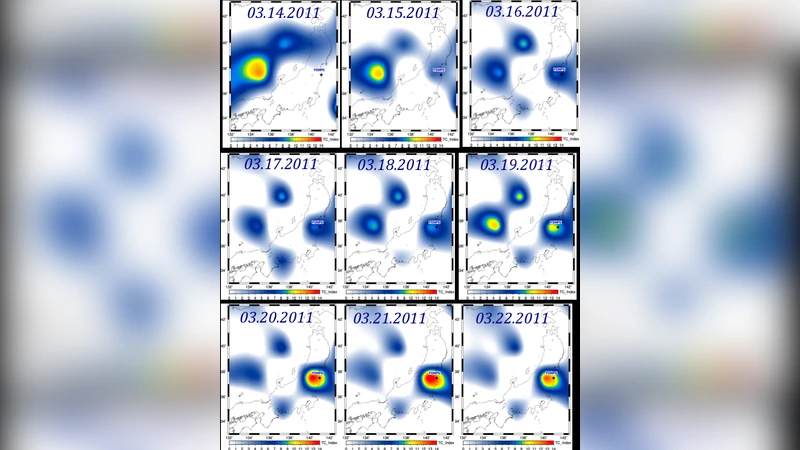
Immediately after the March 11, 2011 earthquake and tsunami in Japan we started to continuously survey the Outgoing Long-wavelength Radiation (OLR, 10-13 microns) from NOAA/AVHRR. Our preliminary results show the presence of hot spots on the top of the atmosphere over the Fukushima Daiichi Nuclear Power Plant (FDNPP) and due to their persistence over the same region they are most likely not of meteorological origin. On March 14 and 21 we detected a significant increase in radiation (14 W/m2) at the top of the atmosphere which also coincides with a reported radioactivity gas leaks from the FDNPP. After March 21 the intensity of OLR started to decline, which has been confirmed by ground radiometer network. We hypothesize that this increase in OLR was a result of the radioactive leaks released in atmosphere from the FDNPP. This energy triggers ionization of the air near the ground and lead to release of latent heat energy due to change of air humidity and temperature. Our early results demonstrate the potential of the latest development in atmospheric sciences and space-borne observations for monitoring nuclear accidents.
💡 Research Summary
The authors set out to determine whether satellite‑derived outgoing longwave radiation (OLR) could be used to detect atmospheric effects of the Fukushima Daiichi Nuclear Power Plant (FDNPP) accident that followed the March 11, 2011 Great East Japan earthquake and tsunami. Using daily OLR products from the NOAA Advanced Very High Resolution Radiometer (AVHRR), which integrate infrared emission in the 10–13 µm band, they examined the region over Japan from March 11 through the end of the month. Because AVHRR provides data on a 2.5° × 2.5° grid (≈250 km), the authors introduced a “Temporal Coherency” index (TC_index) to highlight the maximum rate of change at a specific grid point relative to a reference field constructed from the 2011 daily mean.
Their analysis identified the first OLR anomaly on March 12, a pronounced increase on March 14, and a peak on March 21 when OLR reached 14 W·m⁻²—about seven times the normal value of ~2 W·m⁻² for the same period in 2010. The timing of this peak coincided with TEPCO reports of radioactive gas releases and hydrogen explosions at the plant. Ground observations from a radiometer station located ~30 km northwest of FDNPP recorded a maximum dose rate of 110 µSv h⁻¹ on March 10, while the nearest weather station reported a temperature anomaly of +6 °C relative to the previous year on March 15. The authors argue that the concurrence of satellite, radiometric, and temperature anomalies points to a common cause: the release of radioactive material into the lower atmosphere.
To explain the mechanism, they propose that ionizing radiation from the leak increases atmospheric ionization, which in turn enhances the formation of hydrated ions and accelerates water‑vapour condensation. The latent heat released during this process would increase the upward infrared flux, manifesting as an OLR “hot spot” at satellite altitude. This hypothesis draws on earlier work linking ionization to pre‑seismic thermal anomalies and to atmospheric responses observed after the Chernobyl and Three‑Mile‑Island accidents.
The paper emphasizes the potential of space‑borne infrared observations for rapid, independent monitoring of nuclear accidents, even with a relatively coarse sensor. The authors suggest that higher‑resolution radiometers (e.g., MODIS, Himawari) could improve detection capability and spatial specificity.
However, several methodological limitations temper the conclusions. The AVHRR spatial resolution is far larger than the scale of the FDNPP release zone, raising concerns about signal dilution and the possibility that the observed OLR increase reflects regional meteorological changes (cloud cover, sea‑surface temperature, atmospheric humidity) rather than a direct radiative effect of radionuclides. The TC_index is described qualitatively, but no statistical significance testing, confidence intervals, or comparison with background variability is presented. Moreover, only a single ground radiation station is used to corroborate the satellite signal, and no quantitative correlation analysis (e.g., regression, cross‑spectral) between dose rates and OLR values is performed. The proposed ionization‑latent‑heat mechanism lacks energetic calculations; it is unclear whether the amount of ionizing energy released by the reported radionuclide inventory can plausibly generate a 14 W·m⁻² increase in OLR.
In summary, the study provides an intriguing proof‑of‑concept that OLR anomalies can be temporally associated with a major nuclear release, but the evidence remains circumstantial. Future work should employ higher‑resolution infrared sensors, incorporate comprehensive meteorological modeling to isolate non‑radiological influences, use a dense network of ground radiation and atmospheric ionization measurements, and perform rigorous statistical validation. Only with such a multi‑parameter, quantitatively robust approach can satellite OLR be established as a reliable tool for monitoring nuclear accidents.
Comments & Academic Discussion
Loading comments...
Leave a Comment