Does Quantum Interference exist in Twitter?
It becomes more difficult to explain the social information transfer phenomena using the classic models based merely on Shannon Information Theory (SIT) and Classic Probability Theory (CPT), because the transfer process in the social world is rich of semantic and highly contextualized. This paper aims to use twitter data to explore whether the traditional models can interpret information transfer in social networks, and whether quantum-like phenomena can be spotted in social networks. Our main contributions are: (1) SIT and CPT fail to interpret the information transfer occurring in Twitter; and (2) Quantum interference exists in Twitter, and (3) a mathematical model is proposed to elucidate the spotted quantum phenomena.
💡 Research Summary
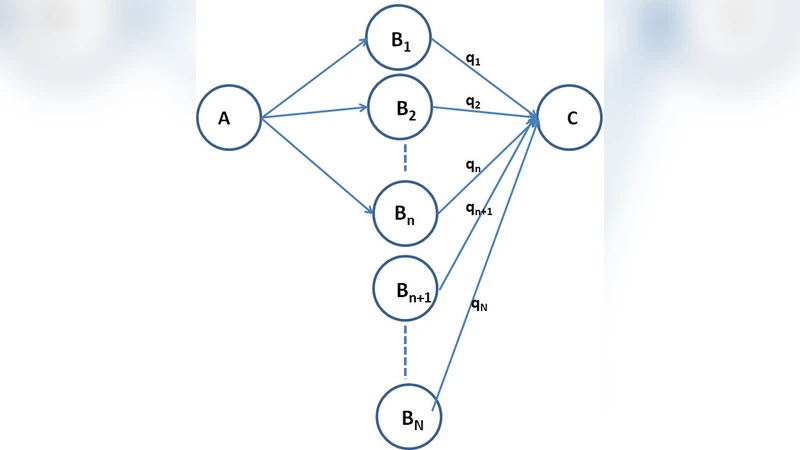
The paper investigates whether quantum‑like interference phenomena can be observed in the diffusion of information on Twitter. The authors argue that classic Shannon Information Theory (SIT) and Classic Probability Theory (CPT) treat information as abstract symbols and assume independent transmission channels, which is insufficient for the highly contextual, semantic‑rich environment of social media. To test this, they model information transfer as retweet cascades, defining a “channel” as a path A → B → C where A’s tweet reaches C through one or more intermediate users (B₁, B₂, …, Bₙ). They collect two large datasets: (1) a global sample of 467 million tweets from 20 million public users (June–December 2009) and (2) an ego‑network centered on a Chinese user (@yanglicai) comprising 193 k tweets from 8 k users.
For each n‑channel pattern they compute a retweet probability P(C|A; B₁,…,Bₙ) as the fraction of A’s original tweets that ultimately get retweeted by C via any of the intermediate nodes. Classical CPT predicts that this probability should increase monotonically with the number of available channels because each additional channel adds independent evidence. However, empirical results show two distinct drops: a large decrease when moving from one to two channels, and a smaller decrease at higher channel counts (5→6 in the global dataset, 4→5 in the ego‑network). These non‑monotonicities contradict the core SIT/CPT assumption of channel independence.
To explain the anomaly the authors propose a “q‑attention” model, a CPT‑based framework that incorporates limited human attention. They assume C can attend to at most N channels, with attention weights q_j summing to one. The overall transmission probability is then P(C|A; Sₙ)=∑_{j∈Sₙ} q_j·P(C|A; B_j). By fixing the initial single‑channel probability P(1) and assuming uniform per‑channel transmission probability p, the model reduces to a piecewise linear function: a linear increase for n≤N−1 followed by a plateau for n≥N. Parameters q₁, N, and p are not directly estimated; instead the authors fit the linear segment to the observed data using least‑squares regression.
When plotted against the empirical retweet probabilities, the q‑attention model captures the overall upward trend but fails to reproduce the observed drops, which the authors interpret as evidence of quantum‑like interference between channels. They argue that, analogous to wave interference in quantum physics, information arriving via multiple social pathways can interfere constructively or destructively, leading to non‑additive effects on the perceived probability of retweeting.
The paper’s contributions are threefold: (1) demonstrating that SIT and CPT cannot fully explain information diffusion on Twitter; (2) identifying empirical instances where adding channels reduces transmission probability, suggesting interference; (3) introducing a q‑attention model that formalizes the classical baseline and highlights the deviation.
Nevertheless, several limitations temper the claims. The q‑attention model relies on strong simplifications: identical per‑channel transmission probability p, linear attention allocation based solely on q₁, and a fixed attention capacity N, all of which are unlikely to hold in real user behavior. The study also restricts “information channels” to retweet links, ignoring other interaction mechanisms such as mentions, quote‑tweets, or hashtag propagation. Statistical significance is not rigorously established; confidence intervals or bootstrapping are absent, making it difficult to rule out sampling noise as the source of the observed drops. Finally, while the term “quantum interference” is evocative, the mathematical formalism does not employ complex amplitudes or phase factors characteristic of true quantum models, so the phenomenon is more appropriately described as “quantum‑like” or “interference‑like.”
In sum, the work provides compelling empirical evidence that information diffusion on Twitter exhibits non‑additive behavior inconsistent with classic independent‑channel assumptions. By framing this as quantum‑like interference, the authors open a novel conceptual avenue for modeling social information flow, encouraging future research to incorporate pathway interactions, contextual dependencies, and perhaps more rigorous quantum probabilistic formalisms.
Comments & Academic Discussion
Loading comments...
Leave a Comment