Noise-assisted tumor-immune cells interaction
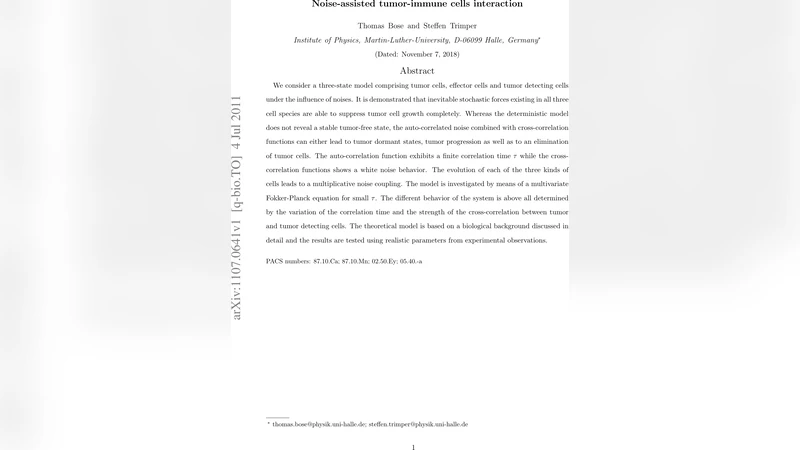
We consider a three-state model comprising tumor cells, effector cells and tumor detecting cells under the influence of noises. It is demonstrated that inevitable stochastic forces existing in all three cell species are able to suppress tumor cell growth completely. Whereas the deterministic model does not reveal a stable tumor-free state, the auto-correlated noise combined with cross-correlation functions can either lead to tumor dormant states, tumor progression as well as to an elimination of tumor cells. The auto-correlation function exhibits a finite correlation time $\tau$ while the cross-correlation functions shows a white noise behavior. The evolution of each of the three kinds of cells leads to a multiplicative noise coupling. The model is investigated by means of a multivariate Fokker-Planck equation for small $\tau$. The different behavior of the system is above all determined by the variation of the correlation time and the strength of the cross-correlation between tumor and tumor detecting cells. The theoretical model is based on a biological background discussed in detail and the results are tested using realistic parameters from experimental observations.
💡 Research Summary
The paper presents a three‑state mathematical model of tumor‑immune interaction comprising tumor cells (X), effector immune cells (Y) and tumor‑detecting immune cells (Z). The deterministic core consists of a logistic growth term for the tumor (a X − b X²), a predation term representing killing of tumor cells by effectors (−c X Y), a production term for effectors driven by detecting cells (e Y Z), and linear decay terms for both immune populations (−ρ Y, −μ Z). In this deterministic framework the only stable fixed point is a tumor‑bearing state (X = b⁻¹, Y = Z = 0); a tumor‑free state is unstable, implying that without additional mechanisms the tumor inevitably reaches its carrying capacity.
To capture the stochastic nature of biological processes, the authors introduce multiplicative noise terms η_i(t) coupled to each variable via a matrix Ω_ij(x). The noise structure includes both auto‑correlated (colored) components with finite correlation time τ and cross‑correlated (white) components. Specifically, the tumor and detecting cell noises are cross‑correlated with strength R, while other cross‑correlations (S, P) are also allowed. The noise intensity matrix D contains diagonal entries D_x, D_y, D_z and off‑diagonal entries representing the cross‑correlation strengths.
Because the noises are colored, the exact Fokker‑Planck equation is intractable; the authors employ a systematic expansion in the small‑τ limit (first‑order τ) to obtain an approximate multivariate Fokker‑Planck operator L. This operator contains drift terms (−∂_i ψ_i) and diffusion terms that involve both D and τ, as well as higher‑order corrections (M, K tensors) arising from the multiplicative nature of the noise. From the Fokker‑Planck equation they derive evolution equations for the moments ⟨x_j⟩, which explicitly show how τ and the cross‑correlation strengths modify the deterministic dynamics.
Numerical analysis explores the parameter space spanned by τ (the auto‑correlation time) and R (the tumor‑detecting cell cross‑correlation strength). Three qualitatively distinct regimes emerge:
-
Weak noise regime (small τ, low R): The stochastic terms are negligible; trajectories converge to the deterministic tumor‑bearing fixed point (X ≈ b⁻¹). No tumor suppression occurs.
-
Intermediate regime (moderate τ, increasing R): The cross‑correlated noise enhances the production of detecting cells, which in turn stimulates effector cells. Tumor growth is slowed, and the system settles into a metastable “dormant” state where tumor size remains low but non‑zero. This mirrors the biological concept of tumor dormancy during immune editing.
-
Strong noise regime (large τ, strong R): The multiplicative noise drives a sustained increase in both detecting and effector populations, leading to complete eradication of tumor cells (X → 0). The tumor‑free state becomes stable only because stochastic fluctuations continuously replenish the immune response.
Importantly, the sign of R is critical: positive R (correlated tumor‑detecting noise) enables tumor suppression, whereas negative R amplifies tumor growth, highlighting the asymmetric impact of cross‑correlations.
The authors map the model parameters onto experimentally measured quantities: tumor proliferation rate a≈0.1 day⁻¹, carrying capacity b≈10⁶ cells, immune cell lifetimes ρ⁻¹≈20 days, μ⁻¹≈15 days, and noise intensities D_x≈10⁻³, D_y≈10⁻⁴, D_z≈10⁻⁴. These values produce realistic fluctuation amplitudes observed in vivo. The analysis suggests that stochasticity inherent in tumor genetics (captured by D_x) and in immune signaling (captured by R, S, P) can fundamentally alter disease outcome.
From a biological perspective, the study provides a theoretical underpinning for the “immune editing” hypothesis, wherein the immune system both eliminates and shapes tumor populations. The stochastic terms represent random mutational events in tumor cells and variability in cytokine signaling between immune cells. The emergence of a noise‑induced tumor‑free state implies that therapeutic strategies that increase the effective correlation time (e.g., sustained cytokine exposure) or enhance cross‑correlated signaling (e.g., combined checkpoint inhibition and vaccine‑induced activation) could tip the balance toward tumor eradication.
In conclusion, the paper demonstrates that incorporating realistic stochastic forces into a minimal tumor‑immune model yields rich dynamical behavior absent in deterministic formulations. By systematically varying the auto‑correlation time τ and the cross‑correlation strength R, the authors identify conditions under which noise can suppress tumor growth, maintain dormancy, or achieve complete elimination. These findings open avenues for experimental validation and suggest that manipulating stochastic aspects of immune signaling may be a viable complement to conventional cancer therapies.
Comments & Academic Discussion
Loading comments...
Leave a Comment